Showing posts with label cushion plant. Show all posts

Sunday, 4 April 2021

Central Plateau Variations: Part 1


[A bleak and windy day on Tasmania's Central Plateau]

When it comes to bushwalks, there’s often a degree of cat herding. Dates, walkers, venues, vehicles and variations are all part of the mix. By the time those are settled, the weather for the walk can sometimes fall into the “like it or lump it” category. Certainly it would on this occasion.

Our planned March walk would see six of us back in familiar territory, walking from Lake MacKenzie across Tasmania’s Central Plateau, into the Walls of Jerusalem. Most of us had done it 3 years earlier (see here), and loved the country so much that we welcomed the chance to return. One variation this time would be a more earnest search for the elusive Ritters Track. Another variation would be our arrival times. We’d be wandering in like Texas Rangers. (If that doesn’t ring a bell, treat yourself by checking out the first 45 seconds of this incredibly cheesy clip https://youtu.be/r2F4K7nbcgs) 


[Three set off from Lake MacKenzie]

Libby was the first “Texas Ranger”, having chosen to walk in a few days early, keen for some solo time, as well as to try out a new tent. Jim, Larry and I would come in next, and meet Libby at our Blue Peaks campsite. Tim and Merran would join us there a day and a half later.

One very neat variation was that Libby, Tim and Merran had already done a car shuffle for us, which would save Jim, Larry and me from having to leave a car at the Walls of Jerusalem carpark, and double back in another car to Lake MacKenzie to start our walk. So the three of us got going relatively early in cool, windy and sometimes showery weather. The weather was such that stopping was unpleasant, so we made good time and surprised Libby out of her tent mid afternoon.


[Seeding mountain rocket bring colour to an overcast day]

She had tales of strong winds, sleet and even snow. She grinned as she explained she’d secretly been hoping for some snow. Nonetheless she had possum-wide eyes as she told us about the strong winds she’d had to deal with. (Her One Planet Goondie 1 had stood up to it perfectly.) By now the afternoon was a little calmer, and the two of us with Helinox chairs settled in for a comfortable cuppa, while the other two feigned indifference.

On that count we carried a secret with us. Libby was, for now, sitting in a Helinox Chair Zero borrowed from Tim and Merran. But those two late comers would be bringing in a brand new one. It was one that we’d all shared in purchasing for Libby as a Covid-delayed wedding gift. This, of course, was to be a surprise to her. So it was hilarious when, after dinner, as we stacked the two "undressed" chairs in bushes out of the wind, spontaneous comments about the chairs exhibiting mating behaviour began to come out. How long, we idly wondered, was the gestation period of a chair? Perhaps the next morning would be a little too early for the appearance of any offspring. But later in the day: who was to know?


[The Helinox chairs getting "acquainted"]

Other excitements were to occupy us most of the next day. Neither Jim nor Libby had been to see the enormous cushion plant “colony” that Larry and a few of us had stumbled upon some years back. The weather more or less cooperated, and we set off towards that wonderfully small eminence, Little Throne. While we were winding our way around the end of one of the lakes, I was startled to find a tiger snake stretched out on some rocks over which I’d just jumped. It seemed little interested in moving, and we took our time to gawk at and photograph this beautifully marked creature. 


[A tiger snake sunning itself]

A little while later, from the top of Little Throne, we were able to message Jim’s wife with a picture of the tiger. She, being a notorious snake-phobic, sent suitably shrieky messages back, and we all chuckled at Jim’s tease. But not long afterwards I noticed Jim was not his usual jovial self. This became more apparent when he suggested that we might make this our turn-around point. We other three, all keen to see the enormous cushion plants, outvoted him. So he shrugged and reluctantly came with us.


[Atop Little Throne]

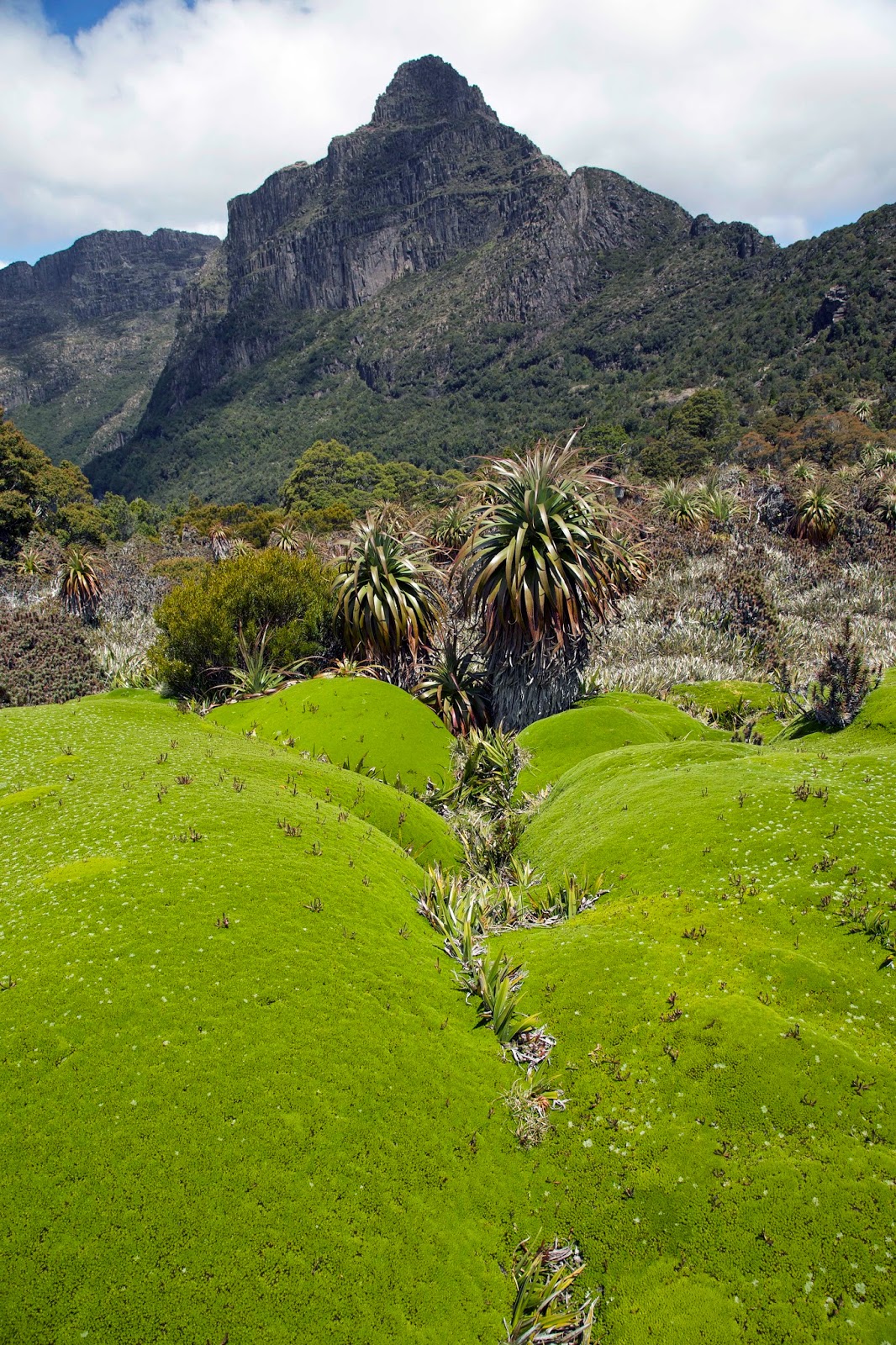
I had a reasonable idea where we would find the cushion plants. However, not for the last time on this trip, I was glad to be walking with a navigational nerd. Larry had marked the spot on his GPS, and this saved us from wandering around too much before finding it. I’m not sure if it was the bleakish weather, or Jim’s bleakish mood, but there was not quite the excitement I’d expected in the presence of this botanical wonder. Still, we lingered and photographed at length what is still the largest cushion plant “forest” I have ever seen.


[Part of the enormous cushion plant "forest"]


[There are often many species in a cushion plant community]

Although the rain held off, the weather was becoming cloudier and cooler. So we wasted no time in getting back to our campsite, this time taking the more direct route through the lake-dotted lower country. We had calculated that Tim and Merran wouldn’t be with us until around 7pm, and in this weather that looked like being well after our bedtime. We’d all eaten dinner by 5, so it looked like some of us might have to rug up and wait around for our friends’ arrival. Then, just after Jim disappeared into his tent, we were surprised to see Tim and Merran coming over the rise and into our campsite.

They’d managed to leave much earlier than expected, and had made good time in trying conditions. We gave them a bit of time to put up their tent, but before they’d finished cooking their dinner, the rest of us started ahemmming loudly. Tim, taking the hint, reached into his pack, and Merran handed over the gift chair to Libby. “They’ve had a baby” I called out, and we all laughed at the way our jokes had fitted so well with the timing of the gift. Libby was completely ‘rapt, not least because she wouldn’t now have to settle for a damp log for a seat.


[Libby: a happy camper in her new chair]

And so we were all together at last. Tomorrow, we hoped, we’d all venture further into the Central Plateau. We knew, after all, that a Texas Ranger’s “work is never through”. 

Saturday, 2 May 2020

A Long-Awaited Reunion: Part 3

When I was young, some car owners opted to buy eye-catching two-tone cars. A rich uncle had a very fancy two-tone Ford Ranch Wagon, with fetching brown sides, and a custard coloured roof. Today confirms that our walking group has turned into a two-tone model.

This starts to become clear while we’re discussing our walking options. The forecast is good, and climbing Tasmania’s highest mountain, Mt Ossa, is high on some agendas. Yesterday’s more adventurous quartet has Ossa and maybe more in mind. I start thinking of them as the “brown” side.


[Small falls between Pelion Hut and Pelion Gap] 
On the “custard” side, Lynne has never ascended Ossa, and would have been keen. But … yesterday’s work on her knee wasn’t a miracle cure. She will still have to nurse it a little, and I plan to stick with her today. Jim was up Ossa with me in 2017, the most recent of many ascents we’ve made. On that occasion we had the best conditions we’re ever likely to see. During our descent we talked about whether we’d ever do it again. We weren't sure then, but when he’s asked if he’ll go today, Jim simply says “Nup”. The “custard” side is firming. Brita then declares that she’s not a summit person, and with Ossa not on her list today, the score becomes Brown 4, Custard 4.


[Our 2017 summit experience on Mt Ossa] 
So the Tims, Merran and Libby are going up to Pelion Gap, then on to the top of Tasmania. TimO adds that he’s never been up Mt Pelion East, and I see that “can I do two summits?” glint in his eye. Jim, Brita, Lynne and I reckon we’ll go as far as the Gap, and then see how we feel. Our two-tone group at least agrees to be back in time for pre-dinner nibbles and drinks together on the grass beside our tents.


[Buttongrass heads and coral fern] 
Part of Brita’s coaching of Lynne is that she could try shorter steps, not striding out too much. A corollary of that is that she should go at her own pace. So the brown team leaves us in their dust, as we custards climb towards Pelion Gap in a more leisurely fashion. One of the advantages for me is more time to photograph, which also means more time to really notice the intricacies of the forest and woodlands we’re walking through. Jim and Brita stay with us for a while, but eventually they firm up a plan to walk past the gap, and up to the side of Mount Doris.


[A small grove of Pandani near Pelion Hut] 


[Celmisia - alpine daisy] 
Lynne is walking a little more easily today, but there’s still some pain, and she stops every now and then to stretch her hamstring. Eventually we top out on Pelion Gap, just as Jim and Brita are about to depart from there for Mt. Doris. 


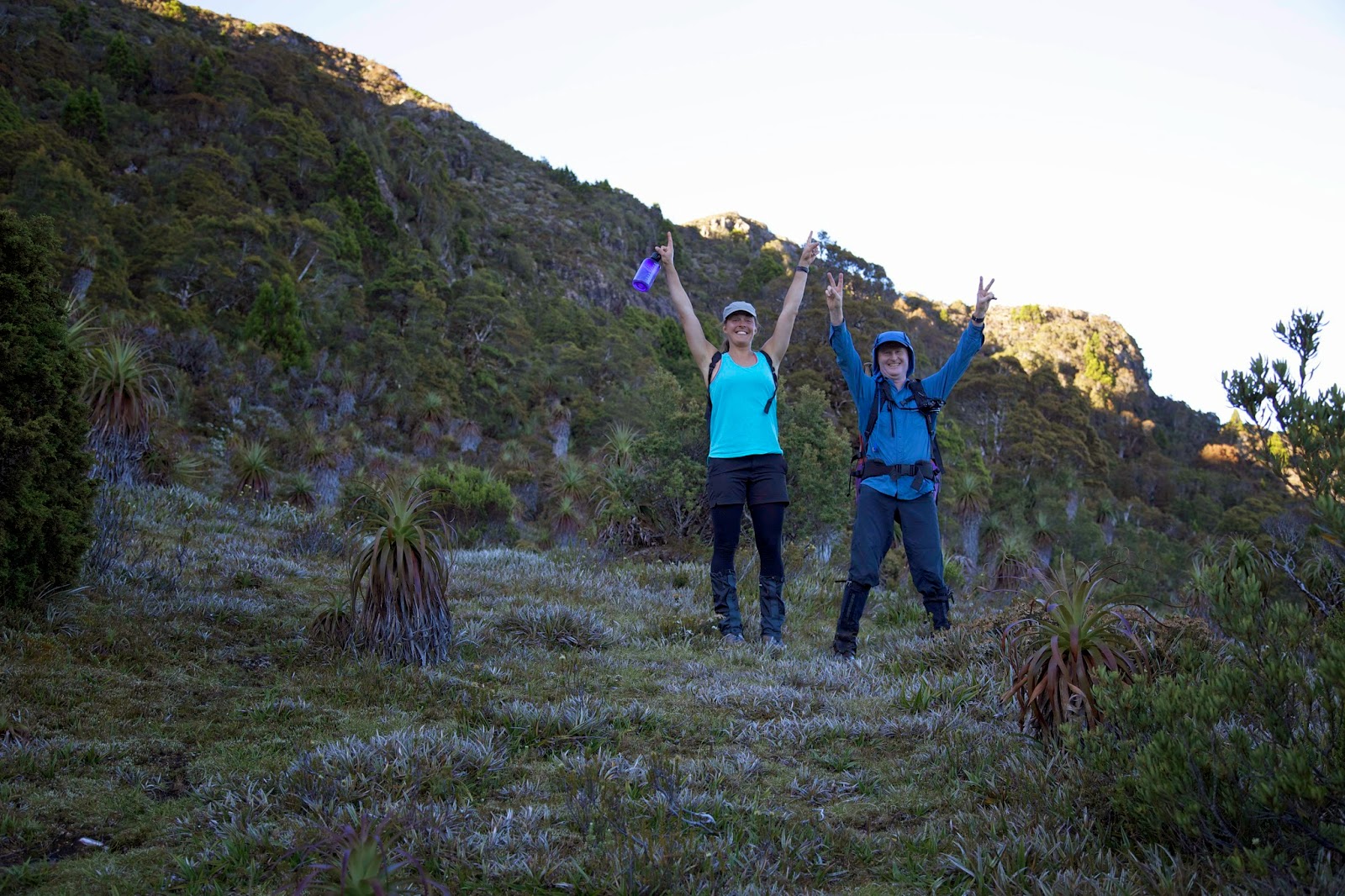
[L to R: Peter, Lynne and Jim at Pelion Gap]  
Jim is keen to show Brita what he calls “The Japanese Garden” on the side of Doris. It’s a relatively level section of an otherwise steep route. Bright green carpets of cushion plant are interspersed with other ground-hugging species, mini-thickets of scoparia, and slabs of lichen-daubed rock. Little runnels and pools of clear water complete the picture: a perfect little natural garden.


[Sunburst on forest detail] 
Lynne reckons this is as far as she should come today, so we farewell the others and sit down to our lunch on the gap’s platform. Afterwards, with our new-found appreciation of walking slowly, we stop often. It proves as good for the soul as it is for the knees. We take the time to find small delights, and to smell the … well, not roses, exactly. It’s things like the pungency of sassafras, the tang of lemon boronia, and the earthiness of buttongrass. And there’s also that indescribable scent you get when you lie amongst all that is breaking down on the rainforest floor, as you try to photograph a King Billy pine that towers above everything.


[King Billy Pine trunk and forest floor] 
Meanwhile back at the “Japanese Garden”, Jim and Brita are surprised by TimO. He’s already been up Pelion East, and in Jim’s words is “looking knackered”. He pauses for a drink, and wonders aloud whether he really should “give Ossa a crack as well”. Politely ignoring Jim’s advice, he sets off towards Ossa. Jim and Brita shake their heads and head in the opposite direction. Jim gets back to Pelion only a little while after us, and lets us know TimO’s apparent plan, and that Brita has gone off for a swim near Old Pelion Hut. Within the hour Tim D, Merran and Libby are back, sounding upbeat after their ascent of Ossa.


[Flower heads of Billy Buttons] 
When everyone has recovered a little, we gather again at the delightfully grassy tent site, a little above the hut. The left-overs from the heli-pad party are reinforced with more cheese, and some extra wine is found. Our gathering looks like a product placement for Helinox chairs, as four of us sit comfortably above the grass in our “Zero” chairs. 


[Nibbles while waiting for TimO & Brita] 
It’s a warm and gentle early evening, and as currawongs pipe in the closing of the day, we’re happy and grateful for many things. All we lack is the presence of our friends TimO and Brita. We’ve got well into the bhuja and cheese, and have started the wine, when a very weary looking TimO traipses down the track from the gap. Almost simultaneously Brita comes up from the side track that leads to Old Pelion. Our group complete, we settle into hearing the varied stories of our party members. As I listen I can’t help thinking what a fine two-tone model we are!

Monday, 26 February 2018

Celebrating 50


-->
At the crowded end of the year; the party end of the year; the too-much-to-do-and-not-enough-time-to-do-it end of the year, my mate Mick came up with an unusual idea. Wanting to celebrate 50 years on earth in a way that didn’t feel like all the other celebrations that jostle for attention in December, he chose to go bush with some mates.

The venue was to be the Blue Peaks, and in his casual come-if-you-can style invitation to his walking friends, Mick said “I cannot think of a better place to spend a few days contemplating life, the universe and everything … Or a better bunch of brigands to spend it with.”


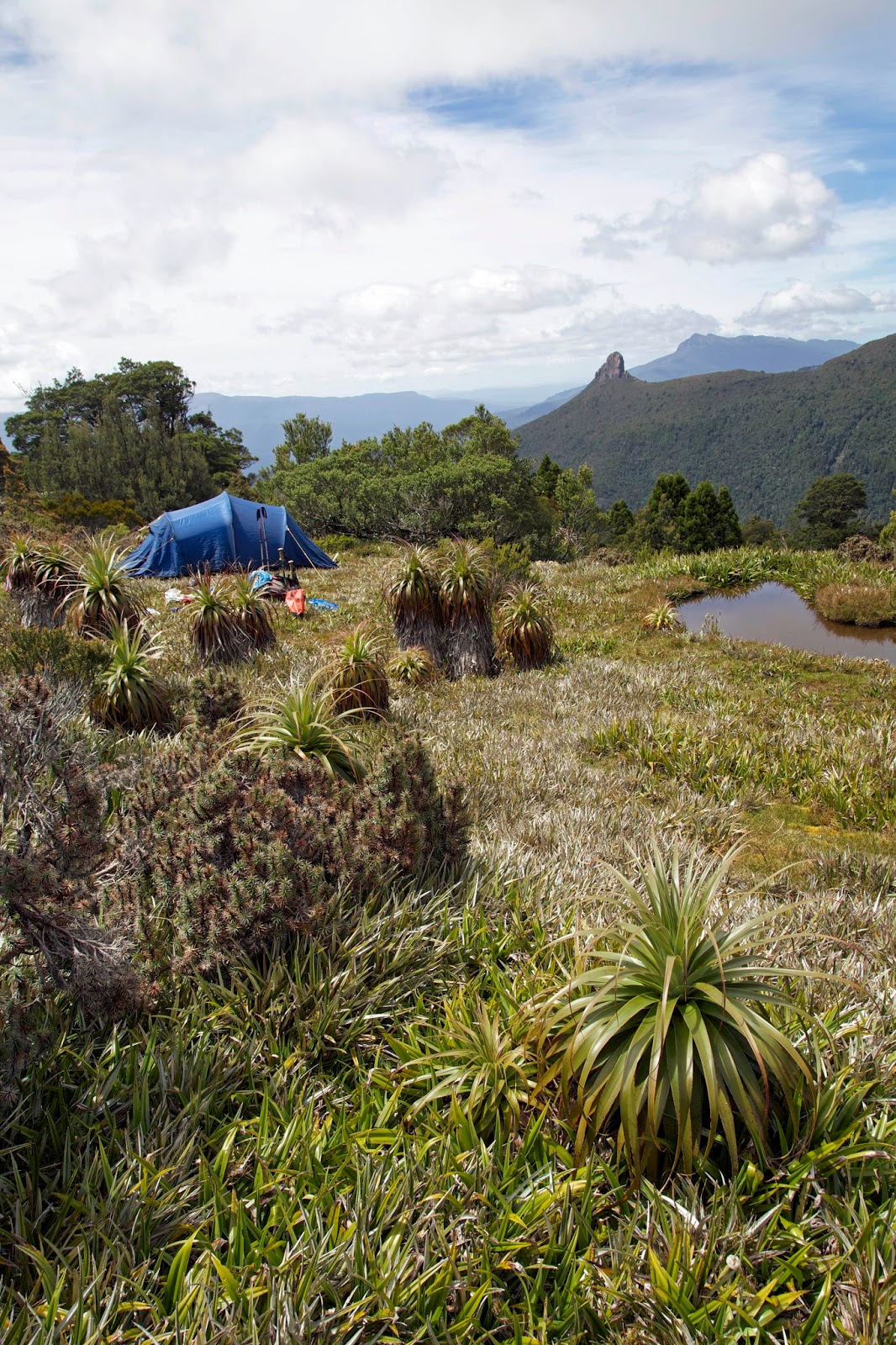
[A campsite for contemplation and celebration, Blue Peaks] 
Three of his thicker-skinned friends managed to put aside any offence, and carve out time from pre-Christmas schedules to join him. (In truth Mick probably has more friends than nearly anyone I know, but most were caught up in just the kind of rush he was keen to avoid.) So … ‘quality not quantity’ it was!

The four of us left Hobart a little after 7am, an almost indecently early departure by our standards. But it did give us the advantage of getting up to the Lake MacKenzie track head before lunch. We’d been walking just long enough to feel some of the sore bits, when I noticed an odd smell. At first it was very faint, but as I tweaked my pack and trudged on, I recognised it: the scent of stale smoke, of burned bush, wafting down valley from a fire that ripped through here in early 2016. Blackened bush soon confirmed that.

I would normally associate the smell with regeneration, fire usually being a means of bringing new growth to Australian bush. And smoke water – with just the scent we’re picking up now – is widely used in Australian native gardening to germinate stubborn seeds. But here, high in the Central Plateau, fire brings death.

It was sobering to experience the lack of new growth; the desolate feel; and the paucity of bird life. Yes, a few plants were making a slow comeback, but not the pencil pines. Their blackened trunks and empty canopies will stand for decades, slowly greying, as a reminder of that fire.


[Pencil pines killed by the 2016 fire] 

We were glad to get out of the fire zone, and into the untouched Blue Peaks area, by early afternoon. Once there, with our tents and tarps set up in the beautiful, familiar pencil pine grove, the bustle and busyness – and some of the sadness – started to fall away. And Mick began to beam, pretty sure that his idea was as genius as it was unusual. On a gently warm, sunny afternoon it wasn’t difficult for the rest of us to agree.


This being a first time visit for the other two, Mick and I pointed out a few of the area’s features to Larry and Ken. While we did so it struck me afresh that the most obvious characteristic of the place is actually its subtlety. Even the “peaks” of its names are understated hills more than peaks. But get your eye in here, and the light, the lakes, the clouds, the wildflowers, the birds, the distant mountains and the depth of the views, will do their work on you.

As it was only a week shy of the longest day, our evening meal was under way hours before sunset. I’d brought along a special birthday wine for Mick, and Larry had brought some brandy, so the celebrations began. Later, feeling suitably mellow, Larry and I decided to explore some of the nearby pools and pencil pines with our cameras. Mick, defying his increasing years, chose to take Ken to the top of one of the “peaks” for sunset.


[Sunset over lakes and pools, Blue Peaks] 
Next day the sun slept in. Given the low cloud and scudding showers, we followed suit. When we finally emerged, a kitchen tarp set up allowed us to breakfast and socialise in the dry for most of the morning. While mosquitoes threatened to keep us busy, they turned out keener to buzz than to bite.

After lunch we overcame our lethargy, put on some wet weather gear, and went for a wander in the light drizzle. We walked westward at a slow amble, the pace determined by the small wonders that kept gripping our attention. Scoparia (Richea scoparia) was blooming everywhere, its delightful flowers the antithesis of its dense and fiercely prickly foliage.


[Scoparia's multi-coloured blooms] 
At our slow pace we began to notice a few unusual things. Here and there we spied skinks scrambling over the prickly foliage to lick and nibble on the sweet blossoms, apparently pollinating them in the process. Wallabies too seemed to have a close relationship with the scoparia. I’ve certainly seem them supping on the sweet blooms. But we also began to notice that many of the bushes had been physically modified – presumably nibbled and trampled by the wallabies – to make highly protected nests.

Traces of wallaby fur and nearby scat mounds were further corroboration of that assumption. And nearly every “nest” – and we saw dozens of them – was sheltered from the prevailing westerly winds. That, combined with the numerous pads and pathways created by wallabies and wombats, led us to consider afresh the definition of the word farming. Such adaptations of the landscape certainly bore some of the marks of basic farming.

[Mick ponders a wallaby "nest" in scoparia] 
Wanting to earn our evening meal, we wandered further off, doing a loop around some lakes and low hills for another couple of hours. It was hardly exhausting work, but it allowed us to feel justified in further feasting once back at camp. Expensive wine, soft cheeses, biscotti, smoked mussels and oysters are hardly your usual bushwalking fare, but we’d all come prepared to celebrate!

The evening turned mellow in more ways than one, as the surrounding hills shrugged off the clouds, and wide, benign skies opened up around us again. Even the mosquitoes seemed to join in the celebration. At one point hundreds – perhaps thousands – lifted into the sky above our campsite, spiralling and swirling like a murmuration of starlings. We watched amazed, unsure what it signified, except that while they were up there they weren’t down here bothering us!

If we needed any confirmation of clearing skies, we had it when the night turned cold, and yet again I had reason to regret taking a summer weight sleeping bag into Tasmania’s high country. A freezing night might have been one reason we got going early. But there was also the sense that Mick and I needed to show the “newbies” a bit more of what the area had to offer. What better, we reasoned, than taking them via a few named lakes (Middle and Little Throne), past a named mountain (Turrana Heights), and to an (unjustifiably) unnamed peak.


[Near the unnamed peak] 
The day was a gem, in more ways than one. The deep blue sky stayed clear all day, apart from a decorative schmear of cirrus cloud. With only day packs, and in no hurry, we strolled easily from lake to lake, hill to hill, chatting, stopping for photos, or scroggin, or just because we wanted to. Still, it was well before midday that we found ourselves scrambling to the top of our destination peak. It was as sensational as we remembered, with literally hundreds of lakes dotting the plateau beneath us, each reflecting the blue sky back to us.

Over lunch our eyes roamed south-west towards the Walls of Jerusalem. On such a day those mountains seemed achievably, tantalisingly close. We looked at our maps, traced a potential route or two, then went back to our lunch. That’s how easily a trip plan is hatched … but that’s another story.


[On top of the unnamed peak, with the Walls behind] 
With so much of the day left, we thought we’d go back “the hard way”, or at least a different way, via a hill we’d never been to, and then on to Little Throne. After a while we fanned out widely, each taking his own off-track route vaguely towards Little Throne. In the process I almost literally stumbled across the most enormous cushionplant I have ever seen. The other guys were maybe a hundred metres away from me, but I just had to call them down to see this spectacular marvel.


[Part of the vast cushionplant] 
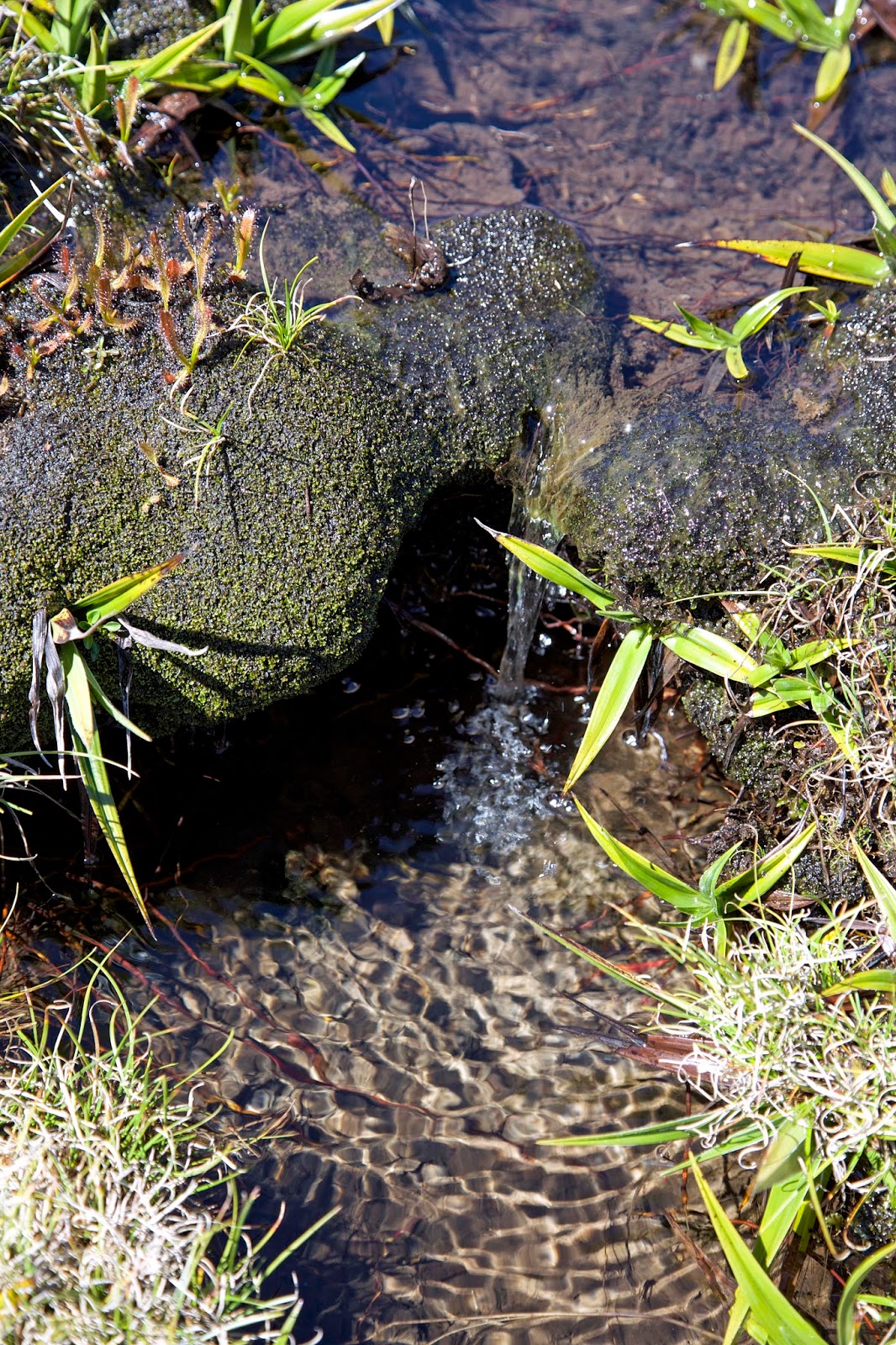
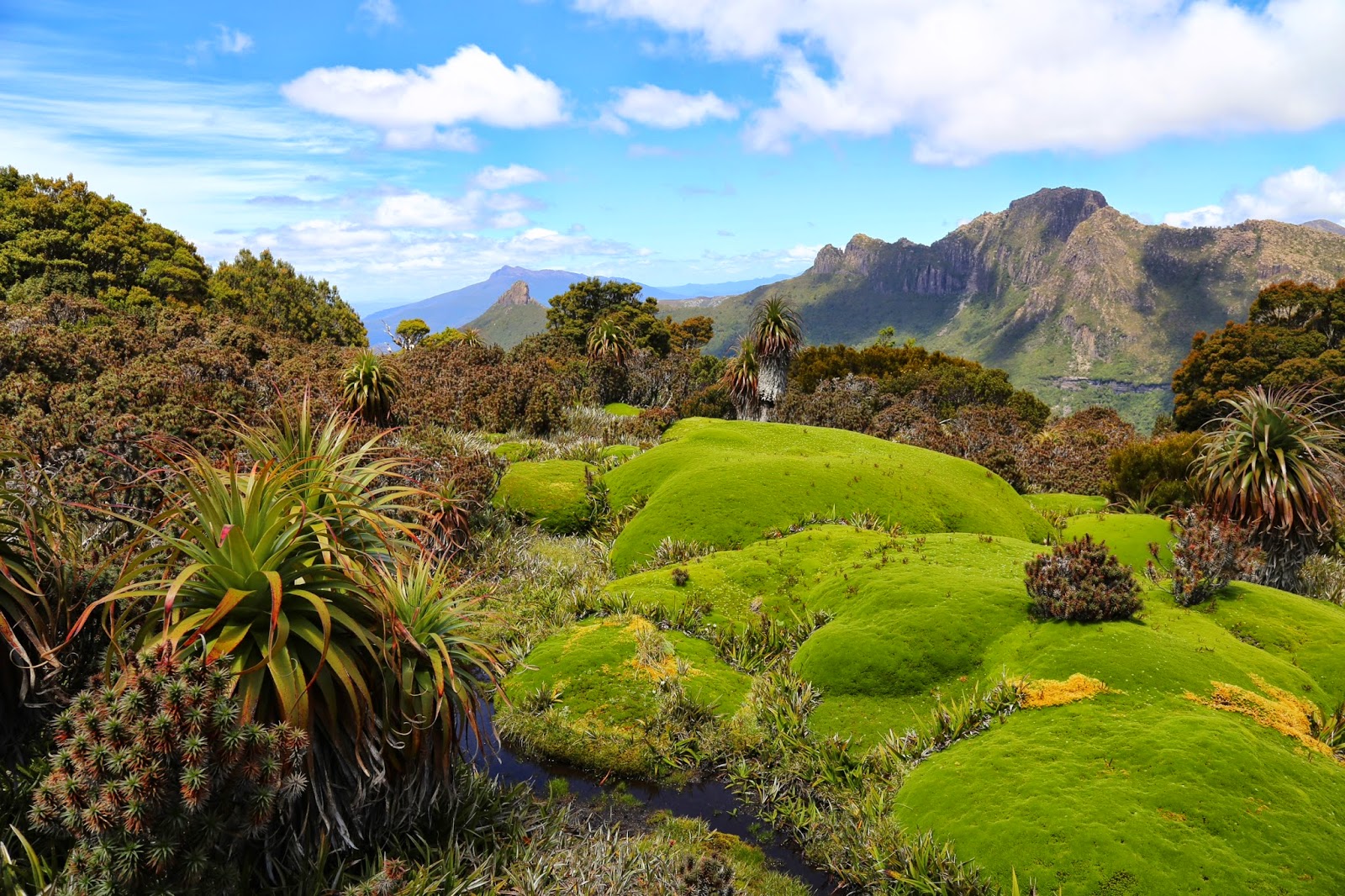
Covering an area of at least 30m by 25m, the cushionplant – more accurately a colony of cushionplants – spread gently downslope in one continuous ruckled carpet of vibrant green. The colony had dammed a small stream, creating a shallow pool upstream, with trickling flow beneath, through and around it, creating ideal growth conditions for the moisture-loving species. It’s possible it had grown here for around 800 years, a notion that staggered us, especially given their vulnerability to trampling, drought and fire. We felt humbled to be in the presence of this giant dwarf among plants, and left with the sense that its exact location should be left unspoken. Some secrets are best kept.


[Cushionplant, pool and mountains] 
Before long Little Throne came into view. Mick and I, familiar with the usual route up the slopes of this twin-peaked, mini-mountain, thought we might try a different approach. Given that we weren’t coming at it from the usual angle, that made sense. Or at least it did until we started to ascend. Then the scrub proved thick and unfriendly, and we were hot, scratched and sweating by the time we hauled out on top.

So when we finally got back to camp, we were feeling well justified in helping Mick polish off the last of the birthday food and wine. It was a fine thing to be still in that wonderful place, winding up the 50th celebrations in style. Yet for everything we’d brought to the party, we’d been given far more by this wonderfully generous place. Good choice Mick!

Sunday, 20 March 2016

Return to Blue Peaks 1: The Aftermath

Blue Peaks Track, Central Plateau, Tasmania: It’s an early Friday afternoon, early autumn. The weather is benign, so is the company. And yet there’s turmoil on the track. It’s a turmoil that matches the lead-up to this trip.

Bushwalking isn’t supposed to be like this. It’s usually a simplified, pared down existence. Challenges are defined, and everyday cares are excluded from the rucksack. It was this summer’s fires that changed all that.


[An ominous bushfire sunset, January 2016] 
In the weeks leading up to the trip the six of us have exchanged dozens of emails, made numerous phone calls. Plan A has been in, then out, then in again … possibly. We’ve discussed Plans B, C, D and more in detail. Our decision has depended entirely on whether the Mersey Forest Road would open again after a prolonged fire-caused closure.

The uncertainty has robbed us of anticipation, one of the pleasures of any trip. I’ve even been waking in the wee hours, my mind going through the options, struggling to match the preferences of our walking party to the potentially available routes.

It’s not until we’re half way up the Midland Highway on our first day that we make the final call. Rumour has it that the Mersey Forest Road will open tomorrow morning. It’s too late. We’re off to the Blue Peaks again. Tim O and I might have just been there in December, but the others haven’t, and the road is definitely open.

There’s one other definite. We’ll be walking into one of the recent fire zones. And it’s the aftermath of the Lake MacKenzie bushfires, just a few hundred metres up the track, that is the cause of more turmoil.


[The charred trunk of a pencil pine, Blue Peaks]  

As we climb the slope away from Lake MacKenzie, the bush is its usual muted, mottled green. Then, as we round a bend at the top of the slope, the ground is suddenly bare. The varied greens are replaced by basic black and brown, a 3D landscape now two dimensional.

We’ve been expecting a bleak scene, but not this assault on every sense. Of course it’s visually awful, with blackened, twisted, bare and broken bush, and barely anything still green and growing. Even the puddles created by recent, too-late rains seem singed, filled with sooty sludge and burned debris.

And the bush also smells like death. Beyond the burning of leaf and limb, there’s the whiff of scorched soil and of countless other incinerated living things. We even see leeches fire-frozen in the act of stretching.


[Burned and unburned: the chaos of bushfire] 
But it’s the sounds – or the lack of them – that haunt me the most. Although there’s a breeze, with no leaves to rustle the wind has no voice. Not one bird calls: not even a raven or other carrion chaser. We too are silent, walking slowly, taking ghoulish photographs, deep in our own thoughts.

I’ve studied fires for years, and have been in fire zones before. I know that much of this bush will slowly recover. It will just need time. Indeed in some places there are already a few tiny green shoots. But while there will be some healing here, it’s the things that will never recover that have me the most concerned.

And sure enough, around a corner we meet our first forever fatalities. Just two months back Tim and I had paused for photos at the track’s first prominent pencil pine. An old survivor, this scarred but living pine stood next to others that had succumbed to past fires. Perhaps its sodden home, among sphagnum and cushion plants, had offered it some protection.


[Before and after the fire: pencil pine and cushion plants, Blue Peaks] 
This time it hasn’t been so lucky. One large limb, ripped from its crown, lies ruined and brown beside it. Its one remaining limb has been singed, though for now it’s still green. Near its base, the normally plump green cushion plants are a sickly brown and yellow: deflated, defeated, doomed. So too are the desiccated sphagnum beds.

We walk on through this strange half-dead landscape. The chaos that is fire has left some patches entirely unburned. Parts of our track are a bizarrely green ribbon through brown, burned barrens. The waterlogged scoop of many footfalls has protected it. But the saddest sights for us are the fatally burned pencil pines. One large stand along a sodden, sphagnum-filled creek that would normally be its salvation, has been almost entirely cremated. We won’t see them here again.


[Before and after: pencil pines and sphagnum, Blue Peaks] 
Twenty minutes later we leave the burning zone. The air has started to feel refreshed, and we hear birds and even frogs again. The bush is now its familiar khaki mix, and we turn our focus to the hard work of walking. We hope we’ll soon reach the unburned refuge of our pencil pine-fringed campsite beneath the Blue Peaks.

Sunday, 25 January 2015

A Mt Anne Epic 3: The Still Point

At the still point of the turning world. Neither flesh nor fleshless;
Neither from nor towards; at the still point, there the dance is.
– T.S. Eliot

For more than 30 years I have wanted to be in this place. I don’t suppose I envisaged arriving in the manner I have. Like some penitent rascal just scraping into heaven, I have limped and slipped and staggered my way down to Pandani Shelf.


[Camping on Pandani Shelf, with Lots Wife behind] 
It is too late in the day to see what kind of smaller beauties it holds, but the shadows falling from the steepling bulk of Mt Anne and her sibling peaks, and the deep darkness in the valleys below, give us more than a hint of the grander scene.

On the soft pineapple grass beside a small pool, I sleep like the dead until around 4am. All is profoundly silent, except for my monkey-mind, which begins jumping from wonder to worry. How bad is my ankle? What if I can’t walk out? I unzip the tent to test it out, and to relieve myself.

Climbing out is awkward. I wince as I inch my injured foot into a Croc, and again as I stand up in the pre-dawn chill. I stumble a few metres from the tent, shivering in the cold. Yet as I stand there, the chill somehow eases the soreness of my ankle. Perhaps walking won’t be impossible, especially after the coming rest day. I slip back into the tent and eventually back into slumber.

In the full morning it’s only the sun striking our tents that brings us out. No-one is in a hurry to get going after the rigours of yesterday. But as we mingle over breakfast, it turns out the “rest day” might include some effort for some. Paola is very keen to try for the summit of Anne. Not wanting to do it on her own, she works on getting Tim to join her. She knows he’s already shown an interest, and that there’s no chance the rest of us will be in it.

Tim is undecided, so Paola plots a recce up the ridge. Lina joins her “just for that bit”. Eventually the women wander back. Paola is full of beans, even though they haven’t found an easy route. Despite our head shakes and talk of “worlds of pain”, Tim soon caves in and they hoist day packs and start climbing. It’s a long and steep climb, but they’ll be visible for parts of the route, and audible practically the whole time. They take the PLB just in case.

Mick, Lina and I go for a slow wander around the shelf, discovering that it’s actually multiple shelves, some of them split-level. They’re separated by bands of scoparia, pandani and other scrub species. I had expected to find prominent patches of cushion plants, but initially it’s mainly pineapple grass, rock slabs, bushy scrub … and a lot of water.


[Some of Pandani Shelf's plentiful water] 
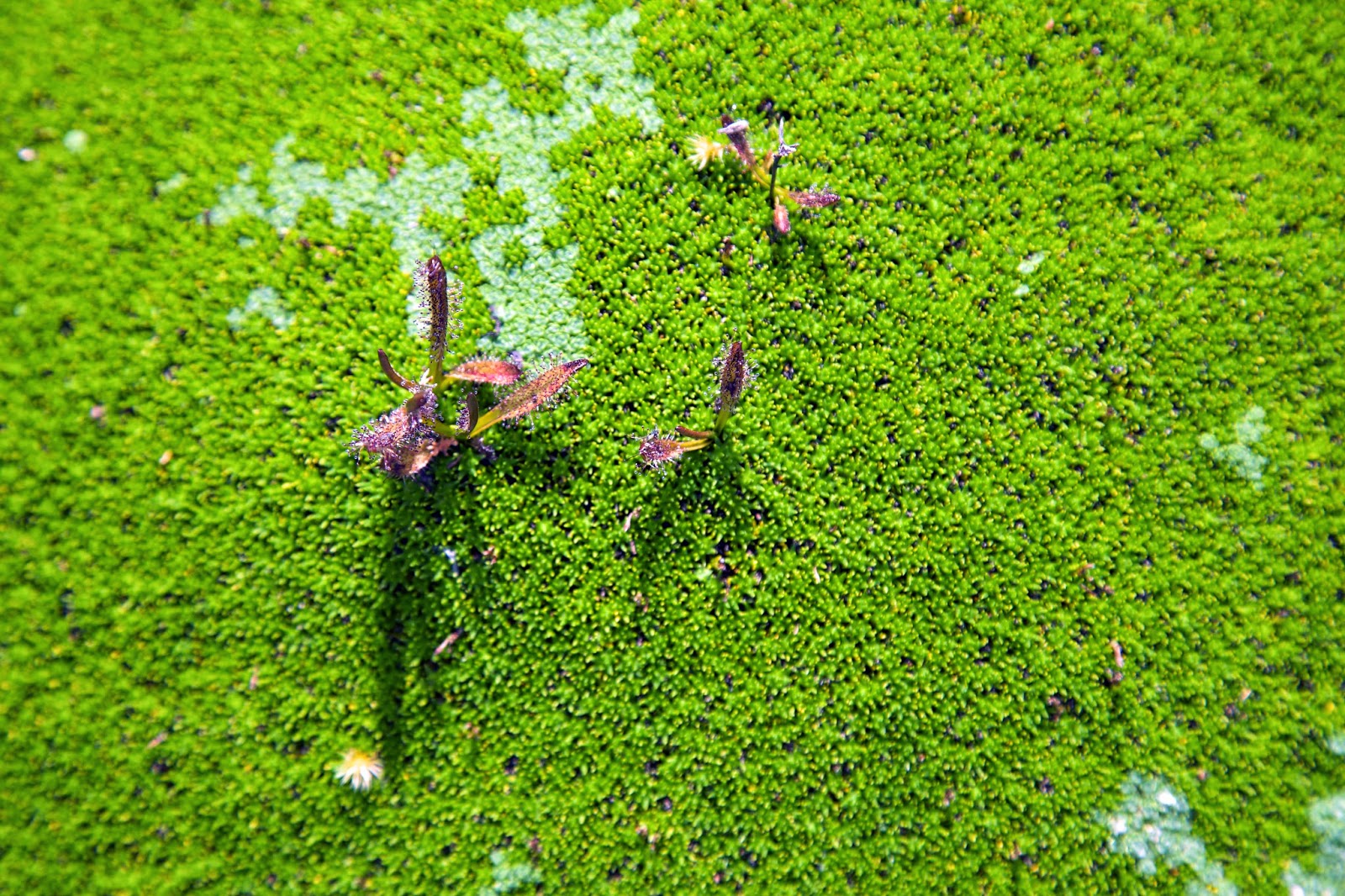
As we push through some bush on a lower level, we meet our first bright green expanses of the aptly-named cushion plants. Actually the name is only apt for their flattish, pillow-like appearance. As we touch them we find they’ve got the texture and ungiving resistance of coral. Bolster heaths, as they are also called, are usually made up of a number of different cushion plant species, often interspersed with other plants that variously piggy-back on, grow alongside, or compete with the “cushions”.


[Sundew on a cushion plant (Abrotanella forsteroides)] 
The surface of a cushion is made up of hundreds – perhaps thousands – of tiny, densely-packed, overlapping leaves. Their uniform growth enables them to form a tight barrier against the harsh conditions experienced in these highlands. This keeps the interior temperature and humidity of each “cushion” remarkably even, making them highly resistant to snow, wind, sun, lashing rain, hail and grazing animals. However prolonged drought and human footfall are both capable of harming these communities, breaking the surface and opening them up to the harsh weather conditions.


[A large cushion plant, with Mt Lot and Lots Wife behind] 
I have seen cushion plants many times, ‘though never in the profusion that we are soon finding. We turn a corner and find one continuous clump that is more than 20m wide. It wobbles and undulates like an enormous quilt hastily thrown over hiding giant-children. I half expect one to emerge with a sudden “boo!”

In and of itself this clump is stunning enough; the equivalent of a giant forest spread low and dense. But as we stand back to take it in, the magnificent backdrop of Mt Anne, Mt Lot and the deep clefts between us and them, has a transcendent effect. For a time we are literally speechless.


[Cushion plant, pandani and Mt Anne] 
The spell is broken when we suddenly hear voices from on high. It’s not a heavenly host, and there’s no hallelujah: it’s just Tim and Paola talking to each other from somewhere high on the mountain. We can’t see them; don’t know whether they’ve made the top or not. But at least they still have breath!

Towards sunset, just as we’re settling in to cook our dinners, we hear the climbers on the ridge nearest us. Nearly half an hour later they wander into the camp with a restrained “whoo hoo”. It turns out they haven’t quite summited; the last 20 metres proving just a little too intimidating.


[Paola and Tim celebrate their "almost!"] 
Still, we’re surprised - and a bit proud - that they’ve managed as much as they have. We make them a brew and hear all about their mammoth effort. They even show us photos of people they saw, and talked with, who were on the summit. So close!

We’re glad to hear that during their last half hour they’ve seen and photographed some of the cushion plants that have so thrilled us. For Mick, Lina and myself, what we’ve seen has been its own mammoth experience. Perhaps keeping (almost) still can be as big an adventure as (almost) making a summit.

Sunday, 3 March 2013

These are the Days


A Mount Olympus Walk: Part 3

“These are the days that make the moments feel like years.”– (Ross Hamilton of Wolfstone)


[Lake Oenone from "Paris Ridge", Mt Olympus] 

Best laid plans. We would be up early, before the march flies, to tackle the steepest part of the climb before the hottest part of the day.

It is a still and clear morning. Tick. We have slept well and feel refreshed. Tick. I pull back the tent flap and there is the mountain, high, clear and beckoning above our home lake. Tick. However one member of our party feels very comfortable remaining horizontal inside the tent. Cross.

So it is not a lightning fast start to our summit day. And we do not beat the heat up the rocky, steep, tree-less and east-facing slope. C’est la vie! At least we are only carrying day packs. Our backs rejoice in that, and our steps feel light as we ease our way up slope, carefully avoiding a fagus mini-forest. It glows a vivid green, contrasting with the demure green of pencil pines. That contrast will be starker in a few months, when the fagus colours up.

The ridge we’ve started climbing looks morainal. Either side of it glacial ice would have moved during the long ice ages that shaped this whole landscape. On our side of the ridge Lake Oenone fills the resulting hollow. On the other side, still out of our view, lies its twin, Lake Helen.

In Greek myth Oenone was a beautiful nymph, secretly married to Paris, the Prince of Troy. Paris, like us, had abandoned Oenone to go to a lonely mountain top. After many intrigues he ended up in Troy where he courted the fair Helen, only to die from a poison arrow wound.

Hopeful of a better end to our story, we continue to ascend “Paris Ridge” towards our own lonely mountain top. On our right the beautiful Lake Helen soon comes into view, scintillating in the mid-morning sunlight, while on our left Lake Oenone recedes slowly. Tim takes some time to photograph the lake, given it bears the same name as his wife. In this heat, I’m more than happy to pause for a water break.


[On the bouldery ascent, Mt Olympus] 
We’ve been off track for two days now, but this ridge is the only obvious route towards the true summit of Mt Olympus. There are clear signs of footfall everywhere, and we have no difficulty reaching the rocky base of the final climb. Here large dolerite boulders lie about like playthings of the gods.

Soon we are leaping and scrambling a little, getting our arms involved as well as our legs. We are earning our altitude gain. As we stop to draw breath we debate the “right” way to the top. If there is such a way, we seem to be close to it. Just near the top of what we hope to be the final climbing gully, we find some pink tape. If we’ve gone the wrong way, we’re not the only ones.

We break out on top in clear and perfect sunshine, sweating and breathless, but elated. Of course it’s not the final top, but reaching that will be easy. We stop, drink, and look around. The views are stunning. Here on the eastern side of the escarpment we look over leeawulena/Lake St Clair to the Traveller Range, and down on Mt Ida. To the north we see Narcissus Bay and beyond that the route of the Overland Track, which winds around the bluffs and peaks of the Du Cane Range, past Cathedral Mountain, and more than 60km onwards to the just-visible Cradle Mountain.


[Summit views from Mt Olympus] 

As we wander towards the humble, lightly-cairned summit of Olympus, we start to also see the mountains to the west and south. Far and near there’s Frenchmans Cap, the West Coast ranges; the Eldon Range and Mt Rufus. Tim and I were on top of Rufus a couple of summers ago, that time with our wives. Even alone on a mountaintop, you carry others with you.

Olympus is no peaky mountain, rather a remarkably flat and quite massive plateau. As we stand scanning the rumpled horizon, it’s as though we’re on the bridge of a giant ship sailing through mountainous seas. So many of the peaks I can see and name have stories for me, three decade’s worth and more. I feel a profound joy in having had their company for so long.

This northern part of the mountain has long, shallow tiers. They are lightly clothed in low, dense vegetation of the sort that can resist heavy snow and scouring winds, as well as high heat and burning sun. One of the most successful communities seems to be the cushion plants. 


[Cushion plant: between a rock and a wet place]

Despite their name they are not soft to the touch, although they have wonderfully rounded edges. Between these mounds there are shallow pools of water. We linger beside one of particular beauty and enjoy lunch.


[Close-up of cushion plant flowering] 

Of course there are march flies in this ointment, and it is almost unbearably hot. But this is one of those mountain days you hope for and work for. These are the days that make late starts, sweaty climbs and muscle aches seem trivial. This is why we walk.