Showing posts with label Blue Peaks. Show all posts

Monday, 16 March 2026

Taking a Question for a Walk

“How much longer do you think you’ll be overnight bushwalking?” 

That question comes as two bushwalkers with a long, shared history sit in the back of a car on the way to Lake Mackenzie, in Tasmania’s Central Highlands. They’re both in their 70s, so it isn’t a purely idle question. Few of us get to our 70s unscathed. We often have bodily issues – inside and out – that start to impinge on our physical capabilities. 

A case in point: one month ago, with two younger bushwalking friends, they had travelled up from Hobart to Mole Creek. They’d planned to stay overnight in the hotel then drive up to Lake Mackenzie for a three day bushwalk in the Blue Peaks area. But overnight one of them had become quite ill. The walk had to end before it had even begun. 

Fast forward to the March Long Weekend. The same four; the same plan. Blue Peaks: Take Two. The night at the hotel was very pleasant. They’d eaten well, then chatted and relaxed around the fire pot as a perfect day slipped gently towards evening. 


[Take Two: Enjoying the fire pit at Mole Creek Hotel]
Next morning their plan was to leave around 9, but they’d surprised themselves by being ready early. The other two in the party had never been to the Blue Peaks, and this was to be their introduction. The pair of older gentlemen had been exploring the area for over a decade. For them this was to be a fond return, a gentle exploration rather than an expedition. Still, a walk doesn’t walk itself, nor does a hill climb itself. So, after leaving the car at Lake Mackenzie, there was a degree of puffing uphill from the lake. They’d told the others there wasn’t much of a climb, but one of their watches declared that they may have bent the truth. The ascent was actually around 200m over a few kilometres; not a big climb, but enough to tell out-of-tune bodies that they’d been working. 


[Uphill from Lake Mackenzie]
That, sadly, fitted with the out-of-tune landscape. Damage from the 2016 bushfires that had ravaged this area was still plain to see. Saddest to witness were those plant species that were not recovering, especially pencil pines, sphagnum and some scoparia. In one valley a whole grove of pines had been all-but wiped out. But in the next valley, a similar grove was fully intact. The group paused at both to take in the stark contrast. * 


[Pencil Pines: Fire killed (above) cf Thriving]
The mild challenge of the walk continued when one member of the party misjudged a creek crossing, and fell face-first into ground that was not as soft as they had imagined. Despite a degree of pain and lost dignity, the victim allowed some candid photographs before full composure had been regained. 


[Ooops! A slip and a fall ...]
After a bit over 2 and a half hours, the group reached the campsite, and gladly threw down their packs in a small, hospitable grove of pencil pines. It was good to be back among these familiar pines, breathing their air, taking in a wider scene that’s graced with lakes near and far. And beyond that with mountains, mountains where their feet had been. A fresh breeze swirled around, mainly from the west, so tent sites were chosen with care. Then it was time for lunch, followed by the mandatory water collection. Work done, and muscles whinging a little, it was time for some relaxation. Truth be told, there may even have been some horizontal resting in tents, away from the mosquitoes that had begun to locate their targets. 


[The view from the Campsite]
Late afternoon, mosquitoes or not, the call of happy hour – with wine, cheese and other delicacies – couldn’t be ignored. They sat in a grassy area around a rock slab that served as their table. It was a beautiful spot to take in the expansive vista across lakes and mountains. And above that the evening sky was beginning to get ready for its daily sunset display. But before that, back in the pine-sheltered kitchen area, meals had to be cooked, compared and consumed. As they sat back replete, the chatter indicated that the two who were new to the area were warming to this much-favoured destination. 

After dinner one member of the party had unaccountably restless legs, and decided to go for an after-dinner walk. No-one else was keen to add more miles to their day’s tally, so he wandered solo down to the neighbouring lake, then along its shore. The water was low, the "tide" out. Perhaps that accounted for the absence of the swans that normally settled overnight on the lake.


[Lakeside scene a few hundred metres from Camp]
The small details of the Central Plateau are one of its lesser-known gems. For instance: golden mountain rocket. He’d been here before with his wife, and they’d delighted in finding golden seed heads in place of the expected red ones on a few mountain rocket plants. A botanist had told them this was rare, but not unknown. And now, as he ambled along the lake, he was finding more golden variants, albeit far outnumbered by the red version. But the sun was lowering, and it was time to return “home” for the sunset show. 

[The Usual Red Seed Heads on Mountain Rocket]

[Golden Seed Heads on Mountain Rocket]
Back at camp, he found the two "newbies" had already headed tent-ward. So, it was only the two stalwarts who braved the growing cold to watch this ever-new, ever-changing show on the widest of widescreens. A neat array of clouds hovered above the horizon: a promising arrangement for a sunset show. As they waited and watched, the sun seemed in no hurry, and their scrutiny didn't speed proceedings. They distracted themselves by marvelling at hundreds of moths that fluttered into the dusk sky, and spiralled around the nearby pencil pines. They were glad they far outnumbered the mosquitoes.

Eventually the sun did the miraculous thing it has done every day since our planet was formed: it dipped below the horizon. (Or, more correctly, our planet rotated out of the path of the sun’s rays). Now for the cold and patient wait for the sunlight on the underside of the clouds to finish off the show as it saw fit. The two of them photographed, chatted, waited, shivered, and photographed some more. And they reminded each other that they were, after all, at the same altitude as Kunanyi/Mt Wellington, and that warm gloves might have been a good idea!


[Sunset from the Campsite]
Had they been blasé television critics, they might have rated the sunset as good rather than great. But that would have been churlish, when really, their eyes were shining as they slowly turned from the westerly sky to take in the wider scene one more time. There was only a waft of breeze, and clouds were small and disorganised, suggesting they’d have a calm if chilly night in their tents. 


[Late sun near Camp, with a sunlit Little Throne, (centre back)]
It turned out calm for some, but for one party member, it was anything but. Cue the return of the same symptoms of an underlying illness that had scuttled their previous walk. The patient, they learned in the morning, had been up several times during the night. Digging holes for urgent toileting in the dark is no fun, they were told. Add rain and a torch failure, and … (the rest required little imagination). 

There was little discussion. If the situation was short of “press the button, call the helicopter”, it definitely required an early departure. Our patient was as upset about abandoning a second trip as he was about feeling crook. The other three simply accepted the necessity of getting out a day early. So they began packing. The patient couldn’t hold down any breakfast, but he sipped some hot water, and slowly packed up. 


[Healthy, well-watered Sphagnum and Pencil Pines]
Fortunately, the overnight drizzle and showers now held off, and they packed up mostly dry gear, and got walking before 10am. In theory the walk back would be easier and quicker than the journey here. But that didn’t factor in a sick walker with no energy, who felt as though he was swimming upstream, even on a mostly downhill walk. For him, simply setting one foot in front of the other was an achievement. That made getting back to Lake Mackenzie in around the same time as yesterday’s walk in, an amazing effort. 

Despite the early forced departure, the group agreed that they had still met the walk’s major objective. The door to a special place had been opened for the “newbies”, and they were sure they’d be back. As for the patient, medical advice and time would determine his answer to that question posed in the back of the car on the way in to Lake Mackenzie. 


[Seed head, possibly Showy Copperwire Daisy] 
* It was heartening to see that the University of Tasmania, in collaboration with Hydro Tasmania, has begun restoration trials in the area, including the re-planting of pencil pines.

Monday, 25 November 2024

A Loopy Walk on the Plateau 1

Day 1: Wild About Harry


Sybil of months, and worshipper of winds,
I love thee, rude and boisterous as thou art


- from “November” by John Clare


It’s a risky business trusting November. John Clare, the 19th century Romantic poet, may have been writing about England and depicting the northern hemisphere’s final month of autumn, but he still nailed my experience of Tasmania’s last month of spring. So yes, we were expecting “windy, rude and boisterous” for our November walk on Tasmania’s Central Plateau. We would not be disappointed.
 
Complications with our various schedules meant we spent the Thursday night at Tim and Merran’s cottage in Sheffield. That allowed us a relaxing night; dinner together; and the prospect of an early start on the Friday. But come Friday morning, the worst of a cold and wet south-west change was still coming through. The forecast was for 70km/h winds and snow squalls in the mountains. Given that, who would blame us for delaying the start in the hope of the front blowing through? 


[Ready to leave Lake Mackenzie]

And so, after a cozy, civilised morning coffee in Sheffield, it was noon before the five of us hoisted our packs and started walking away from Lake Mackenzie. For the first two hours we followed our usual route towards the Blue Peaks. The wind was strong, and showers whooshed through at intervals, occasionally turning to sleet and snow. 
 
Our first night’s destination was new to three of us, so Tim D and Libby, who’d been there earlier in the year, took the lead in guiding us towards Harry Lees Lake. Tim had earlier estimated it was only about three hours from Lake Mackenzie. We took that with a grain of salt, given not only Tim’s optimistic nature, but also the strongly adverse weather conditions.


[And then came the snow]
 
As we crested the high point of the day’s walk, the wind grew in ferocity, almost knocking us off our feet. And then the sleet and snow were replaced by hail. Icy pellets thwacked into us, stinging any part that was exposed. We cinched our hoods down, and kept our gaze at our feet until the squall finally passed. This was unpleasant walking, yet somehow it was more than a little exhilarating. We were uncomfortable certainly, but with good gear and care with navigation, we were not in any danger.


[Libby still smiling in the snow]
 
At one point we stopped for a quick rest, and TimO tested Tim D’s knowledge of the number of high points before we could finally descend to Harry Lees Lake. Such points, according to our group’s lore, are called “faux plateaux”: a lower equivalent of false summits. And TimO reminded us that there are always four. Tim D was a little evasive in his answer, a sure sign that we still had quite a few crests ahead of us. 
 
At this stage, for some reason, I started singing “I’m Just Wild About Harry” to myself. I quickly ran out of words, since it’s a 1920s song, and as ancient as I was now feeling, I wasn’t around when the song was popular. Perhaps it was my way of wooing the lake; willing it to appear just over the next hill, or around the next bend. I can’t say it worked, but perhaps it distracted me a little from the buffeting wind and stinging rain.
 
Finally, after some four hours of walking, we turned a corner, walked down a gentle slope, and there sat Harry Lees Lake. Better still, on its western shore we saw a substantial pencil pine forest. With that came the prospect of finding some shelter from the ferocious wind. As we scouted around for suitable tent sites, and eventually found them, I started to feel a little more positive. Perhaps I could just get a little wild about Harry, especially when occasional rays of sun lit up the late afternoon. 
 
Still, our evening meal was a hurried affair. A freezing wind whooshed loudly through the pine foliage. We sat huddled in our puffer jackets, trying in vain to get warm as we cooked between showers. Libby in particular sat there shivering, a Gore-tex coated icy pole. It wasn’t long before we all scurried off to bed. 


[Snow: our morning surprise]
 
The wind and showers kept up all night. I got up at first light, and was surprised to find that the overnight showers had actually been snow. Our tents were spattered with snow, and the ground all around was white. The overnight weather had certainly been wild around and about Harry!


[Larry stays in his tent to cook a warming brew]
 
We started the day slowly. I’d already expressed a wish to stay another night “with Harry”, and the wish grew stronger in this weather, which continued windy, cold and showery. But some in the party had other plans, and once I’d finished a lazy breakfast and a follow-up coffee, I could see the writing on the wall. The agenda for our walk had been evolving over the weeks leading up to it. At first we were going to do a through walk to the Little Fisher valley, but this had been scuttled because of car-shuffle complications. 


[A bleak morning at Harry Lees Lake]
 
Gradually the plan had morphed into a possible circuit, taking in those parts of Ritter’s Track that we’d not visited before. If a loop walk out to Ritter’s Track and back to Lake Mackenzie was now the plan, we would need to move on each day. As wild as I was about Harry, I agreed we should pack up and move on.  

Sunday, 4 April 2021

Central Plateau Variations: Part 1


[A bleak and windy day on Tasmania's Central Plateau]

When it comes to bushwalks, there’s often a degree of cat herding. Dates, walkers, venues, vehicles and variations are all part of the mix. By the time those are settled, the weather for the walk can sometimes fall into the “like it or lump it” category. Certainly it would on this occasion.

Our planned March walk would see six of us back in familiar territory, walking from Lake MacKenzie across Tasmania’s Central Plateau, into the Walls of Jerusalem. Most of us had done it 3 years earlier (see here), and loved the country so much that we welcomed the chance to return. One variation this time would be a more earnest search for the elusive Ritters Track. Another variation would be our arrival times. We’d be wandering in like Texas Rangers. (If that doesn’t ring a bell, treat yourself by checking out the first 45 seconds of this incredibly cheesy clip https://youtu.be/r2F4K7nbcgs) 


[Three set off from Lake MacKenzie]

Libby was the first “Texas Ranger”, having chosen to walk in a few days early, keen for some solo time, as well as to try out a new tent. Jim, Larry and I would come in next, and meet Libby at our Blue Peaks campsite. Tim and Merran would join us there a day and a half later.

One very neat variation was that Libby, Tim and Merran had already done a car shuffle for us, which would save Jim, Larry and me from having to leave a car at the Walls of Jerusalem carpark, and double back in another car to Lake MacKenzie to start our walk. So the three of us got going relatively early in cool, windy and sometimes showery weather. The weather was such that stopping was unpleasant, so we made good time and surprised Libby out of her tent mid afternoon.


[Seeding mountain rocket bring colour to an overcast day]

She had tales of strong winds, sleet and even snow. She grinned as she explained she’d secretly been hoping for some snow. Nonetheless she had possum-wide eyes as she told us about the strong winds she’d had to deal with. (Her One Planet Goondie 1 had stood up to it perfectly.) By now the afternoon was a little calmer, and the two of us with Helinox chairs settled in for a comfortable cuppa, while the other two feigned indifference.

On that count we carried a secret with us. Libby was, for now, sitting in a Helinox Chair Zero borrowed from Tim and Merran. But those two late comers would be bringing in a brand new one. It was one that we’d all shared in purchasing for Libby as a Covid-delayed wedding gift. This, of course, was to be a surprise to her. So it was hilarious when, after dinner, as we stacked the two "undressed" chairs in bushes out of the wind, spontaneous comments about the chairs exhibiting mating behaviour began to come out. How long, we idly wondered, was the gestation period of a chair? Perhaps the next morning would be a little too early for the appearance of any offspring. But later in the day: who was to know?


[The Helinox chairs getting "acquainted"]

Other excitements were to occupy us most of the next day. Neither Jim nor Libby had been to see the enormous cushion plant “colony” that Larry and a few of us had stumbled upon some years back. The weather more or less cooperated, and we set off towards that wonderfully small eminence, Little Throne. While we were winding our way around the end of one of the lakes, I was startled to find a tiger snake stretched out on some rocks over which I’d just jumped. It seemed little interested in moving, and we took our time to gawk at and photograph this beautifully marked creature. 


[A tiger snake sunning itself]

A little while later, from the top of Little Throne, we were able to message Jim’s wife with a picture of the tiger. She, being a notorious snake-phobic, sent suitably shrieky messages back, and we all chuckled at Jim’s tease. But not long afterwards I noticed Jim was not his usual jovial self. This became more apparent when he suggested that we might make this our turn-around point. We other three, all keen to see the enormous cushion plants, outvoted him. So he shrugged and reluctantly came with us.


[Atop Little Throne]

I had a reasonable idea where we would find the cushion plants. However, not for the last time on this trip, I was glad to be walking with a navigational nerd. Larry had marked the spot on his GPS, and this saved us from wandering around too much before finding it. I’m not sure if it was the bleakish weather, or Jim’s bleakish mood, but there was not quite the excitement I’d expected in the presence of this botanical wonder. Still, we lingered and photographed at length what is still the largest cushion plant “forest” I have ever seen.


[Part of the enormous cushion plant "forest"]


[There are often many species in a cushion plant community]

Although the rain held off, the weather was becoming cloudier and cooler. So we wasted no time in getting back to our campsite, this time taking the more direct route through the lake-dotted lower country. We had calculated that Tim and Merran wouldn’t be with us until around 7pm, and in this weather that looked like being well after our bedtime. We’d all eaten dinner by 5, so it looked like some of us might have to rug up and wait around for our friends’ arrival. Then, just after Jim disappeared into his tent, we were surprised to see Tim and Merran coming over the rise and into our campsite.

They’d managed to leave much earlier than expected, and had made good time in trying conditions. We gave them a bit of time to put up their tent, but before they’d finished cooking their dinner, the rest of us started ahemmming loudly. Tim, taking the hint, reached into his pack, and Merran handed over the gift chair to Libby. “They’ve had a baby” I called out, and we all laughed at the way our jokes had fitted so well with the timing of the gift. Libby was completely ‘rapt, not least because she wouldn’t now have to settle for a damp log for a seat.


[Libby: a happy camper in her new chair]

And so we were all together at last. Tomorrow, we hoped, we’d all venture further into the Central Plateau. We knew, after all, that a Texas Ranger’s “work is never through”. 

Thursday, 7 May 2020

A Long-Awaited Reunion: Part 4

Plans change, even long-settled ones. Originally we were to walk out together on day 4. Then, once we’d reached the cars, Jim, Lynne, Brita and I would farewell the four who were going home early, and we’d go on to Blue Peaks. That required driving around to Lake Mackenzie, re-packing, and getting walking again in the late afternoon for the 2-3 hour walk up to Blue Peaks.


[The track between Pelion and our cars] 
That all sounded good on paper, and looked very do-able on the map. But there were two flies in the ointment. Firstly the forecast for the days ahead included quite a bit of rain. Secondly Lynne’s knee/hamstring issue was still of concern. Jim and I had independently been pondering the dilemma: how could we help Brita to make the most of her limited time in Tasmania, while not further damaging Lynne’s knee? Amazingly we had come up with the same possible solution. Merran and Tim D had some extra accommodation, a cottage next to their house in Sheffield, and we hoped we might prevail upon them to use it for two nights. We’d be able to visit Cradle Mountain on the day in between.


[An unidentified wildflower brightened up the walk out] 
Jim and I laughed when we finally had a quiet little tête-à-tête about the issue, and discovered we’d had the same idea. (I guess that happens when you’ve been friends for nearly 40 years.) We put it to Tim D and Merran, and they were more than happy for us to use the cottage. We checked it with Lynne and Brita, who were happy to go along with the new plan. Problem solved, the only thorny issue was how to nurse Lynne through the potentially arduous walk out to the car. To allow the maximum time for her to walk as slowly as she needed, we were all up very early. And Lynne left before the rest of us, as she didn’t want to slow anyone down.

That seemed wise to me, although I expected I’d catch her within the hour. Instead the kilometres went by: buttongrass became forest; forest gave way to heathland. We toiled through rocky sections, then walked some more through scrubby forest. We were now walking in gender groups, and we boys were having a fascinating theological discussion, as you do between three Christians and a Buddhist. It didn’t slow us down at all, but however fast we walked, there was no sign of Lynne.

To say we didn’t see her again until the cars would be a slight exaggeration. But we only caught up with her when she stopped for a scroggin break, and to wait for the rest of us. We weren’t walking slowly. Lynne was simply walking like a new person: fluently, and without knee pain.


[The track was rough and cryptic in a few places] 
Still, it was a long and tiring walk out. On the way in to Pelion we’d taken more than 6 hours, and walking out still took us well over 4 hours. Yet there was elation at getting back to the cars before lunchtime. I gave Lynne a congratulatory hug, and we both thanked Brita for her great work on Lynne’s hamstring. She just deflected the thanks, and said it was all to do with Lynne’s “super tough body”. Lynne looked both surprised and delighted with the compliment.

Once we’d stowed our gear back in the cars, the prospect of getting out to a hot lunch before too long was uppermost in our minds. Apart from anything else, we had to farewell Libby and TimO, who were leaving us once we’d had that café lunch. We were aiming for Mole Creek pub, but decided to stop and try Earthwater Café, a few km short of Mole Creek. Changing plans seemed to be going well for us today: it proved a fabulous find. We sat outside, partly so other diners didn’t have to share our ripe bushwalking odour. Once we’d pulled a couple of tables together beneath some beautiful trees, we settled down to the kind of meal that’s especially welcome after time in the bush.


[Our lunch stop at Earthwater Cafe] 
Sooner than we hoped, but later than they needed to, TimO and Libby departed for the south. The remaining six of us were going to Sheffield, and were very thankful that we weren’t having to hoist packs and walk again that day. We were even more thankful we’d have actual beds, with real mattresses, for the next few nights. Call us soft, we don’t care!

There was one other major item on Brita’s “must see” list. Despite having seen wallabies, pademelons, eagles, cockatoos and dozens of other creatures that aren’t to be found in Austria – and most of New Zealand – we had not been able to find a wombat. That gave us a focus for our day at Cradle Mountain. But that was tomorrow, tonight we needed to find food, while leaving Tim and Merran to settle in and get ready for work tomorrow. We took a dining short-cut, deciding to eat what we still had in our packs. Yes, we had catered for more nights out, but the prospect of more dehydrated food wasn’t hugely enticing. A visit to the pub for a pre-dinner drink took the edge off our disappointment, and a little wine with dinner helped wash it down happily.


[Cradle Mountain reflected in Dove Lake] 
The forecast for our Cradle Mountain day was not great, although the amount of rain predicted seemed to diminish by the hour (which was how often we checked it). By the time we left Sheffield the showers had stopped. And when we got to the new visitor centre at Cradle Valley, the cloud had lifted off Cradle itself. The plan to walk the Dove Lake Loop Track wasn’t looking so daft after all. Dove Lake itself was very busy, as this honey-pot has been for many years now. But once we walked beyond Glacier Rock, just a few hundred metres from the carpark, the foot traffic dropped significantly. As we ambled closer to Cradle, we showed Brita some more of the kind of rainforest she had come to love in both Tasmania and New Zealand. 


[Rainforest on the Dove Lake Loop Track] 
We talked about the common origins of those forests in ancient Gondwana. This kinship even goes down to the kinds of fungi found in both forests. We pointed out some myrtle orange fungi (Cyttaria gunnii), which are very closely related to Cyttaria species found on the beech trees of both New Zealand and Patagonia, even down to their resemblance to golf balls.


[Myrtle orange fungi in myrtle beech trees] 
After dipping beneath Cradle itself, the track took us around to yet more rainforest, the wonderful Ballroom Forest. But there was an elephant in the ballroom. Or more correctly, a large, rotund, furry marsupial (and no, I’m not referring to Jim) was missing from the ballroom. We weren’t likely to see wombats here, so we walked quite quickly back to Dove Lake. The one sure-fire place to see wombats in the wild was Ronny Creek, so we caught a shuttle bus from Dove Lake and got off at Ronny Creek.


[Jim in Ballroom Forest] 
Within a few minutes we were meeting other walkers coming towards us with smiles on their faces. Yes, there were wombats here! I’d like to say we stopped, snapped a few quick photos, and quickly turned for home, where we had a date to eat home-made pizza with Merran and Tim. But no, this was Brita’s new happy place. 


[Brita's happy place: watching wombats near Ronny Creek] 
She took a hundred photos of distant wombats. Then a couple of them started wandering down towards the track. After she took another hundred closer photos, and became a little annoyed with the noisy, impatient and pushy behaviour of some other observers, we thought Brita was finished. 


[Wombat approaching!] 
But then one wombat climbed onto, and over, the boardwalk, close enough for Brita to touch it (which she knew not to). She had an extended period of wombat bliss – while we basked in its vicarious glow – before we signalled it was time to head back to the shuttle bus stop. Brita belatedly joined us – after a deal of waving and calling – only moments before the bus pulled out. But somehow not even that was going to stop her smile!

Back in Sheffield, we hunted for pizza toppings, the deal being that Tim would make the bases, and we would supply, and put on, the toppings. We also wanted to search out some little thank-yous for our Sheffield hosts. That done, we went “home” again, and freshened up for dinner. 


[Master chef Tim. Who wants some pizza?] 

[Not your typical bushwalking food. Thanks Tim!] 
Tim excelled himself, as usual, with three courses of pizza: entrée (pizza bianca); main course (many and varied) and dessert pizzas. We supplied the wine, and sat back to watch the setting sun painting the clouds around Mount Roland. It was a magical end to a very special few days together. We met no resistance from Brita when we suggested we must do it all again. But perhaps we might not wait eleven years this time!


[... as the sun sinks slowly over Mt Roland.] 

Wednesday, 28 February 2018

Crossing the Plateau 1: Starting with the Known


So I am on the plateau again, having gone round it like a dog in circles to see if it is a good place. I think it is, and I am to stay up here for a while. – Nan Shepherd
How blithely we speak about mountaintop experiences, as though there’s nothing but serenity to be had on summits. Certainly I’ve experienced joy, and elation, and a good degree of satisfaction on getting to the top. But like most walkers and climbers I know, I have a dirty little summit secret. Even as I sit there my serenity is tempered by restlessness. I simply can’t resist planning where to go next.


[The Mountaintop where it began, looking to the Walls] 
That’s exactly what happened last December, when four of us sat on top of an unnamed mountain near Tasmania’s Blue Peaks. As our eyes scanned the wide horizon, they were magnetically drawn towards that other favourite walking area: the Walls of Jerusalem. How about we walk across the Central Plateau from Lake MacKenzie via the Blue Peaks and on to the Walls?

If that was the germ, the infection soon spread. Those who hadn’t been on that December walk all wanted in. Via email we discussed potential dates and other logistics. That’s usually where the drop-outs start happening, but not this time. While some of us had previously walked into the Walls from Lake Ada or similar, this exact route was new to us all. And no-one wanted to miss out.

The logistics of making this a one-way walk already required some mental gymnastics. Added to that two of our walkers needed to come in late on the first day, and leave a bit earlier at the end. So the plan was to pick up one of their cars and take it, along with one of ours, to leave it at the Walls carpark. That meant starting off in three walking groups, the car shuffle walkers, the non-shuffle walkers, and the late walkers. Confused? So were we, but it all worked out.


[Sunset-lit clouds, Blue Peaks] 


One of these times we’ll get to “our” Blue Peaks campsite and find someone already ensconced. (Note to self: stop extolling the virtues of this place!) Thankfully, given we were a large group, this wasn’t such a time. In dribs and drabs we finally got to the site, and settled ourselves for the adventure ahead.

If our minds had been ruffled by travel and logistics, the sunset from our campsite smoothed and soothed them. The stunning light show went on for nearly an hour, after which Tim D and I got down to discussing walking route options. 


[Sunset from Blue Peaks campsite] 
All involved the unknown, as well as the unnamed: that is the unnamed peak that was the site of the walk’s genesis. We traced a vague route on the map that would take us between Turrana Heights and the unnamed peak, then down towards Lake Lexie. After that things got fuzzier, with words like “southish” and “westish” featuring. But we did know that we were heading towards Mount Jerusalem, and that we’d have to dodge plenty of lakes and any thicker bits of forest or scrub. Tim’s other general thought was to stick to higher country, to avoid both bog and scrub. Given low water levels in the lake near our campsite, we figured boggy ground wouldn’t be much of an issue.

It was strange to be packing up to leave Blue Peaks the next morning, given it was usually our base for a number of days. Strange too not to know where we’d be camping that night. Internet searches hadn’t revealed a lot about our route, but then that was part of the adventure. We knew about a very old cattle drove route known as Ritter’s Track. But as well as it being south of our intended route, we also knew it was sketchy. And while there were sporadic cairns along the route, the ground trail itself wasn’t likely to offer better going than off-track walking. So off-track it was, firstly around our nearby lake, then off via Middle Lake and Little Throne Lake towards the unnamed peak.

Although slowed a little by carrying full packs where we normally took day packs, the going was easy, especially as the lakes were so low that we could cut across them at times. A couple of hours in, and just before the climb that would have taken us up our unnamed mountain, we veered “westish” and dropped down to a small, pine-encircled tarn. We were now officially walking where none of us had ever been before.


[Low tide on Lake Lexie] 
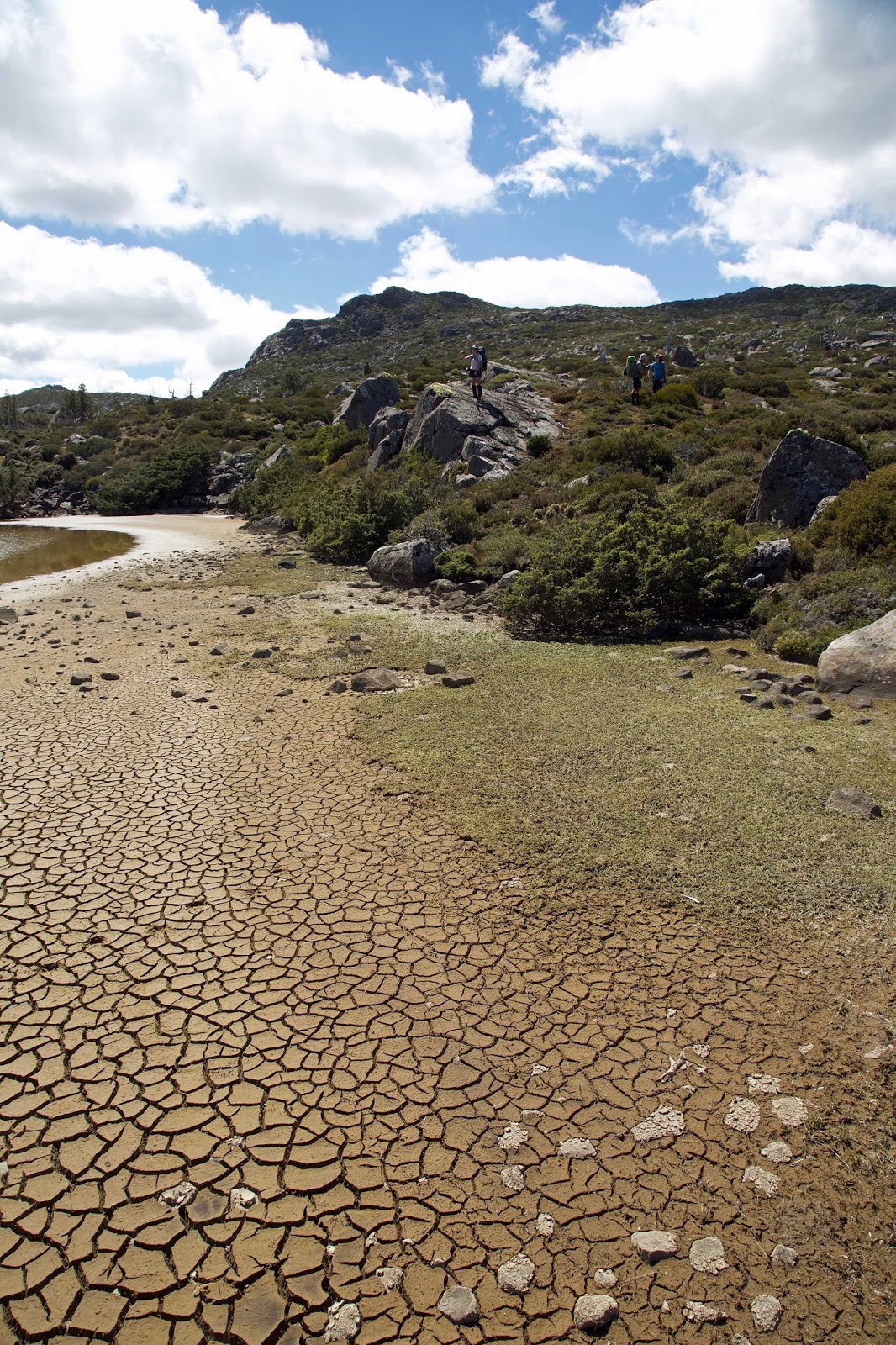
The weather was clear, the sky blue, and out of the stiffish breeze the day was growing warm. After a short scroggin and drink break, we hoisted packs and walked on towards the more sizeable Lake Lexie. We dodged around its long and sometimes convoluted shores, the shallowest of which looked like mud flats at low tide. Some parts had dried and cracked so much that they gave a convincing impression of a desert.


[Yes, the Plateau was dry!]  
Towards the end of Lake Lexie we found a lunch spot that offered some shelter from the growing wind. As we ate we discussed how far we should walk before settling for the night. Opinion here was divided. Some were keen to start looking for sites sooner rather than later; others wanted to head as far towards Long Tarns as we could, knowing that late tomorrow the forecast was for rain and wind. The Walls themselves offered more shelter, if we could get there before that expected weather change.

Sometimes, however, a gift horse appears. And that was the case when we came to Pencil Pine Tarn. To my mind, it being only 2:30pm, this was a bit early to stop for the day. But once we’d wandered up slope to the pencil pine forest that had given the tarn its name, we all decided we’d be mad to miss the chance to camp here.


[The sheltered campsite near Pencil Pine Tarn] 
The beautiful, ancient-looking pencil pine grove offered superb shelter from  nearly every quarter. The site had obviously been used before, with logs and rocks arranged as camp furniture, and (sadly) signs of a past campfire. Apart from fires being illegal across this whole “fuel stove only” area, I shudder when I see signs of fire anywhere near these irreplaceable pencil pines. But I calmed down once I’d spent a few minutes among the pines, breathing in their rich, resinous scent. It seemed we had landed on our feet with this campsite.


[Relaxing at Pencil Pine Tarn camp] 
Once we’d set up tents and tarps, Tim O and I declared we were going down to the lake for a swim. There were two surprises with that. Firstly everyone else said they’d do the same, and secondly the water proved to be only a foot deep, with the tarn bottom’s mud about the same depth. So our “swim” ended up being a hilarious exercise in getting both wet and muddy. At best we managed to float on our backs, propelling ourselves along like inept, over-sized otters. Still a wash is a wash, and even Jim – not a keen swimmer – stayed in the whole time. We all came out glad he’d made the effort, and more than happy to settle back in to our brilliant campsite.