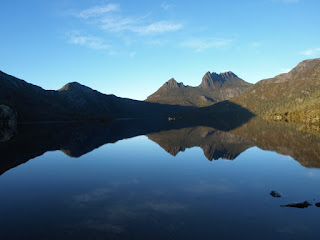
Showing posts with label Dove Lake. Show all posts

Thursday, 7 May 2020

A Long-Awaited Reunion: Part 4

Plans change, even long-settled ones. Originally we were to walk out together on day 4. Then, once we’d reached the cars, Jim, Lynne, Brita and I would farewell the four who were going home early, and we’d go on to Blue Peaks. That required driving around to Lake Mackenzie, re-packing, and getting walking again in the late afternoon for the 2-3 hour walk up to Blue Peaks.


[The track between Pelion and our cars] 
That all sounded good on paper, and looked very do-able on the map. But there were two flies in the ointment. Firstly the forecast for the days ahead included quite a bit of rain. Secondly Lynne’s knee/hamstring issue was still of concern. Jim and I had independently been pondering the dilemma: how could we help Brita to make the most of her limited time in Tasmania, while not further damaging Lynne’s knee? Amazingly we had come up with the same possible solution. Merran and Tim D had some extra accommodation, a cottage next to their house in Sheffield, and we hoped we might prevail upon them to use it for two nights. We’d be able to visit Cradle Mountain on the day in between.


[An unidentified wildflower brightened up the walk out] 
Jim and I laughed when we finally had a quiet little tête-à-tête about the issue, and discovered we’d had the same idea. (I guess that happens when you’ve been friends for nearly 40 years.) We put it to Tim D and Merran, and they were more than happy for us to use the cottage. We checked it with Lynne and Brita, who were happy to go along with the new plan. Problem solved, the only thorny issue was how to nurse Lynne through the potentially arduous walk out to the car. To allow the maximum time for her to walk as slowly as she needed, we were all up very early. And Lynne left before the rest of us, as she didn’t want to slow anyone down.

That seemed wise to me, although I expected I’d catch her within the hour. Instead the kilometres went by: buttongrass became forest; forest gave way to heathland. We toiled through rocky sections, then walked some more through scrubby forest. We were now walking in gender groups, and we boys were having a fascinating theological discussion, as you do between three Christians and a Buddhist. It didn’t slow us down at all, but however fast we walked, there was no sign of Lynne.

To say we didn’t see her again until the cars would be a slight exaggeration. But we only caught up with her when she stopped for a scroggin break, and to wait for the rest of us. We weren’t walking slowly. Lynne was simply walking like a new person: fluently, and without knee pain.


[The track was rough and cryptic in a few places] 
Still, it was a long and tiring walk out. On the way in to Pelion we’d taken more than 6 hours, and walking out still took us well over 4 hours. Yet there was elation at getting back to the cars before lunchtime. I gave Lynne a congratulatory hug, and we both thanked Brita for her great work on Lynne’s hamstring. She just deflected the thanks, and said it was all to do with Lynne’s “super tough body”. Lynne looked both surprised and delighted with the compliment.

Once we’d stowed our gear back in the cars, the prospect of getting out to a hot lunch before too long was uppermost in our minds. Apart from anything else, we had to farewell Libby and TimO, who were leaving us once we’d had that café lunch. We were aiming for Mole Creek pub, but decided to stop and try Earthwater Café, a few km short of Mole Creek. Changing plans seemed to be going well for us today: it proved a fabulous find. We sat outside, partly so other diners didn’t have to share our ripe bushwalking odour. Once we’d pulled a couple of tables together beneath some beautiful trees, we settled down to the kind of meal that’s especially welcome after time in the bush.


[Our lunch stop at Earthwater Cafe] 
Sooner than we hoped, but later than they needed to, TimO and Libby departed for the south. The remaining six of us were going to Sheffield, and were very thankful that we weren’t having to hoist packs and walk again that day. We were even more thankful we’d have actual beds, with real mattresses, for the next few nights. Call us soft, we don’t care!

There was one other major item on Brita’s “must see” list. Despite having seen wallabies, pademelons, eagles, cockatoos and dozens of other creatures that aren’t to be found in Austria – and most of New Zealand – we had not been able to find a wombat. That gave us a focus for our day at Cradle Mountain. But that was tomorrow, tonight we needed to find food, while leaving Tim and Merran to settle in and get ready for work tomorrow. We took a dining short-cut, deciding to eat what we still had in our packs. Yes, we had catered for more nights out, but the prospect of more dehydrated food wasn’t hugely enticing. A visit to the pub for a pre-dinner drink took the edge off our disappointment, and a little wine with dinner helped wash it down happily.


[Cradle Mountain reflected in Dove Lake] 
The forecast for our Cradle Mountain day was not great, although the amount of rain predicted seemed to diminish by the hour (which was how often we checked it). By the time we left Sheffield the showers had stopped. And when we got to the new visitor centre at Cradle Valley, the cloud had lifted off Cradle itself. The plan to walk the Dove Lake Loop Track wasn’t looking so daft after all. Dove Lake itself was very busy, as this honey-pot has been for many years now. But once we walked beyond Glacier Rock, just a few hundred metres from the carpark, the foot traffic dropped significantly. As we ambled closer to Cradle, we showed Brita some more of the kind of rainforest she had come to love in both Tasmania and New Zealand. 


[Rainforest on the Dove Lake Loop Track] 
We talked about the common origins of those forests in ancient Gondwana. This kinship even goes down to the kinds of fungi found in both forests. We pointed out some myrtle orange fungi (Cyttaria gunnii), which are very closely related to Cyttaria species found on the beech trees of both New Zealand and Patagonia, even down to their resemblance to golf balls.


[Myrtle orange fungi in myrtle beech trees] 
After dipping beneath Cradle itself, the track took us around to yet more rainforest, the wonderful Ballroom Forest. But there was an elephant in the ballroom. Or more correctly, a large, rotund, furry marsupial (and no, I’m not referring to Jim) was missing from the ballroom. We weren’t likely to see wombats here, so we walked quite quickly back to Dove Lake. The one sure-fire place to see wombats in the wild was Ronny Creek, so we caught a shuttle bus from Dove Lake and got off at Ronny Creek.


[Jim in Ballroom Forest] 
Within a few minutes we were meeting other walkers coming towards us with smiles on their faces. Yes, there were wombats here! I’d like to say we stopped, snapped a few quick photos, and quickly turned for home, where we had a date to eat home-made pizza with Merran and Tim. But no, this was Brita’s new happy place. 


[Brita's happy place: watching wombats near Ronny Creek] 
She took a hundred photos of distant wombats. Then a couple of them started wandering down towards the track. After she took another hundred closer photos, and became a little annoyed with the noisy, impatient and pushy behaviour of some other observers, we thought Brita was finished. 


[Wombat approaching!] 
But then one wombat climbed onto, and over, the boardwalk, close enough for Brita to touch it (which she knew not to). She had an extended period of wombat bliss – while we basked in its vicarious glow – before we signalled it was time to head back to the shuttle bus stop. Brita belatedly joined us – after a deal of waving and calling – only moments before the bus pulled out. But somehow not even that was going to stop her smile!

Back in Sheffield, we hunted for pizza toppings, the deal being that Tim would make the bases, and we would supply, and put on, the toppings. We also wanted to search out some little thank-yous for our Sheffield hosts. That done, we went “home” again, and freshened up for dinner. 


[Master chef Tim. Who wants some pizza?] 

[Not your typical bushwalking food. Thanks Tim!] 
Tim excelled himself, as usual, with three courses of pizza: entrée (pizza bianca); main course (many and varied) and dessert pizzas. We supplied the wine, and sat back to watch the setting sun painting the clouds around Mount Roland. It was a magical end to a very special few days together. We met no resistance from Brita when we suggested we must do it all again. But perhaps we might not wait eleven years this time!


[... as the sun sinks slowly over Mt Roland.] 

Wednesday, 24 October 2012

Under Gustav’s Spell


The talk will begin with words about Gustav Weindorfer. It will celebrate his century old vision proclaimed Moses-like, arms outstretched, from the top of Tasmania's Cradle Mountain.

"This must be a national park for the people for all time."


Within two years the Austrian, by then in his mid-thirties, had built Waldheim – “forest home” in English – a guest house fit for his vision. The building, or a close replica of it, fashioned from the forest’s King Billy pines, still sits at the edge of a forest that now bears Weindorfer’s name.

And I sit in a hut, just a stone’s throw west of Waldheim, preparing a talk about how we might care for wild places. I am pondering the kind of life that “Dorfer”, his wife Kate, and their many friends and guests experienced here. While we have driven to the door in under two hours from Launceston, on their early trips they averaged less than two miles per hour from the nearest road at Moina. Weindorfer long lobbied successive governments to build a road in, but had very limited success.


Waldheim, Cradle Mountain, Tasmania 

It is spring, so there is snow. It falls on and off all day, by turns soft and slow; angular and sharp. We choose to walk regardless. Pulling rain hoods tight against the wind-driven snow, we trudge, huff and crunch our way up to Crater Lake.

In the lee of the hills the wind drops, the showers abate, and we lower our hoods in time to enjoy the waterfalls and forest of Crater Creek. The fagus has begun budding, and we smile at its disregard of the snow. We spend a long while taking photographs, agreeing that we have no schedule to keep. Is this what Gustav meant when he welcomed people here with the words “this is Waldheim where there is no time and nothing matters”?


Spring thaw and fagus buds near Crater Lake 

By the time we have climbed close to Crater Lake it is snowing steadily, softly. I wonder how many south-westerly squalls it took for ice-age snow to accumulate here and gouge out the deep crater – really a cirque – that is now filled by Crater Lake. But this is not the day to stay and ponder. With visibility down to fifty metres, we cinch our hoods tight and turn back into the cross-fire of a spectacular flurry.


Snow flurries at Crater Lake, Tasmania 

Gustav’s beloved Kate died tragically young in 1916. Waldheim had been her vision as much as his. Indeed she had purchased the land on which it was built. After Kate’s death he chose to take up permanent residence here. Although he was considered a hermit by casual visitors, “Dorfer” was anything but. He thrived on hosting others and showing them this special place. But with no road, and visitors concentrated in the warmer months, he became intensely lonely, especially when snow cut off access. He must have longed for spring and the return of warmer weather and more frequent company.

And I wonder, really, how homely this wet forest could ever have been. To me its soft, green-mantled, dappled light is achingly beautiful. But it is also shady, cold and waterlogged. Even with the sun shining, the dripping is incessant, and as I write the cold draughts finger their way through gaps in the cabin.


In Weindorfers Forest near Waldheim 

Clothes washing, in fact any sort of ablutions, must have required a degree of fortitude. Just beside Waldheim, astride a fast-flowing creek, we find the old bath house. A wooden sluice provided it with fresh – VERY fresh – water. With snow lying on the ground, I know I would have been very tempted to put off bath-time!

All night snow slumps from the roof, a careless intruder stumbling into our silence. It is cold. But morning brings the gift of a cloudless blue sky. We drive to Dove Lake after breakfast to see Gustav’s Cradle covered in snow. Words are few – but on a day like this it would be a hard heart that failed to share Weindorfer’s dream.


Cradle Mountain above Dove Lake, Tasmania 

On the drive back I look across Ronny Creek towards Waldheim. The “forest home” is at the edge of a narrow wedge of wet forest dominated by King Billy pine and myrtle-beech. But all around is eucalypt woodland and buttongrass moorland. Gustav’s century old abode suddenly looks small, fragile, susceptible to changes that are reaching even to this haven.

Am I under some kind of spell to believe that the on-going preservation of such wild places is still possible? As we drive away a pair of black currawongs calls sharp and hard across the valley, as they have for long ages. Spell or not, I hear it as a ringing endorsement of Gustav’s vision.

Tuesday, 27 October 2009

Cradled

[a beautiful day in a beautiful place - with a sting in its tail!]


[Cradle Mountain reflected in Dove Lake]

At 1545 metres, Cradle Mountain is Tasmania’s fifth highest mountain. That’s not particularly high, even by Australian standards. But by those same standards it is a delightfully shaped mountain, satisfyingly “peaky”, and justly famous for its lopsided twin towers separated by a hammocky ridge, the whole often reflected in the flawless waters of Dove Lake.

I’ve succumbed to the appeal of its summit at least four times over the last three decades. Each climb has been different, but the most recent was more eventful than I’d have preferred.

Three of us were there – with dozens of others – on a rarely-perfect October day. There had been so much rain over winter and early spring that the creeks here had begun to flow clear instead of their normal beer colour, the tannins diluted to the point of invisibility. And if it wasn’t raining, wind and snow showers had gone to work. But on this day the weather gods had put aside their tools and gone for a smoko.

The mountain draws many walkers, not all of them ready for the challenge. We passed a number of walkers having difficulties with the steep dolerite scree that leads to a snowy amphitheatre beneath the final tower. One couple chose, not unanimously, to be satisfied with the northward view from the scree rather than the 360 degree summit vista. While there is nothing technically difficult about any of the scree, it does involve a certain amount of rough-house hauling of yourself up fridge-sized boulders. The contrast with the duck-boarded approach walk is too stark for some. On the other hand the dozens heading for the summit this day included children as young as seven or eight.

Once over the hump of the scree approach, there’s a steep side-slope to traverse. Except in the height of summer there is usually some snow here on the south-east facing slopes, over-towered as they are by tooth-like pillars of dolerite. The day was mild and sunny, so at this point the metre deep snow was soft and slushy. We took out trekking poles to help with balance and gingerly began to cross the side slope.

A year ago, almost to the day, I had paused here with my son and sons-in-law to slide down the forty degree snow slope in our wet weather gear. The few seconds of exhilaration had to be backed up by a far longer and more tedious slog back up the slope. Twice was enough for me, although some of the next generation tried it a few more times.

This time we were intent on the summit, so we by-passed the obvious sliding section. I was in front, and began to head up the very steep climbing chute, choosing to go to the left of a large rock. I remember gripping the rock with both hands, although one must have also been holding the trekking poles. From that semi-fixed position I kicked a step into the snow just beneath the boulder, and tested it briefly, before trying to heave myself upwards.

The step held only until I put real weight on it, then gave way, sending my left foot a metre lower than I was expecting it to be. That ripped my hands from the rock, flipped my feet skyward, and sent me careening backwards down the slope. I completed a one and a half backward somersault, landed on my back, then slid head first down the chute at what might have been described as an exhilarating pace. Did my life flash before me? Did I pray, or fling my arms over my head for protection? I quite honestly didn’t have time to do anything more than to think “Oh ... my head is likely to stop me by hitting a rock!” I’m not even sure an expletive popped into my mind, although I can think of a couple that would have been very suitable.

After a very rapid slide of maybe 25 metres, I stopped quite suddenly as my back – thankfully cradled by a day-pack – crashed into a suitcase-sized rock. I lay there, for the moment pain-free, thinking “ooh – I think I’m alright”. I then conveyed the same in response to Jim and Tim’s yelled query. Their next shouted words disconcerted me. “Don’t move!” Spinal injury? A huge drop just beneath me? No. “Gotta get a photo!" followed by “Bugger! Wish we’d got that in movie-mode.” Then I knew I was going to be okay.

A few careful minutes checking myself, talking with the boys, and righting myself, was followed by an extra cautious crawl up-slope to the start of the climbing chute. Twenty minutes later we were out on the summit - the sun shining, the breeze a mere zephyr - with me yabbering nineteen-to-the-dozen as you do when the adrenaline kicks in after even a mild shock.

And at the end I had no badge of honour, not even a decent bruise, to show for my troubles. Being joined on the summit by three youngish girls and their family seemed to underline that we had done nothing even slightly heroic. I think I can get over that. Two days later, such thoughts are already being replaced by a strong thankfulness that I was somehow cradled during my fall. I will live to walk another day, God willing!