Showing posts with label snow. Show all posts

Monday, 25 November 2024

A Loopy Walk on the Plateau 1

Day 1: Wild About Harry


Sybil of months, and worshipper of winds,
I love thee, rude and boisterous as thou art


- from “November” by John Clare


It’s a risky business trusting November. John Clare, the 19th century Romantic poet, may have been writing about England and depicting the northern hemisphere’s final month of autumn, but he still nailed my experience of Tasmania’s last month of spring. So yes, we were expecting “windy, rude and boisterous” for our November walk on Tasmania’s Central Plateau. We would not be disappointed.
 
Complications with our various schedules meant we spent the Thursday night at Tim and Merran’s cottage in Sheffield. That allowed us a relaxing night; dinner together; and the prospect of an early start on the Friday. But come Friday morning, the worst of a cold and wet south-west change was still coming through. The forecast was for 70km/h winds and snow squalls in the mountains. Given that, who would blame us for delaying the start in the hope of the front blowing through? 


[Ready to leave Lake Mackenzie]

And so, after a cozy, civilised morning coffee in Sheffield, it was noon before the five of us hoisted our packs and started walking away from Lake Mackenzie. For the first two hours we followed our usual route towards the Blue Peaks. The wind was strong, and showers whooshed through at intervals, occasionally turning to sleet and snow. 
 
Our first night’s destination was new to three of us, so Tim D and Libby, who’d been there earlier in the year, took the lead in guiding us towards Harry Lees Lake. Tim had earlier estimated it was only about three hours from Lake Mackenzie. We took that with a grain of salt, given not only Tim’s optimistic nature, but also the strongly adverse weather conditions.


[And then came the snow]
 
As we crested the high point of the day’s walk, the wind grew in ferocity, almost knocking us off our feet. And then the sleet and snow were replaced by hail. Icy pellets thwacked into us, stinging any part that was exposed. We cinched our hoods down, and kept our gaze at our feet until the squall finally passed. This was unpleasant walking, yet somehow it was more than a little exhilarating. We were uncomfortable certainly, but with good gear and care with navigation, we were not in any danger.


[Libby still smiling in the snow]
 
At one point we stopped for a quick rest, and TimO tested Tim D’s knowledge of the number of high points before we could finally descend to Harry Lees Lake. Such points, according to our group’s lore, are called “faux plateaux”: a lower equivalent of false summits. And TimO reminded us that there are always four. Tim D was a little evasive in his answer, a sure sign that we still had quite a few crests ahead of us. 
 
At this stage, for some reason, I started singing “I’m Just Wild About Harry” to myself. I quickly ran out of words, since it’s a 1920s song, and as ancient as I was now feeling, I wasn’t around when the song was popular. Perhaps it was my way of wooing the lake; willing it to appear just over the next hill, or around the next bend. I can’t say it worked, but perhaps it distracted me a little from the buffeting wind and stinging rain.
 
Finally, after some four hours of walking, we turned a corner, walked down a gentle slope, and there sat Harry Lees Lake. Better still, on its western shore we saw a substantial pencil pine forest. With that came the prospect of finding some shelter from the ferocious wind. As we scouted around for suitable tent sites, and eventually found them, I started to feel a little more positive. Perhaps I could just get a little wild about Harry, especially when occasional rays of sun lit up the late afternoon. 
 
Still, our evening meal was a hurried affair. A freezing wind whooshed loudly through the pine foliage. We sat huddled in our puffer jackets, trying in vain to get warm as we cooked between showers. Libby in particular sat there shivering, a Gore-tex coated icy pole. It wasn’t long before we all scurried off to bed. 


[Snow: our morning surprise]
 
The wind and showers kept up all night. I got up at first light, and was surprised to find that the overnight showers had actually been snow. Our tents were spattered with snow, and the ground all around was white. The overnight weather had certainly been wild around and about Harry!


[Larry stays in his tent to cook a warming brew]
 
We started the day slowly. I’d already expressed a wish to stay another night “with Harry”, and the wish grew stronger in this weather, which continued windy, cold and showery. But some in the party had other plans, and once I’d finished a lazy breakfast and a follow-up coffee, I could see the writing on the wall. The agenda for our walk had been evolving over the weeks leading up to it. At first we were going to do a through walk to the Little Fisher valley, but this had been scuttled because of car-shuffle complications. 


[A bleak morning at Harry Lees Lake]
 
Gradually the plan had morphed into a possible circuit, taking in those parts of Ritter’s Track that we’d not visited before. If a loop walk out to Ritter’s Track and back to Lake Mackenzie was now the plan, we would need to move on each day. As wild as I was about Harry, I agreed we should pack up and move on.  

Thursday, 6 August 2015

One Scoop or Two?

The last time it snowed like this in Hobart was July 25th 1986. Those old enough to remember – and a few who really weren’t – know it as “The Great Snow of ‘86”. It’s all relative of course. 8cm of snow is hardly “great” by world standards.


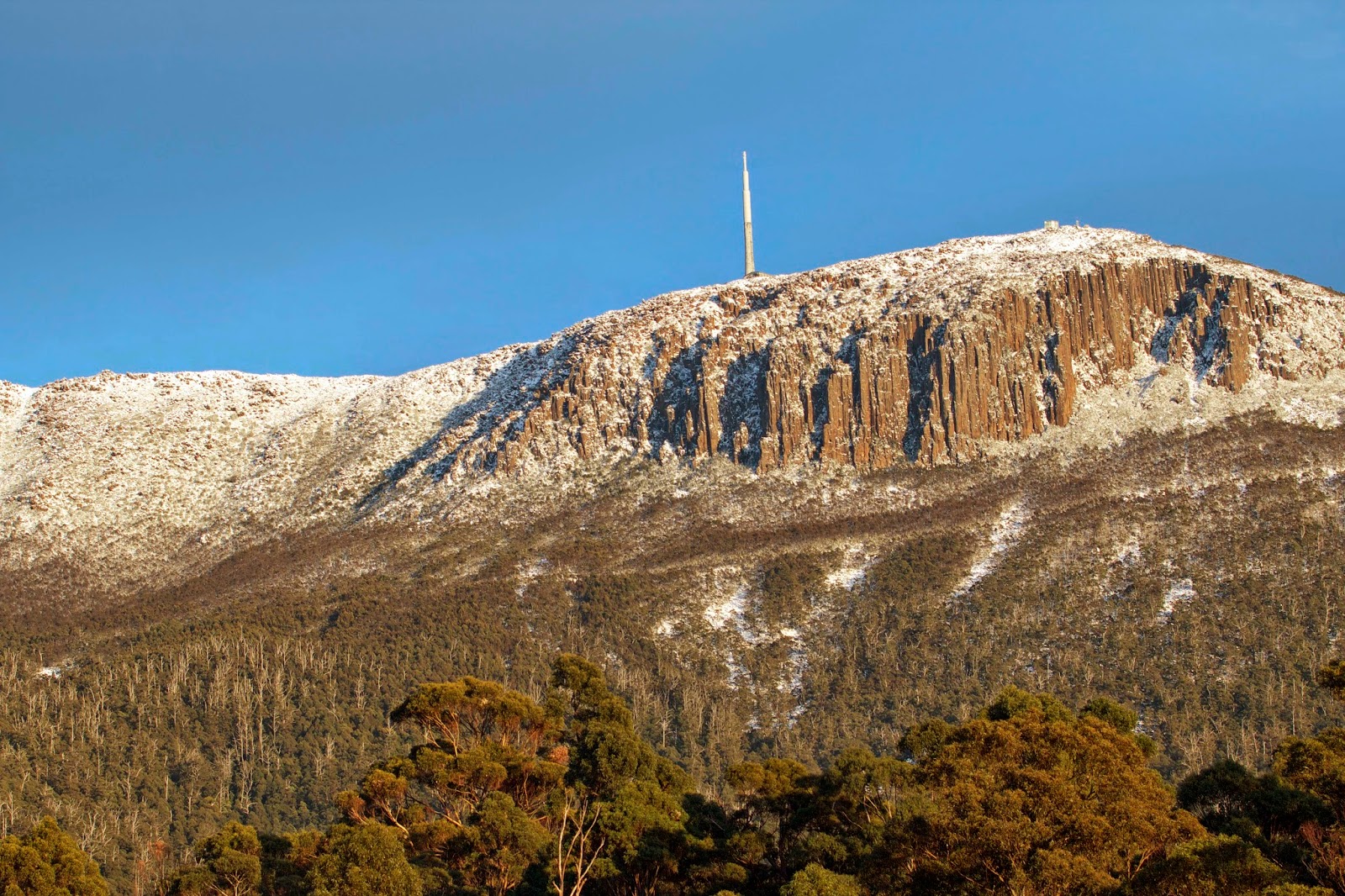
[Snow on kunanyi/Mt Wellington, August 2015] 
Yet for Hobart, with its mild maritime climate, snow is a rarity. Yes we can see it at any time of the year on our mountain, 1270m high kunanyi/Mt Wellington. But it’s when the snow comes to the suburbs that we Hobartians really make merry.

In 1986 my sister Liz and her two young daughters were visiting us from Sydney. It was her first winter visit, and she playfully expressed her wish that it would snow. Older and wiser, we assured her it “almost never” snowed down this far. And of course it did. Starting on Thursday night, and then well into Friday the 25th, it snowed hard, right down to sea level.


[Family snap of snow in our garden, July 1986] 
As my sister was only visiting for a short time, I’d already arranged to take the Friday off. Of course everyone in Hobart ended up having that day off. When snow is rare, people aren’t prepared for it. Buses and cars stayed off the roads; schools and some businesses shut down; a few hardy types skied to work, just because they could. But most people rugged up and went out to play.

I witnessed some of the frivolity first-hand because, Murphy’s Law being what it is, I’d run out of film for my camera. I chose to walk the 4km down the snow-bound road to buy some. On that excursion normally staid neighbours called out their glee, a few even taking snow ball pot-shots at me, all in good fun of course.

And so to August 2015. Snow to sea level was forecast for August the 3rd, and we woke to about 5cm of it at home. Our neighbours and their young children were soon out in the yard re-enacting the snow yahooing we’d done 29 years before.


[Morning snow on our garden, August 3rd, 2015] 
Lynne and I, still older and wiser, decided to stick to the usual and go for a walk in our bush. That was about all that was “usual” about the morning. What a different look and feel snow lends to the familiar!

Snow slanted down in flurries, covering our usual tracks, disguising the bush, threatening to disorientate us. Occasionally the icy wind bit hard into any exposed skin, then relented as the sun broke through. In that stillness, amid the muffled squeals of our neighbours and the caaarking of ravens, flakes of snow parachuted thick and slow around us. It was cold, certainly. And we were quite ready to get back to the fire and some hot coffee. But for now, there was nowhere we would rather be.


[Snow flurries in our bush] 
My sister died of a brain tumour too few years after “the Great Snow of ‘86”. Fast forward to August the 5th 2015, two days after this year’s first dump. Again snow was forecast to “low levels”. Given Monday’s dump, and Tuesday’s freezing, wet conditions, you might think we’d have grown tired of this cold interruption. Instead I found myself hoping for lots more. Perhaps some of Lizzie’s playfulness was rubbing off on me, because there was nothing older or wiser about this hope. I felt more like a child clutching a cone at the ice cream van, imploring mum or dad for a second “scoop”.

Saturday, 12 July 2014

Just Add Snow: Part 2

Snow was falling,
so much like stars
filling the dark trees
that one could easily imagine
its reason for being was nothing more
than prettiness. 

- Mary Oliver

Ah, snow and imagination! Such powerful and persistent allies, even in the face of our actual experience of snow’s discomforts and dangers.


[Fiercely beautiful: summer snow in the Swiss Alps] 

We are traversing a little-walked route at the back of the Cradle Plateau. We are defying a “woolly” weather forecast, which has now taken a turn for the worse. Just after our point-of-no-return we enter a snowy, whooshing white-out.

The snow presents us with two problems. One is way finding, as our route has become disguised and there are no snow poles. We walk on into the white anyway: a little apprehensive, but keen to try ourselves out.


[The point-of-no-return? Heading into snow on the Cradle Plateau.] 

Snow’s second problem soon arises, and that is movement per se. Post-holing isn’t something most walkers in Tasmania get to practise. We usually only have brief skirmishes with snow, and its odd amnesiac properties wipe former difficulties from our memory. Right now we have to re-learn what an apt term post-holing is for what happens when you to try to cross fresh, soft snow.

We’ve started with visions of softly traversing the snow’s surface a la Legolas the elf. This is punctured as quickly as the snow, as first one leg then the other sinks thigh-deep into the snow. Only with a shuddering and inelegant heave do we extricate a back leg, scissor it up and across our front leg, and then plunge into a new hole.

We do this over and over again, wondering why we thought walking in snow would be fun. Even breathing is a challenge, as snow lashes our faces and the cold wind swipes the air from us. After a relatively short amount of this energy-sapping exercise we are exhausted, even a little demoralised. A little voice tells me it’d be wise to lurk behind the lead walker and use his steps as mine. But it’s a variety of slipstreaming that is usually noticed by the leader. It will soon end with one or other of them “allowing” me my turn; if my pride doesn’t make me take it first.


[Back on track: the Horse Track, Cradle Mountain] 

That day on the Cradle Plateau was only a brief taste of hard snow walking. We soon found the better marked Horse Track and dropped down out of the worst of the snow, and back to a warm hut.

And now, despite all that I have just written about the difficulties of those few hours, I look back on that day with overwhelming fondness. In asking myself why, I have begun to think that there’s something deeper at work than just the aesthetics, the prettiness, of snow.

As I write this I am looking out on a snowy kunanyi/Mt Wellington. It is cold here at 200m, but up there it is way below zero, and winds of 40kmh are blowing from the south-west. The snow up there is deadly as well as beautiful. And perhaps those two sides of snow have always been deeply embedded within us.

There is a fierce beauty to snow. It can kill, but it can uplift: like death, like love. Was that what Danish writer Peter Hoeg was getting at in Miss Smilla’s Feeling For Snow when he wrote these words?

Maybe falling in love, the piercing knowledge that we ourselves will someday die, and the love of snow are in reality not some sudden events; maybe they were always present.

Sunday, 6 July 2014

Just Add Snow: Part 1

I was recently interviewed on radio – in the line of duty – about bushwalking in winter. The interview covered things like appropriate clothing and suitable tracks for Tasmania’s cool season. But the S-word did come up, as it inevitably will in winter.


[A Christmas snow-dome: our fantasy of snow?] 
Snow is a word freighted with thrills and chills. Yet while we join the world in enjoying the aesthetic lift a covering of snow gives a landscape, it seems Australians are oddly naïve about the real thing. Think of our plethora of kitsch snow-domes, with snowy scenes of places as unlikely as Uluru and the Great Barrier Reef!

Perhaps we should blame it on the weather in our big cities. Winter in places like Sydney and Melbourne can be as miserable as anywhere in Tasmania. But being that few degrees warmer than Tassie, and lacking nearby mountains, those cities miss out on our snowy compensations. (Although they do boast their own snow-domes.)

Having snow, we Tasmanians can readily step outside the dome and get acquainted with the reality. Lynne and I spent our first Tasmanian winter in Fern Tree, the highest suburb in Hobart. It nestles into the slopes of kunanyi/Mt Wellington at an altitude of over 400m. When forecasts speak of “snow in elevated suburbs” you can bet that includes Fern Tree.


[A dusting of snow on the slopes of kunanyi/Mt Wellington] 

That year was 1980. We’d come from mainland Australia expecting our first child, and with our “fur-kid” in tow. Wuppy was a border collie/kelpie cross, a smart and lively dog, bred to round up sheep on the western plains of NSW. If we were naïve about snow, he was utterly clueless. After our first decent fall, we let him outside for a look. He stood there wide-eyed, barked, looked uncertainly back at us before bounding out into the snow. He then barked some more before repeatedly biting into the “big white thing” that had invaded his space.

Gradually we have become more closely acquainted with Tasmania’s infrequent, unreliable yet delightful snowfalls. We even choose, at times, to bushwalk in it. 

One winter a group of us heads into the high country north of Lake St Clair, despite a bushwalker’s weather alert warning of snow. We have all the right gear: good waterproofs, down jackets, tents, winter sleeping bags and plenty of food and cooking gear. We plan to sleep in a hut and are walking on a well-known track. What could possibly go wrong?


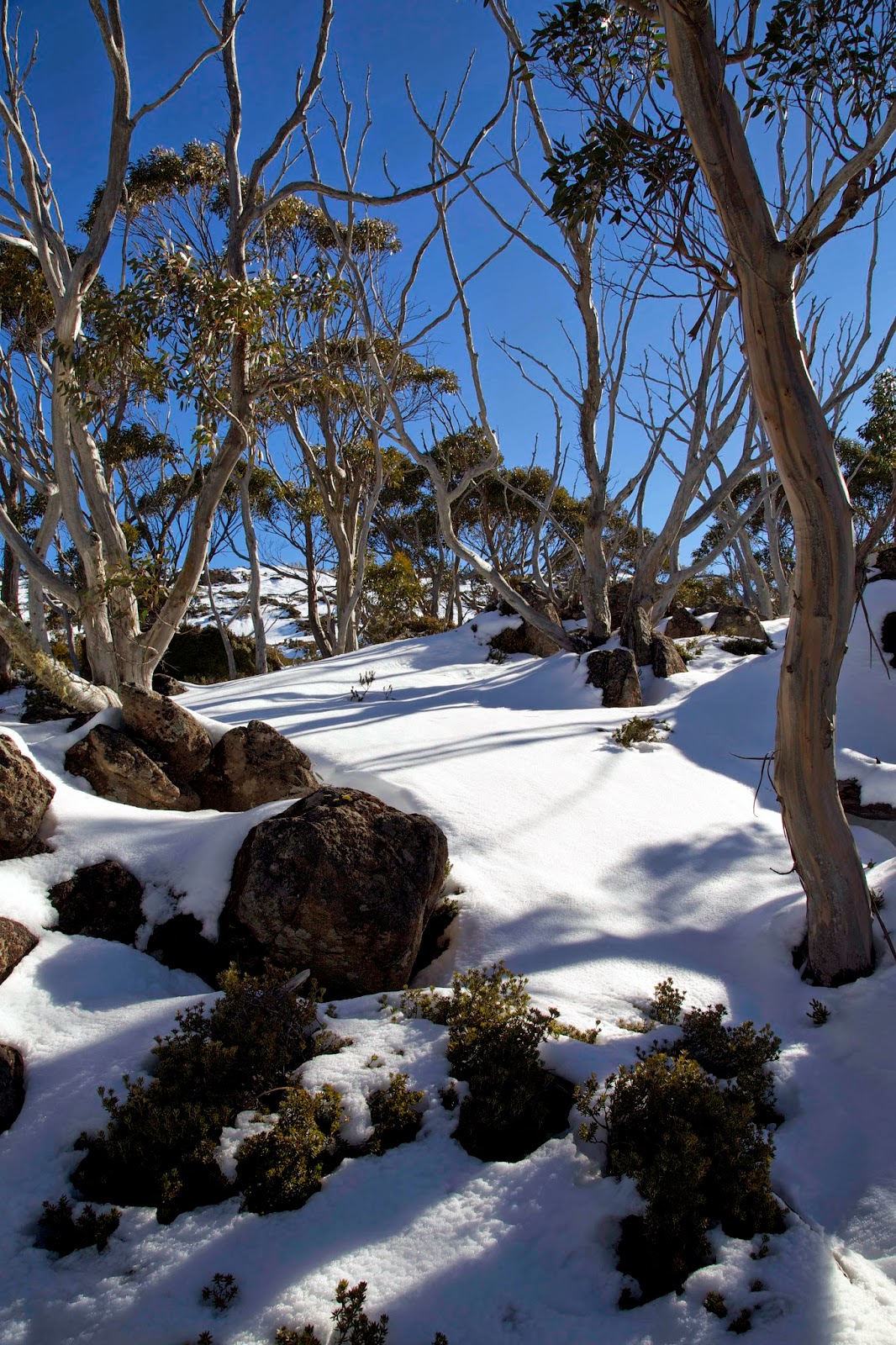
[A picturesque amount of snow: Mt Field National Park] 
The short answer is: quite a lot. Deep snow can make your progress perilously slow; it can exhaust you; disguise the track; cause you to miss a hut. Icy conditions can easily lead to slips, falls and injury. And an immobilising injury in freezing and snowy conditions can quickly become much more serious.

We’re not oblivious to all this. We mindfully, carefully walk on through a magical snowy forest. Its trees shield us from the worst of the freezing winds. The snow is of the slushy Tasmanian variety: not deep enough to delay us; not hard enough to crunch beneath our boots; just slippery, soft and endearingly squeaky. As we trudge beneath snow-laden branches, the occasional barrow load of snow plops down around us: a harmless form of Russian roulette.


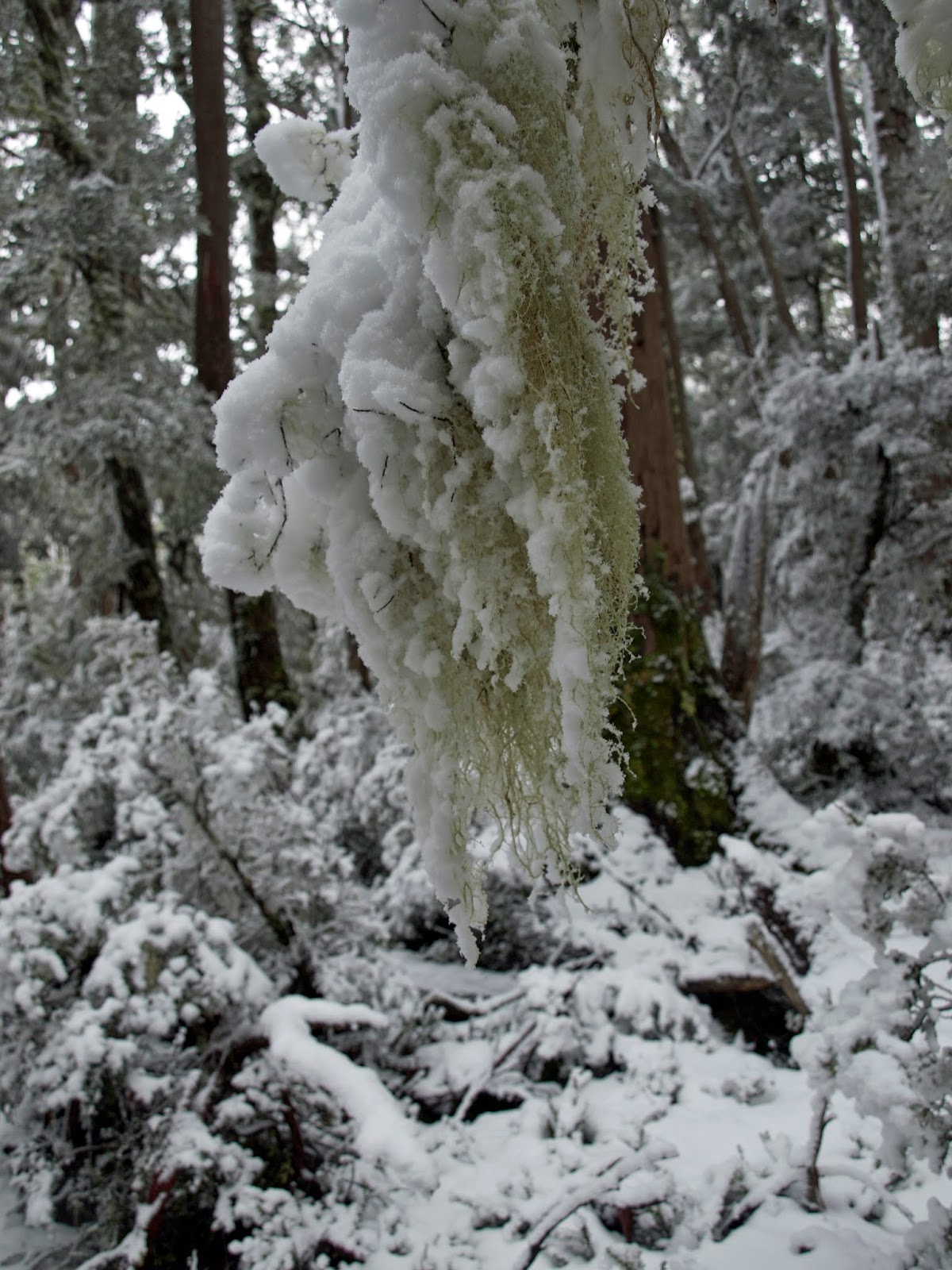
[Old man's beard and snowy forest near Windy Ridge] 
We play a more favourably-loaded, but far more dangerous form of that game on a snowy walk in New Zealand. As we approach a steep, sidling bit of track we see a prominent sign. With typical Kiwi candour, the sign warns us not to stop between this sign and the next. A local tells us this is an avalanche zone that's especially active in winter and early spring.


He cheerfully adds that a football-sized chunk of snowy ice whizzing down that vast slope could take our heads off. This is a little worse than risking  a bit of snow down our collar. Even though it’s late spring, and the snow is thin, there’s an extra zing in our steps as we cross that slope! We’re not keen to meet the hard reality of snow literally head-on.


Wednesday, 24 October 2012

Under Gustav’s Spell


The talk will begin with words about Gustav Weindorfer. It will celebrate his century old vision proclaimed Moses-like, arms outstretched, from the top of Tasmania's Cradle Mountain.

"This must be a national park for the people for all time."


Within two years the Austrian, by then in his mid-thirties, had built Waldheim – “forest home” in English – a guest house fit for his vision. The building, or a close replica of it, fashioned from the forest’s King Billy pines, still sits at the edge of a forest that now bears Weindorfer’s name.

And I sit in a hut, just a stone’s throw west of Waldheim, preparing a talk about how we might care for wild places. I am pondering the kind of life that “Dorfer”, his wife Kate, and their many friends and guests experienced here. While we have driven to the door in under two hours from Launceston, on their early trips they averaged less than two miles per hour from the nearest road at Moina. Weindorfer long lobbied successive governments to build a road in, but had very limited success.


Waldheim, Cradle Mountain, Tasmania 

It is spring, so there is snow. It falls on and off all day, by turns soft and slow; angular and sharp. We choose to walk regardless. Pulling rain hoods tight against the wind-driven snow, we trudge, huff and crunch our way up to Crater Lake.

In the lee of the hills the wind drops, the showers abate, and we lower our hoods in time to enjoy the waterfalls and forest of Crater Creek. The fagus has begun budding, and we smile at its disregard of the snow. We spend a long while taking photographs, agreeing that we have no schedule to keep. Is this what Gustav meant when he welcomed people here with the words “this is Waldheim where there is no time and nothing matters”?


Spring thaw and fagus buds near Crater Lake 

By the time we have climbed close to Crater Lake it is snowing steadily, softly. I wonder how many south-westerly squalls it took for ice-age snow to accumulate here and gouge out the deep crater – really a cirque – that is now filled by Crater Lake. But this is not the day to stay and ponder. With visibility down to fifty metres, we cinch our hoods tight and turn back into the cross-fire of a spectacular flurry.


Snow flurries at Crater Lake, Tasmania 

Gustav’s beloved Kate died tragically young in 1916. Waldheim had been her vision as much as his. Indeed she had purchased the land on which it was built. After Kate’s death he chose to take up permanent residence here. Although he was considered a hermit by casual visitors, “Dorfer” was anything but. He thrived on hosting others and showing them this special place. But with no road, and visitors concentrated in the warmer months, he became intensely lonely, especially when snow cut off access. He must have longed for spring and the return of warmer weather and more frequent company.

And I wonder, really, how homely this wet forest could ever have been. To me its soft, green-mantled, dappled light is achingly beautiful. But it is also shady, cold and waterlogged. Even with the sun shining, the dripping is incessant, and as I write the cold draughts finger their way through gaps in the cabin.


In Weindorfers Forest near Waldheim 

Clothes washing, in fact any sort of ablutions, must have required a degree of fortitude. Just beside Waldheim, astride a fast-flowing creek, we find the old bath house. A wooden sluice provided it with fresh – VERY fresh – water. With snow lying on the ground, I know I would have been very tempted to put off bath-time!

All night snow slumps from the roof, a careless intruder stumbling into our silence. It is cold. But morning brings the gift of a cloudless blue sky. We drive to Dove Lake after breakfast to see Gustav’s Cradle covered in snow. Words are few – but on a day like this it would be a hard heart that failed to share Weindorfer’s dream.


Cradle Mountain above Dove Lake, Tasmania 

On the drive back I look across Ronny Creek towards Waldheim. The “forest home” is at the edge of a narrow wedge of wet forest dominated by King Billy pine and myrtle-beech. But all around is eucalypt woodland and buttongrass moorland. Gustav’s century old abode suddenly looks small, fragile, susceptible to changes that are reaching even to this haven.

Am I under some kind of spell to believe that the on-going preservation of such wild places is still possible? As we drive away a pair of black currawongs calls sharp and hard across the valley, as they have for long ages. Spell or not, I hear it as a ringing endorsement of Gustav’s vision.

Friday, 18 June 2010

Alert Not Alarmed


[Your blogger enjoying snow near Du Cane Gap, Tasmania. Photo: Lynne Grant]

Tasmania is the only place in the world that has bushwalkers weather alerts. I’ve no doubt people in many other places, including mainland Australia, receive adverse walking weather. Trampers in New Zealand, hikers in North America, and ramblers and hill walkers in the UK face conditions every bit as hazardous as ours. But by accident of history, vocabulary and popularity, Tasmania’s bushwalkers join sheep graziers in receiving specific weather alerts when cold, wet and snowy weather is forecast.


What is it like to find yourself out there when one of these alerts is current? The June long weekend this year provided a good test. Our group planned to head for Windy Ridge, at the southern end of Tasmania’s Overland Track.

Two days before we leave, snow showers are forecast down to 500m. When the words “bushwalkers weather alert” are added, some members of the group become nervous about us walking to well above 1000m. We go anyway – jollying them along with optimistic bravado.


Arriving at Lake St Clair we note, with eyebrow-raising interest, that the outside air temperature is only 1 degree C. The showers are coming and going, but the snow isn’t settling at the lake’s 700m altitude. We head for the ferry that will smoothly deliver us to the head of the cloud-shrouded lake in little more than 20 minutes.


80 years ago the trip for Jack Thwaites and party was more hair-raising. A. D. Fergusson (“Fergy”) used to run an open boat up and down the lake at break-neck speed – when he could get the engine firing. His deliberately erratic driving would have put him in the hoon category today, so the Thwaites party were all thoroughly wet by the time they reached Narcissus Bay. And they only achieved that after they’d rowed more than a mile up the lake when the engine died.


We arrive safely, achieving a similar level of wetness only after a few kilometers of showery walking. As we gain altitude the showers are turning sleety, and by the time we reach Windy Ridge there is plenty of snow on the ground.


The next morning we half expect to wake to a blanket of snow. But the showers have eased, and it proves to be a flimsy blanket, with less than a foot’s depth of snow around the forest-enfolded walkers’ hut. Through the trees we catch glimpses of snow caps on the Du Cane Range. It is cold and the clouds promise more snow, but Du Cane Gap and the waterfalls are calling. We put on fire-dried boots and wet weather gear, and soak them all again within the hour.


It’s said that the North American Inuit have a vast number of words for snow. While that is debated, the various Finnish dialects do have more than 50 words for snow (or “icy precipitation”). And it shouldn’t surprise us that people of the far-north have a nuanced vocabulary for snow.


I, on the other hand, am a snow novice. A teenager before I saw snow in the flesh, as we climb through the ever-thickening snowy forest, I am a teenager again. I can’t find the vocabulary for the wonder of this frozen scene.


[old man's beard (lichen) encrusted in snow]

But I begin to get a sense of snow as a symbol for the here and now. Transient yet firm, soft but transforming, full both of light and delight. It disguises danger; reveals shape; muffles sound; sighs softly; kills gently. It can tickle, thrash, melt, smack and scratch. And every flake of it is unique.


What if we’d heeded the bushwalkers weather alert? What if the thermal gravity of the wood heater had held us down in the warm hut? In answer I simply smile.