Showing posts with label avalanche. Show all posts

Sunday, 6 July 2014

Just Add Snow: Part 1

I was recently interviewed on radio  in the line of duty  about bushwalking in winter. The interview covered things like appropriate clothing and suitable tracks for Tasmania’s cool season. But the S-word did come up, as it inevitably will in winter.


[A Christmas snow-dome: our fantasy of snow?] 
Snow is a word freighted with thrills and chills. Yet while we join the world in enjoying the aesthetic lift a covering of snow gives a landscape, it seems Australians are oddly naïve about the real thing. Think of our plethora of kitsch snow-domes, with snowy scenes of places as unlikely as Uluru and the Great Barrier Reef!

Perhaps we should blame it on the weather in our big cities. Winter in places like Sydney and Melbourne can be as miserable as anywhere in Tasmania. But being that few degrees warmer than Tassie, and lacking nearby mountains, those cities miss out on our snowy compensations. (Although they do boast their own snow-domes.)

Having snow, we Tasmanians can readily step outside the dome and get acquainted with the reality. Lynne and I spent our first Tasmanian winter in Fern Tree, the highest suburb in Hobart. It nestles into the slopes of kunanyi/Mt Wellington at an altitude of over 400m. When forecasts speak of “snow in elevated suburbs” you can bet that includes Fern Tree.
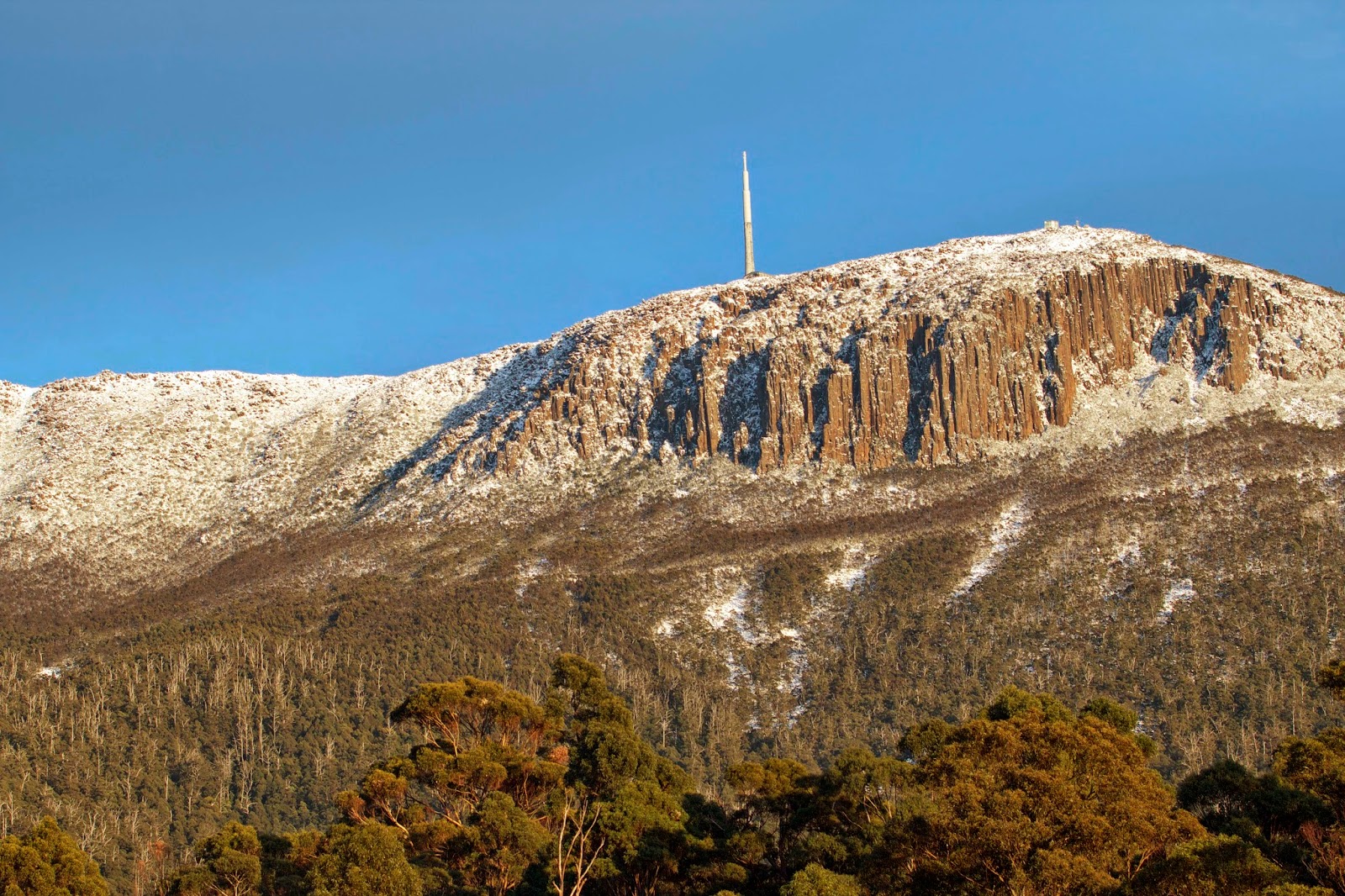


[A dusting of snow on the slopes of kunanyi/Mt Wellington] 

That year was 1980. We’d come from mainland Australia expecting our first child, and with our “fur-kid” in tow. Wuppy was a border collie/kelpie cross, a smart and lively dog, bred to round up sheep on the western plains of NSW. If we were naïve about snow, he was utterly clueless. After our first decent fall, we let him outside for a look. He stood there wide-eyed, barked, looked uncertainly back at us before bounding out into the snow. He then barked some more before repeatedly biting into the “big white thing” that had invaded his space.

Gradually we have become more closely acquainted with Tasmania’s infrequent, unreliable yet delightful snowfalls. We even choose, at times, to bushwalk in it. 

One winter a group of us heads into the high country north of Lake St Clair, despite a bushwalker’s weather alert warning of snow. We have all the right gear: good waterproofs, down jackets, tents, winter sleeping bags and plenty of food and cooking gear. We plan to sleep in a hut and are walking on a well-known track. What could possibly go wrong?
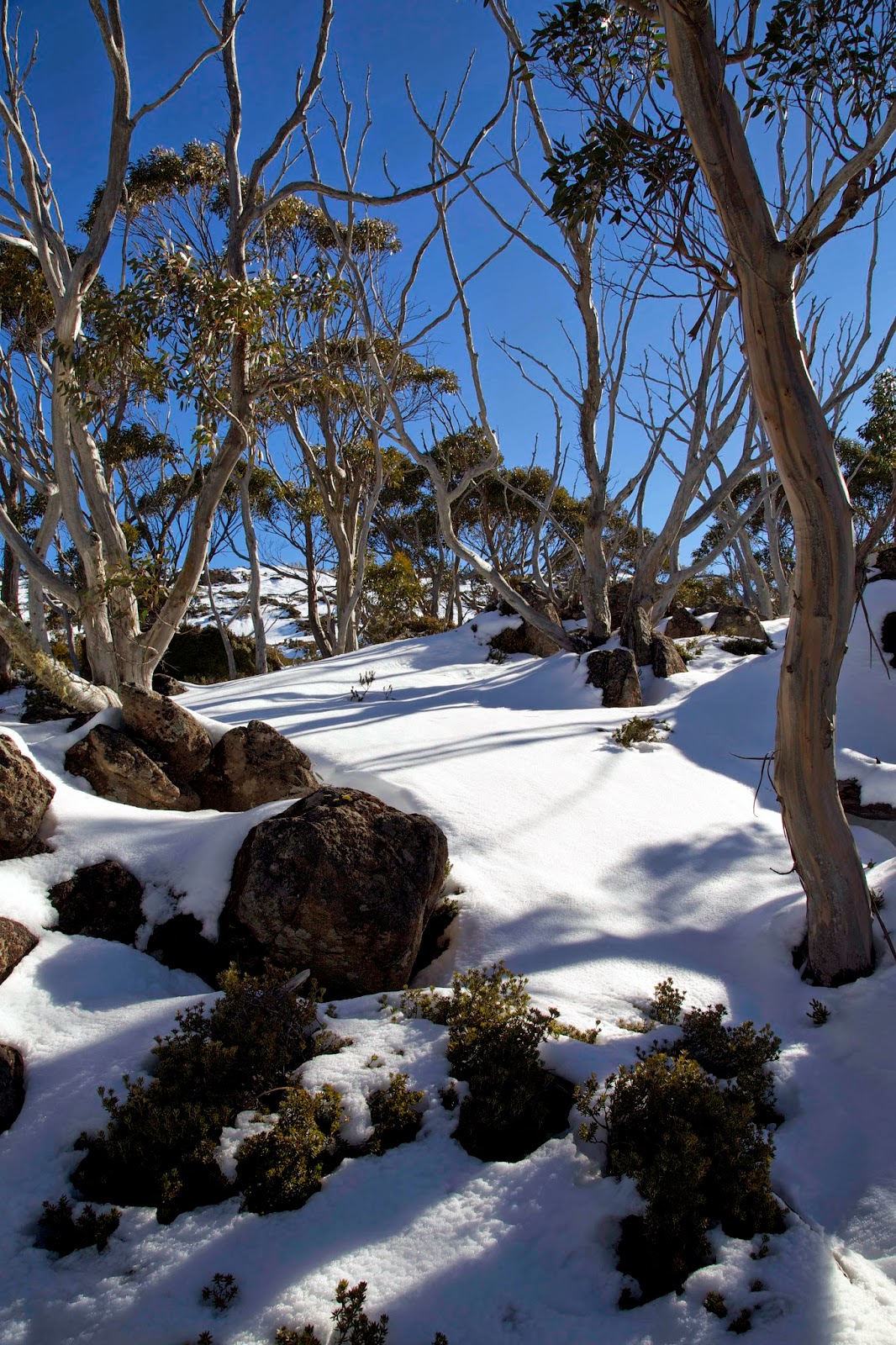


[A picturesque amount of snow: Mt Field National Park] 
The short answer is: quite a lot. Deep snow can make your progress perilously slow; it can exhaust you; disguise the track; cause you to miss a hut. Icy conditions can easily lead to slips, falls and injury. And an immobilising injury in freezing and snowy conditions can quickly become much more serious.

We’re not oblivious to all this. We mindfully, carefully walk on through a magical snowy forest. Its trees shield us from the worst of the freezing winds. The snow is of the slushy Tasmanian variety: not deep enough to delay us; not hard enough to crunch beneath our boots; just slippery, soft and endearingly squeaky. As we trudge beneath snow-laden branches, the occasional barrow load of snow plops down around us: a harmless form of Russian roulette.
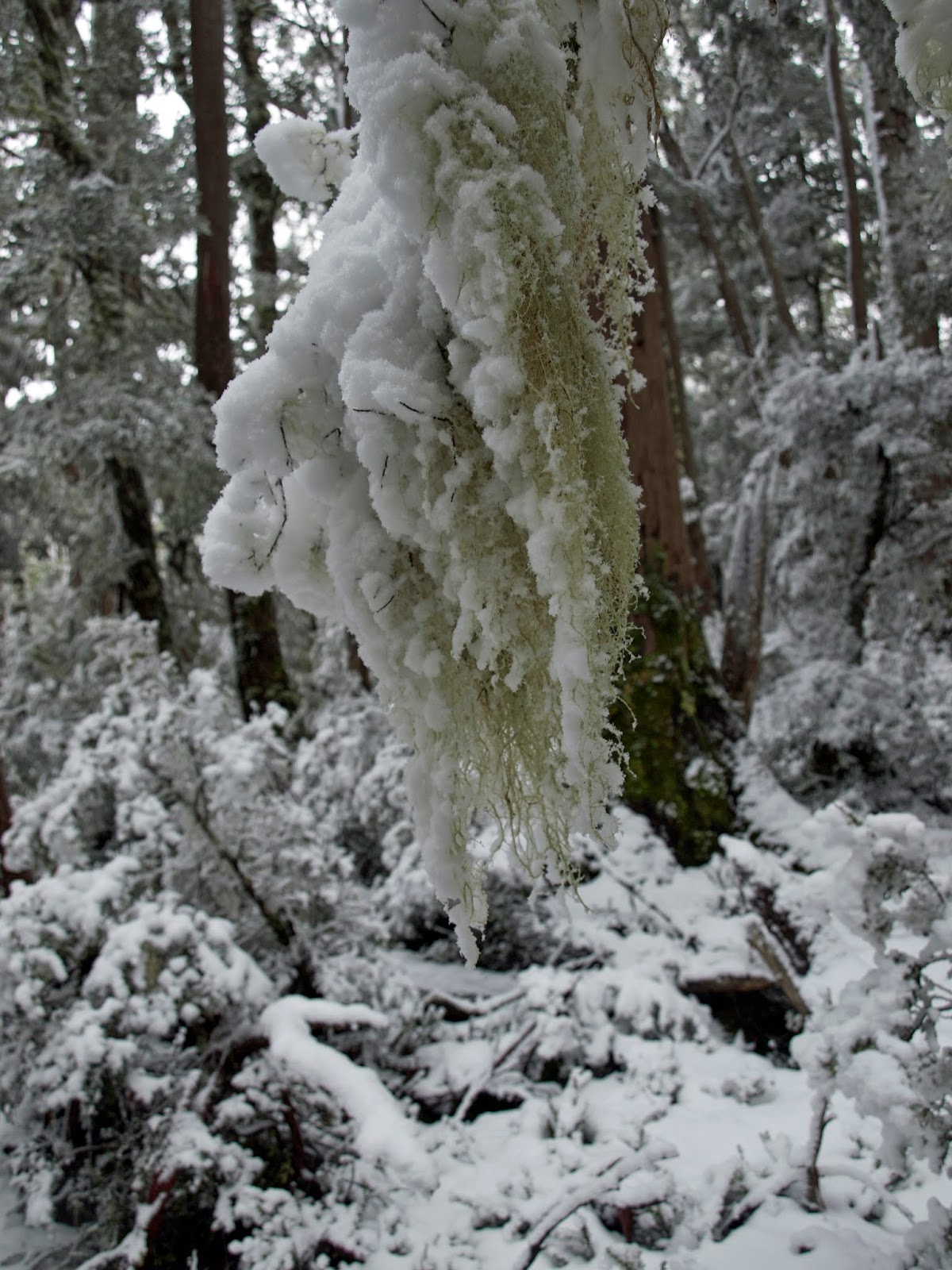

[Old man's beard and snowy forest near Windy Ridge] 
We play a more favourably-loaded, but far more dangerous form of that game on a snowy walk in New Zealand. As we approach a steep, sidling bit of track we see a prominent sign. With typical Kiwi candour, the sign warns us not to stop between this sign and the next. A local tells us this is an avalanche zone that's especially active in winter and early spring.


He cheerfully adds that a football-sized chunk of snowy ice whizzing down that vast slope could take our heads off. This is a little worse than risking  a bit of snow down our collar. Even though it’s late spring, and the snow is thin, there’s an extra zing in our steps as we cross that slope! We’re not keen to meet the hard reality of snow literally head-on.


Friday, 30 July 2010

Snowed Under


[walkers head towards Mt Field East, a light 21st century dusting of snow on the gound]

One winter, nearly 31 years ago, something very unusual happened in Mt Field National Park in southern Tasmania. The night of Friday August 10th 1979 saw more than a metre of snow fall on its mountains. Driven by a freezing south-westerly wind, the snow smothered the park from low levels to the heights of Mt Mawson, changing the shape, sound and look of the mountains entirely.


Skiers keen to spend their Saturday taking advantage of this amazing snow cover – one John Davis among them – must have rubbed their mittens in anticipation. With the whole area skiable, many skiers were ascending and descending the slopes when, without warning, a snow cornice above the Golden Stairs collapsed. John Davis and some other skiers were trapped beneath. While the others were rescued, John remained buried in the snow and died. His was the first death by avalanche recorded in Tasmania: a grisly and unwanted statistic that is unlikely to be added to, given climate change and the kinds of snow seasons Tasmania has experienced this century.


My first year in Tasmania was the year after this tragic death. Every visitor to the ski-field was told the story, and most had a grim desire to see the site. I was among those who gingerly climbed the Golden Stairs in snow, subsequently skiing cross-country towards Mt Field West. But from the mid 1980s onwards, skiing at Mt Mawson was starting to become a hit-and-miss affair. And this century not many winters have seen a good ski season.


I returned to the area earlier this July, enjoying an icy excursion into the highlands, ‘though not via the Golden Stairs. Like the gaping jaws of Sydney’s Luna Park after the ghost train tragedy, the “stairs” have a sad taint. The route is now closed.


While it was cold wandering over to Tarn Shelf – this was July after all – there was barely enough snow for a miniature snowman. The visit confirmed that I’d never invest in ski gear for use in Tasmania. It also had me reflecting afresh on John Davis’ dreadful luck.

New Zealand is another matter altogether. While their glaciers are shrinking, skiing is alive and well. And avalanches still manage to claim many lives every year. Even in late spring, trampers on many of Aotearoa’s mountainous tracks are advised to check avalanche forecasts. In some places bridges and other infrastructure are removed over winter to prevent them being swept away by avalanche.


[walking through an avalanche prone area on NZ's Routeburn Track ... and it's almost summer!]

It is sobering to walk through an avalanche zone, especially when Kiwis tell you with a smile that a football sized snow-ball at terminal velocity will take your head off. “But the good thing is, you won’t hear it coming” one added, with typically dry gallows humour.