Showing posts with label bushwalking. Show all posts

Tuesday, 2 August 2022

Happy Places 1: Smultronställe

In the (relatively shallow) depths of a Tasmanian winter, I find myself daydreaming of other places and other seasons. Take Sweden in summer as an example. Why Sweden for goodness sake? (you may ask.) Haven’t you watched enough Scandi noir to know Sweden is a place of constant snow, rain and grey weather, all bundled up in a flat and dreary landscape?

My simple answer is this. Before you judge it, spend one week of summer in Sweden. That is unless you object to VERY long, mild days, beautiful forests, meadows full of wildflowers, and stunningly intricate waterscapes of lakes and sea. And that’s not to mention the Swedes themselves, who in summer throw off their Scandi gloom, and become all frisky and fun-loving.


Take, for instance, one of their linguistic delights: the Swedish word smultronställe. It literally translates “place of wild strawberries”, but is most often used metaphorically to mean a semi-secret favourite place; a place that makes you happy. English phrases like “sweet spot” or “happy place” feel linguistically pale in comparison. If you've eaten wild strawberries, you'd surely agree. Smultronställe is a word forged from dark winters, scarce sun, and the utter delight at the sweet return of light and flavour. 


So it’s not unusual in Sweden to be asked for your smultronställe. What is your special place in the outdoors? It’s a question that resonates very much with me in relation to bushwalking in Tasmania. I’m often asked, especially by those who are not bushwalkers, or by people from other parts of Australia or the world, what my favourite bushwalking spots are. My plan for what remains of winter is to write about some of these in a series of blog posts; to share a bit of my daydreaming about places I'd rather be. However I should warn – and it’s probably in the spirit of smultronställe – that my posts might be a little geographically vague. If places are semi-secret, maybe it’s best that people discover their sweetness for themselves.


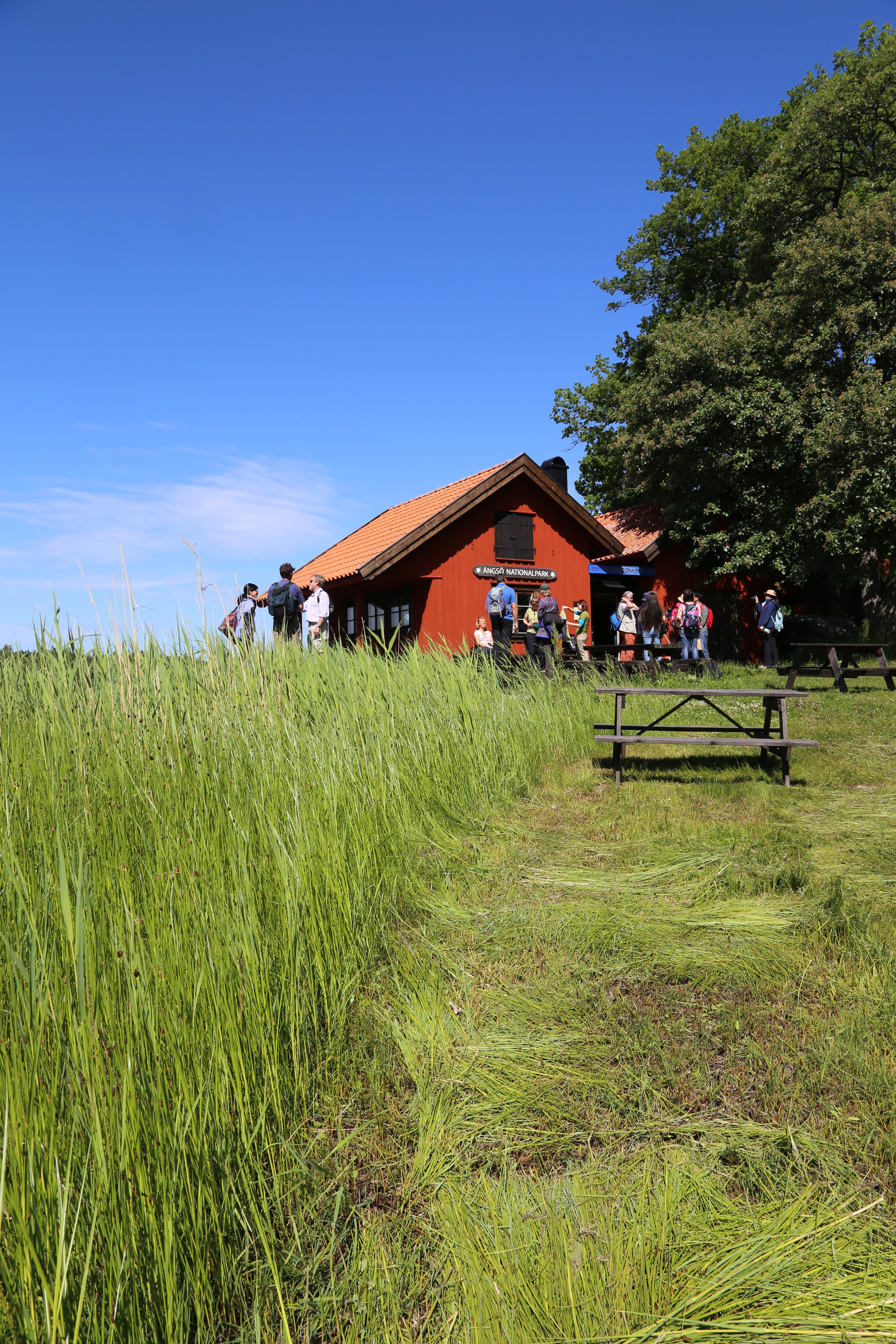
But before I start on my Tasmanian smultronställe, it’s only fair that I mention at least one favourite Swedish place. And that is Ängsö National Park, on the eastern coast of Sweden, about an hour’s drive north-east of Stockholm. I’ll let these images be a little taster of this beautiful place, and a reminder of all that was sweet – and accessible – before the pandemic. Let’s hope that such places will be within safe reach again in the future.


[Scenes from Ängsö National Park, Sweden]

Thursday, 8 September 2016

Three Capes Track: First Impressions

There's a new kid in town,
Everybody's talking 'bout the new kid in town *

We all know that kid. She/he turns up part way through the year, dressed to the nines, driving a flash new car while the rest of us walk or ride a bus. We experience that curious mixture of admiration, envy and suspicion.

Tasmania's newest walking experience, the Three Capes Track, is that new kid. While it has attracted a lot of admirers, there are detractors too. All of this made me keen to get to know the "new kid" personally, and find out what he's really like. Here are some of my impressions **
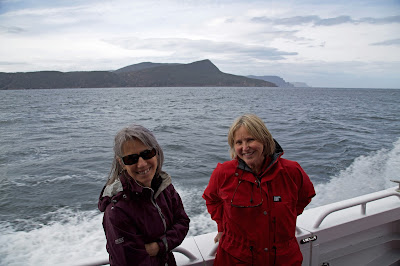

[The boat trip from Port Arthur brought lots of smiles] 
1) The Boat Trip ... or "The excursion you have to have". 

You start at Port Arthur, the World Heritage convict site on the Tasman Peninsula, and take what could be a simple 10 minute boat trip. Instead it lasts 90 minutes, with the boat describing a series of loops up and down the waters of the large inlet, before it delivers you to Denman Cove where the walking starts. Some critics describe it as an expensive and unwanted excursion. For everyone on our trip it was a highlight: a great way to come to grips with the lie of the land - and the water - as well as a way of including "the third cape", Cape Raoul, in the trip. (You get to see it from the water).
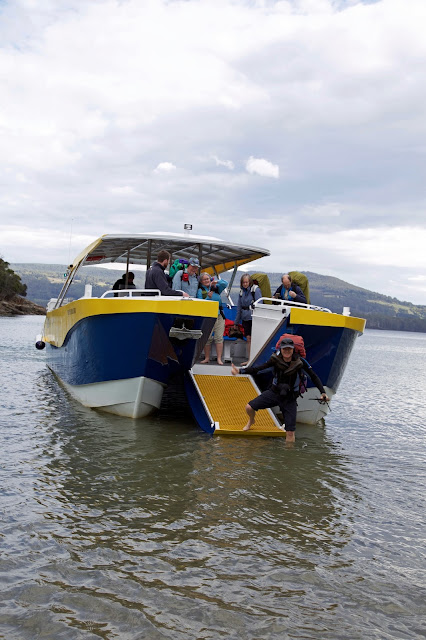

[A wet-footed start at Denmans Cove] 
2) The Track ... or "It's bushwalking Jim, but not as we know it". 

Constructed to "dry boot" standard, and capable of accommodating two walkers side-by-side for much of its length, this is the highest grade track work you'll find anywhere in Australia. 

Some, particularly long-time bushwalkers, consider the track over-engineered, too expensive, and too intrusive on an otherwise wild landscape. In parts - particularly the boardwalk on the way to Cape Pillar - they may have a point. But those who walk it generally love that they are not having to dodge mud or otherwise worry about their footing. Crucially this means that it will - and does - attract many first-time walkers. 
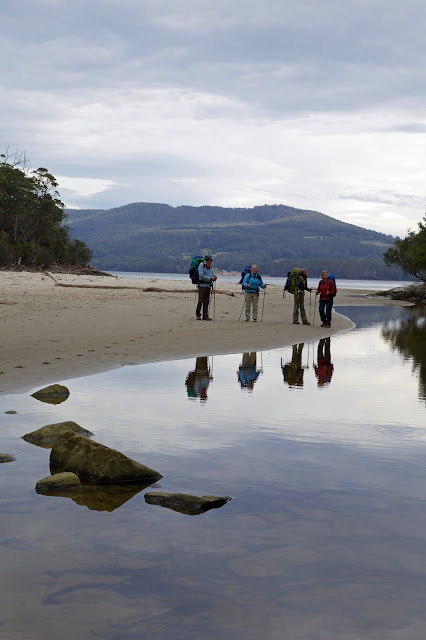

[Ready to walk: Denmans Cove with Port Arthur across the water] 
It also should be said that some of the rocky sections of track are so expertly made that they're almost works of art. The track looks as though it will last for hundreds of years. However it is a 46km walk, and there are occasional steep sections. It still requires a degree of fitness and determination.

3) The Experience ... or "Once upon a time there were Three Capes"

Q. When is a bushwalk not just a bushwalk? 
A. When it's also an experience.

The Parks and Wildlife Service team that's behind this walk speak of it as an "experience" and not just a walk. Of course all bushwalks are more than just a walk. So is this "experience" business just so much tourism wank

The way I read it, "experience" is about integrating those "other" aspects of a walk into your thinking from the very beginning. Here it is factors such as the variety of walking; its rich social aspects; the depth of stories held in the landscape; and the varied ways you're invited to approach those stories, that help to offer a seamless and rich experience. 
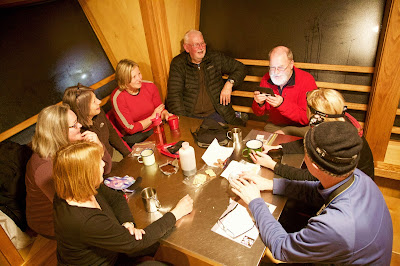

[Story-time in the hut: part of the social experience] 
Some examples? The track has a large number of "story starters", various installations, sculptures, or other prompts, that invite walkers to think about the wealth of stories related to this place. Rather than "signs-on-sticks", you are pointed to the informative booklet that's given to each walker. 

But does it enhance the walk? Certainly the walkers I went with thought so. They raved about so many aspects of the walk, but many singled out the wonderfully low-key interpretation, and the thought-provoking installations. 
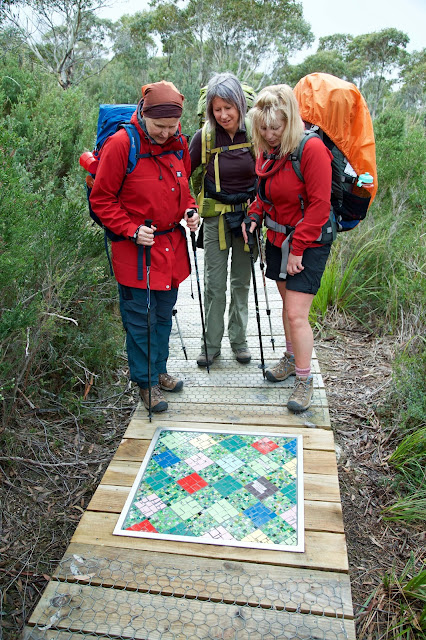

[Inspecting a "story-starter" on the boardwalk]
Crucially those walkers universally reckoned they'd come again. There was one caveat to that, and that concerns the cost. For some of our group, the usual fee of $495 per person (for 4 days, 3 nights, incl. the boat trip, bus retrieval and a two-year pass to Port Arthur) was too much. They only came because of the special national park centenary offer of $250 per person (which has now ended).

Of course it's arguable that the level of service here, from the boat trip to the high grade track to the presence of host rangers, warrants a higher fee. And then, of course, there are the huts.

4) The Huts ... or "He sees the vision splendid of the sunlit cliffs extended"

When New Zealand trampers thought the new Anchorage Hut on the Abel Tasman Coast Track too grand, they ironically dubbed it the Anchorage Hilton. The three huts on this track attract similar jibes. They're seen as too large, too plush, too intrusive and too costly. It's fair to say they are all of these. And yet ... the walkers who use them (remember quite a number of these are first-time bushwalkers) generally sing their praises.
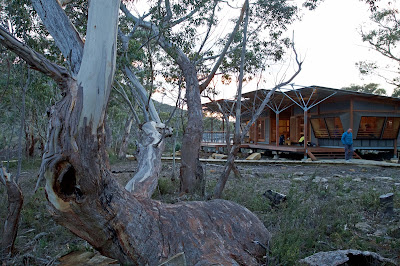

[Early morning at Retakunna Hut] 
Each overnight site has comfortable dormitory-style rooms, with eight bunks in each, and mattresses supplied. Should the snorers trouble you, the host rangers can supply ear plugs. Interconnecting decks lead to separate rooms for cooking/dining/socialising. Gas cook tops, pots and pans, and basic cooking utensils are provided. Water is supplied from roof tanks, and accessed via hand pumps over large indoor sinks. Toilets are in separate buildings, with fly-in/fly-out "sputniks" to collect the waste, making the smell minimal. 
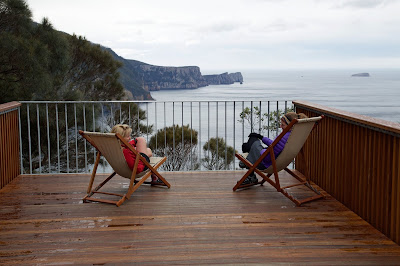

[Deckchair conversation on the Munro viewing deck] 
It's fair to say that each hut commands a stunning site. That's particularly true of the Munro site, high above Munro Bight. Its viewing deck gives truly stunning views towards Cape Hauy. The deck chairs (yes, they're supplied at each hut) can be taken onto the deck, allowing walkers unique rewards for their efforts in getting here. And sunrise from Munro's nearby helipad can be an amazing experience. It certainly was for our group. Munro Hilton anyone?
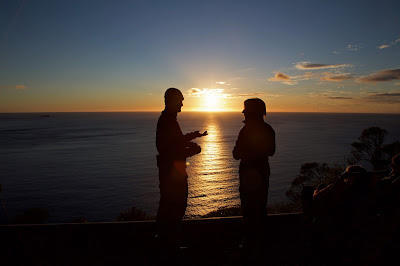

[Sharing sunrise above Munro Bight] 
5) The Development Issue ... or "Is this the thin end of the wedge?"

Some Tasmanians (in particular) are not happy with this style of development within a national park. They see it as intruding on the area's rich natural and cultural values to pander to the wealthy and the "soft". And there is a strong fear that this is a "thin-end-of-the-wedge" situation. A counter-argument is that sensitively opening an area to a wider variety of people, and not just hardy bushwalkers, can only increase the number of people who will value its conservation, and push for its ongoing protection.

After walking the track, and seeing many on it who would not otherwise bushwalk, I would lean towards the counter-argument above. The bulk of the track, and the siting of the huts, has been done relatively sensitively, given 21st century fire, building and safety regulations. Personally, I loved the experience, and would happily go back numerous times.

That said, I don't think "traditional bushwalkers" have been adequately considered in the current model. I think there should be a way for them to experience the whole track, and to have the option of camping instead of staying in huts. There is just one camping site provided, at Wughalee Creek, off the Cape Pillar Track. This is hardly an attractive or convenient site, and nor does it allow walkers to experience the first day and half of the track, between Denmans Cove and Munro. 


[Relieving sore feet at the end, Fortescue Bay] 
Given the high cost of providing the track and other services; and given the precedent of camping walkers having to pay the full Overland Track fee, I'm not arguing that Three Capes "camping walkers" should be given a significant discount. But I am arguing that a camping option for the full track should be actively considered in future.

6) The Landscape ... or "So much more than ABC"

Blasé tourists in Europe sometimes use the acronym ABC to refer to the surfeit of grand buildings. (ABC can variously refer to "another bloody castle" or "another bloody cathedral".) In the context of this walk, there were some who thought the experience would attract the ABC acronym with regard to cliffs. How wrong they would be! Simply put, the sheer variety of landscapes on this walk - from cliffs to seascapes; heath to woodland; cloud forest to rainforest - is quite stunning. 


[Walking through rainforest near Mt Fortescue] 
I've been visiting this area for many years, and thought I knew what to expect. I had little doubt that the cliffs would attract the most "wows". But I was not prepared for how extensive and how beautiful the forests would be, particularly the rainforest on the flanks of Mt Fortescue on the final day. I also underestimated the extent and beauty of the wildflowers.
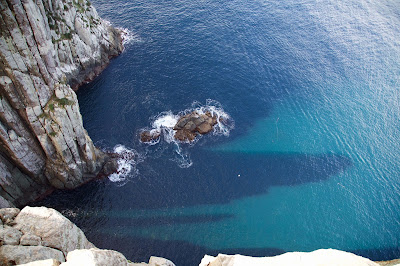

[Cape Hauy, the Candlestick and the Totem Pole casting shadows] 
Of course the cliffs deserve every rave they get, and not only because of the grandeur of the outlook they provide. For the patient and observant, they can also offer views of wildlife that'll keep the jaw dropping. White-bellied sea eagles, wedge-tailed eagles, albatrosses and many other birds can be seen. In the off-shore waters whales and dolphins are frequent visitors, and both Australian and New Zealand fur seals can be spotted resting on the rocky shores.

If I had to sum up the whole experience in just three letters, they would be WOW! If you've been thinking about walking the Three Capes Track, just do it!

There's more information here Three Capes Track


[Looking towards Cape Raoul from near Cape Pillar] 
* from "New Kid in Town" by the Eagles

** The disclaimers: I worked on staff with Tasmania Parks & Wildlife Service from 1991 until July 2015. I helped start up the interpretation aspects of this project, had some field trips to, and discussions at, some sites. I also sat in lots of boring meeting rooms. Before retiring, I handed the project on to some very creative staff and contractors. I paid to do this walk, and the opinions expressed are my own, and based on my August 2016 trip.

Sunday, 22 February 2015

Dreamwalking

Grounded: (adjective) sensible and down-to-earth; having one's feet on the ground; (verb) to confine (a child) to the house as a punishment. (Collins Dictionary)

For the past 6 weeks I’ve been grounded. In the aftermath of our Mt Anne “epic”, and the ankle injury I sustained there, I’ve had to be very sensible about how I put my feet on the ground. And it has involved enough confinement to make it feel like a punishment.


[Let me outa here! I need to walk!] 

The backstory can be found here Mt Anne Epic Part 2But to put it simply, politely, I badly sprained my ankle. According to the physiotherapist I probably tore my soleus muscle. This lurks somewhere beneath the Achilles tendon, near quite a few other equally unpronounceable bits and bobs. And I didn’t confine the damage to that muscle. The harm from the initial twist spread to quite a few other unnamed parts, thanks to the steep, rough and hot 10 hour hobble back to the car. It all hurt, and I could barely walk for two days after getting home.

So while the summer variously sizzles and fizzles itself out, I’ve been slowly recuperating. It has involved more “thou shalt nots” than “thou shalts”. I can do some simple (and boring) physio exercises and I can wear an ankle support brace. But I can’t run, and I can’t walk anywhere too rough. Nor can I walk very far or carry much weight on my back. And that has meant no overnight bushwalks since early January.

So what does a passionate walker do, at the height of the walking season, when that activity is curtailed? For a start I dream of walking. I pore over maps, plotting and planning walks that I WILL DO when … I also walk vicariously, listening to friends talking about their trips, reading others’ accounts of their walks.


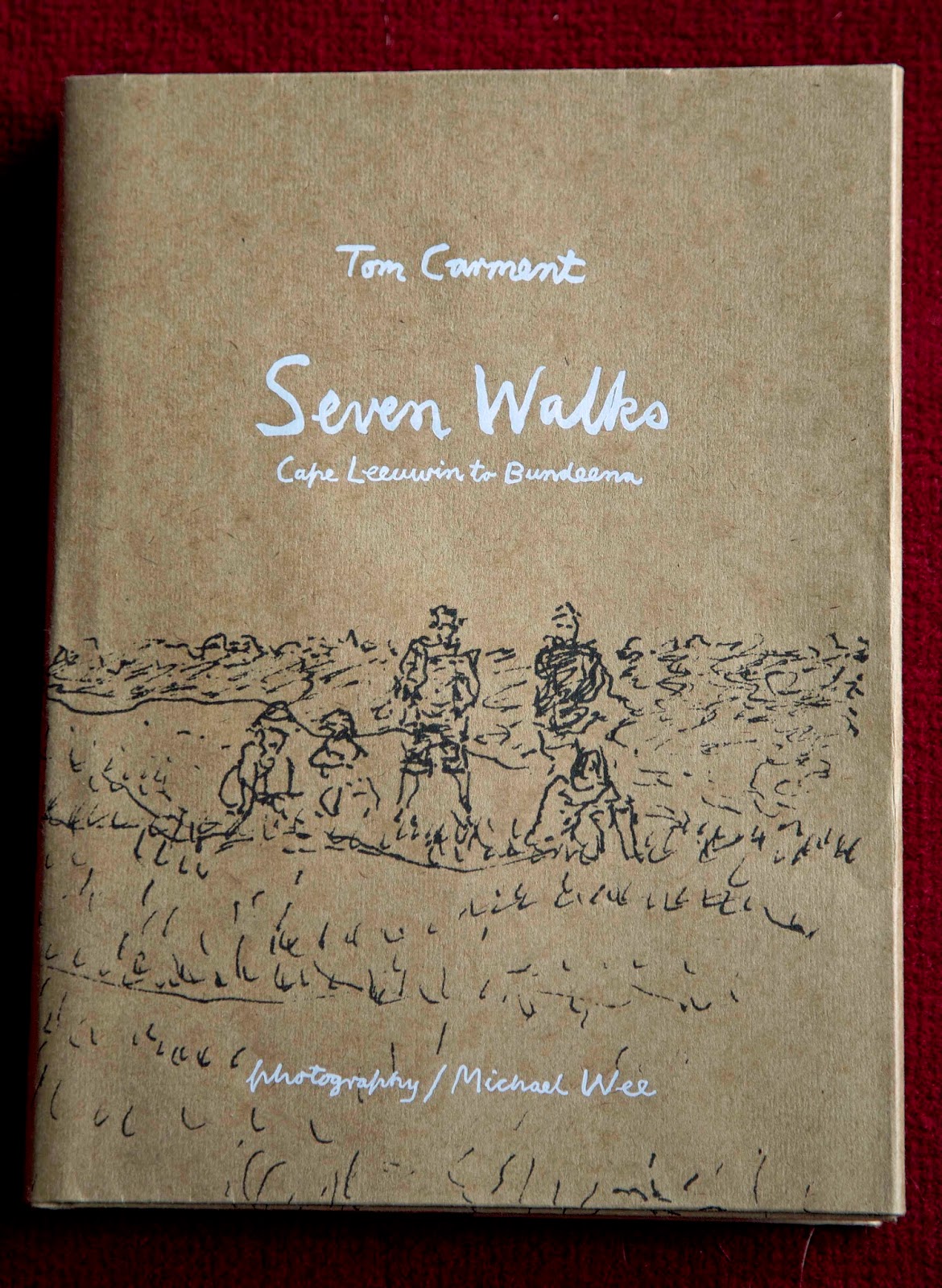
My dreamwalking is always being fed by books. But during my recent confinement, Tom Carment and Michael Wee’s “Seven Walks: Cape Leeuwin To Bundeena” has happily filled a void. As well as its beautiful and artful presentation, I am enjoying its spare, wry observations about bushwalking in Australia. I laughed, for instance, at Carment likening the randomly gathered walkers on the Overland Track to “the cast of their own six-day play.”


English poet Simon Armitage’s “Walking Home” is a delightful take on the long distance Pennine Way. Armitage walks from the Scottish border to his Yorkshire home, giving poetry readings each evening in return for his bed and board. It’s probably only the English weather that creates any semblance of adventure here. But this book is more about the characters and places Armitage meets along the way than it is about the walk itself.


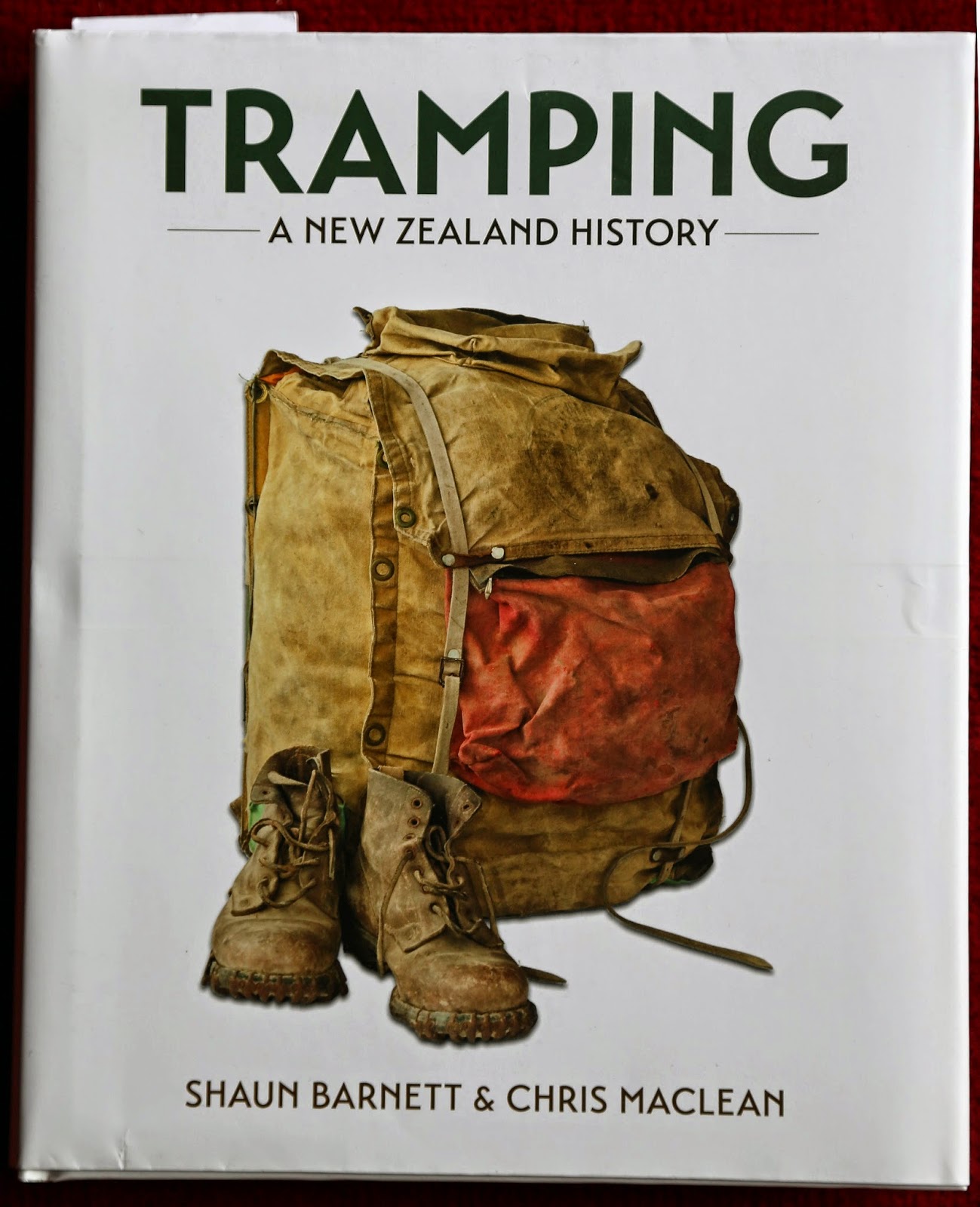
“Tramping: A New Zealand History” by Shaun Barnett and Chris Maclean is a monumental – and beautifully illustrated – account of tramping in New Zealand. This is a book to dip into endlessly, whether to learn the origins of the word “tramp”; to hear of the unique place of huts in NZ walking; or to admire the feats of pioneers crossing the Southern Alps. I managed to bring the book back from New Zealand late last year as “hand luggage”. If you want to try the same, I’d suggest you do some arm strengthening exercises. This wonderful book weighs in at almost 2kg!


Despite this wealth of indirect experience, I've concluded that it’s only actual walking that is properly good for your body and soul. So last weekend I donned my boots – and my ankle brace - and fought off my growing cabin fever via an exploratory walk on the mountain. It involved some steep, rough slopes (don’t tell my physio!), but the reward was the discovery of two mountain huts I’d never been to. I survived the walk well enough to imagine that my next book just might be a bushwalker's log book!


[Log book in a hut on kunanyi/Mt Wellington] 

Sunday, 24 August 2014

11 Dumb Ways to Die While Bushwalking


[Perfect weather for walking, but will it stay that way?]
People die bushwalking. Every year several people shuffle off this mortal coil while shuffling their boots through the Australian bush.

Our bushwalking retailers, bushwalking websites and other authorities issue warnings along the lines that “outdoor activities carry their own risks of injury and death.” They’re trying to tell us that when we lace up our bushwalking boots and hoist your pack, we’re doing something dangerous.

How dangerous? Well, it’s as risky as getting in a car; or catching an aeroplane; or going to hospital; or swimming; or making love; or riding a bike; or sitting on the toilet; or any of the other common activities that kill a proportion of their participants. If we wanted to be really paranoid, since most people die in bed, we might consider avoiding sleeping there.

Having established that most activities carry risk, wise participants will look for ways to minimise those risks. Or some might prefer to learn lessons from those who’ve already made mistakes. I’m in that second category. So I thought I’d offer here my own far-from-exhaustive list of dumb ways to get into trouble while bushwalking.


[A gently-flowing Ronny Creek, near Cradle Mt, Tasmania]
A few caveats: I point out that I have adopted – as one born-to-it – the voice of a dumb (male) walker! Also, although his list applies to bushwalking in Tasmania, it should be transferable to most cool/temperate/alpine walking areas. Here then are: 

11 Dumb Ways to Die While Bushwalking

1. Don’t take a map
Maps are expensive, and I’ve got a perfectly good road map after all. And don’t get me started on how expensive a GPS is! I’ve got my smart-phone, and I’m sure it has GPS built in. Besides the route is easy to follow - she’ll be right!

2. Don’t carry a tent
There are huts on this walk, for heaven’s sake! Why would I bother buying a tent that I won’t even need? Do they think I’m made of money? In an emergency I’ll just use the bin-liner I’ve got inside my pack.


[Who needs a tent: unless the hut is full]
3. Ignore weather warnings
I’m on a tight schedule, so I have to leave today. Besides those bushwalker’s weather alerts are a bit of an over-reaction, I reckon. I’ve got pretty good clothing and my bin-liner will keep stuff in my rucksack dry.

4. Wear denim or cotton clothes
If there’s one thing that drives me crazy about bushwalkers, it’s how incredibly daggy they look in all that expensive gear they get from those rip-off outdoor stores! My good ol’ jeans look SOOO much better, and they’re comfortable. Same with my cotton T-shirt. Okay they get a bit heavy when they’re wet, but since when did a little moisture kill anyone?


[Daggy, but effective for cold/wet weather]
5. Start late in the day
I believe in flexibility. We had planned to get walking by noon, but that early lunch turned into a long – and very pleasant - one. And we certainly weren’t going to leave our beers! Who cares if it’s nearly four o’clock?! We’ve got a warm inner glow, and a couple of torches to match. We’re up for navigating in the dark if we have to.

6. Don’t take a PLB
Here’s another con from the gear stores! A personal locator beacon will set you back hundreds of dollars. And I hear you have to register with some dodgy-sounding international organisation. If worse comes to worst, a good old smoke signal will do the same thing, and it won’t cost you an arm and a leg.

7. Split up from your group
If you’re lost, there’s a better chance to find the track if you all split up and go looking. Many hands make light work, and all that. You can always find each other again by shouting or whistling.

8. When you’re lost, just keep walking
I’ve got a great sense of direction, so I figure if I just keep looking I’ll eventually find my way back to the track. My other rule of thumb is to walk downhill. For one it’s easier, but for another it’ll lead you towards a lake or the sea, and that’s always good, eh!

9. Don’t leave your trip plans with anyone
As I said, I like to be flexible, so I never bother leaving my plans with anyone. Where’s the spontaneity in that? Also, I NEVER sign any of those damned log books. I don’t want the government knowing my personal business!

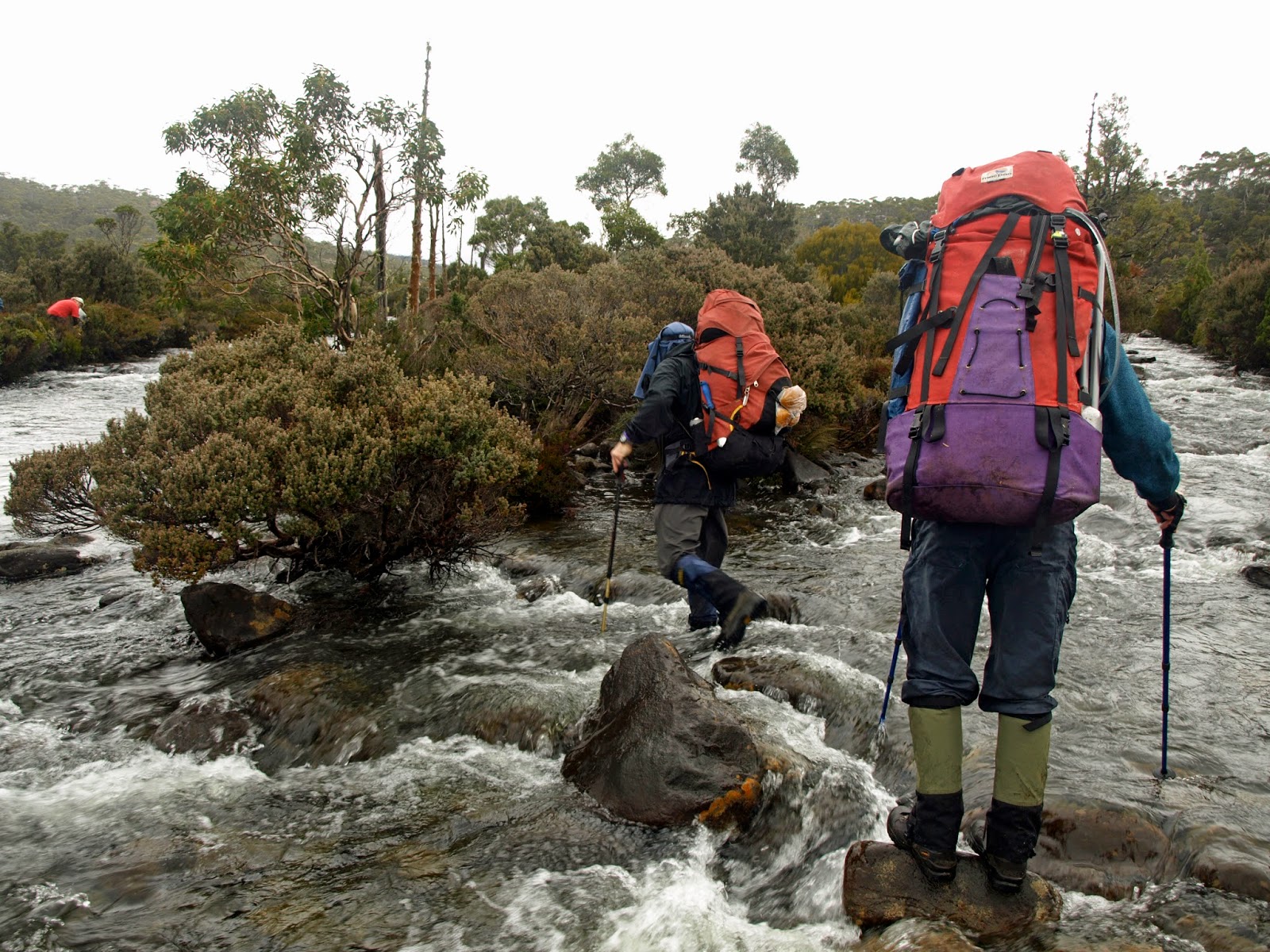
10. Cross that flooded creek no matter what!
I’ve already told you that a bit of moisture isn’t going to kill you. I’m not one to let a bit of flowing water intimidate me, or stop me from getting to my campsite on the other side. Just plunge on in and keep going, I reckon. Anyway I’m not a bad swimmer.


[A creek crossing: what could possibly go wrong?]
 
11. Never underestimate your abilities
I take learning seriously. It’s very important to think that you can work everything out on your own. If you stopped to ask for help every time you struck a hard patch you’d never improve your own abilities. What kind of wimp ever admits that he’s in trouble?!

* * *


As you can see, there are a good many dumb ways to die while bushwalking. If you’re as rigorously gormless as my dumb friend, there’s a good chance you’ll never even be bothered by the sound of the rescue helicopter. It’ll all be too late.

Sunday, 6 July 2014

Just Add Snow: Part 1

I was recently interviewed on radio  in the line of duty  about bushwalking in winter. The interview covered things like appropriate clothing and suitable tracks for Tasmania’s cool season. But the S-word did come up, as it inevitably will in winter.


[A Christmas snow-dome: our fantasy of snow?] 
Snow is a word freighted with thrills and chills. Yet while we join the world in enjoying the aesthetic lift a covering of snow gives a landscape, it seems Australians are oddly naïve about the real thing. Think of our plethora of kitsch snow-domes, with snowy scenes of places as unlikely as Uluru and the Great Barrier Reef!

Perhaps we should blame it on the weather in our big cities. Winter in places like Sydney and Melbourne can be as miserable as anywhere in Tasmania. But being that few degrees warmer than Tassie, and lacking nearby mountains, those cities miss out on our snowy compensations. (Although they do boast their own snow-domes.)

Having snow, we Tasmanians can readily step outside the dome and get acquainted with the reality. Lynne and I spent our first Tasmanian winter in Fern Tree, the highest suburb in Hobart. It nestles into the slopes of kunanyi/Mt Wellington at an altitude of over 400m. When forecasts speak of “snow in elevated suburbs” you can bet that includes Fern Tree.


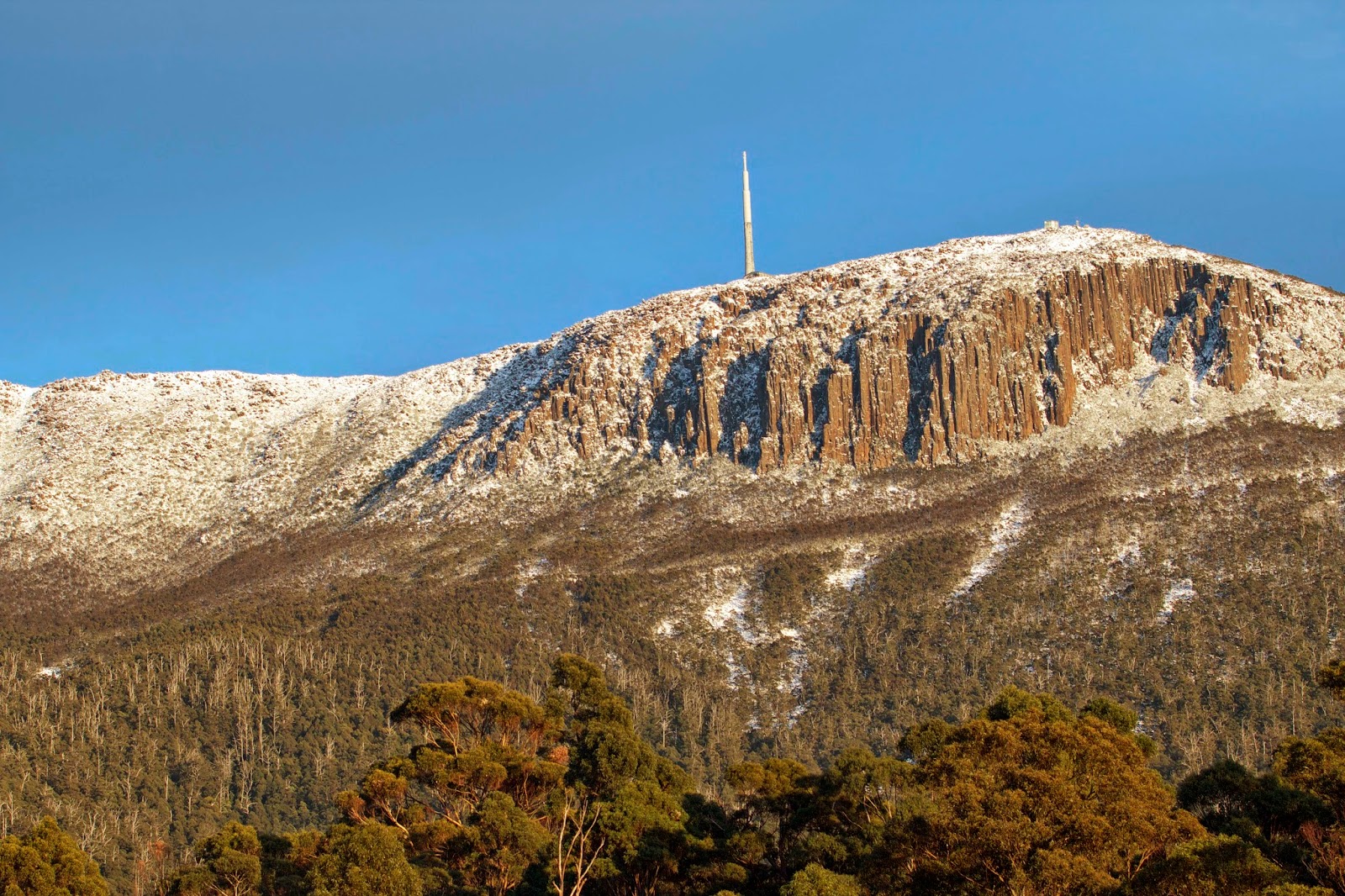
[A dusting of snow on the slopes of kunanyi/Mt Wellington] 

That year was 1980. We’d come from mainland Australia expecting our first child, and with our “fur-kid” in tow. Wuppy was a border collie/kelpie cross, a smart and lively dog, bred to round up sheep on the western plains of NSW. If we were naïve about snow, he was utterly clueless. After our first decent fall, we let him outside for a look. He stood there wide-eyed, barked, looked uncertainly back at us before bounding out into the snow. He then barked some more before repeatedly biting into the “big white thing” that had invaded his space.

Gradually we have become more closely acquainted with Tasmania’s infrequent, unreliable yet delightful snowfalls. We even choose, at times, to bushwalk in it. 

One winter a group of us heads into the high country north of Lake St Clair, despite a bushwalker’s weather alert warning of snow. We have all the right gear: good waterproofs, down jackets, tents, winter sleeping bags and plenty of food and cooking gear. We plan to sleep in a hut and are walking on a well-known track. What could possibly go wrong?


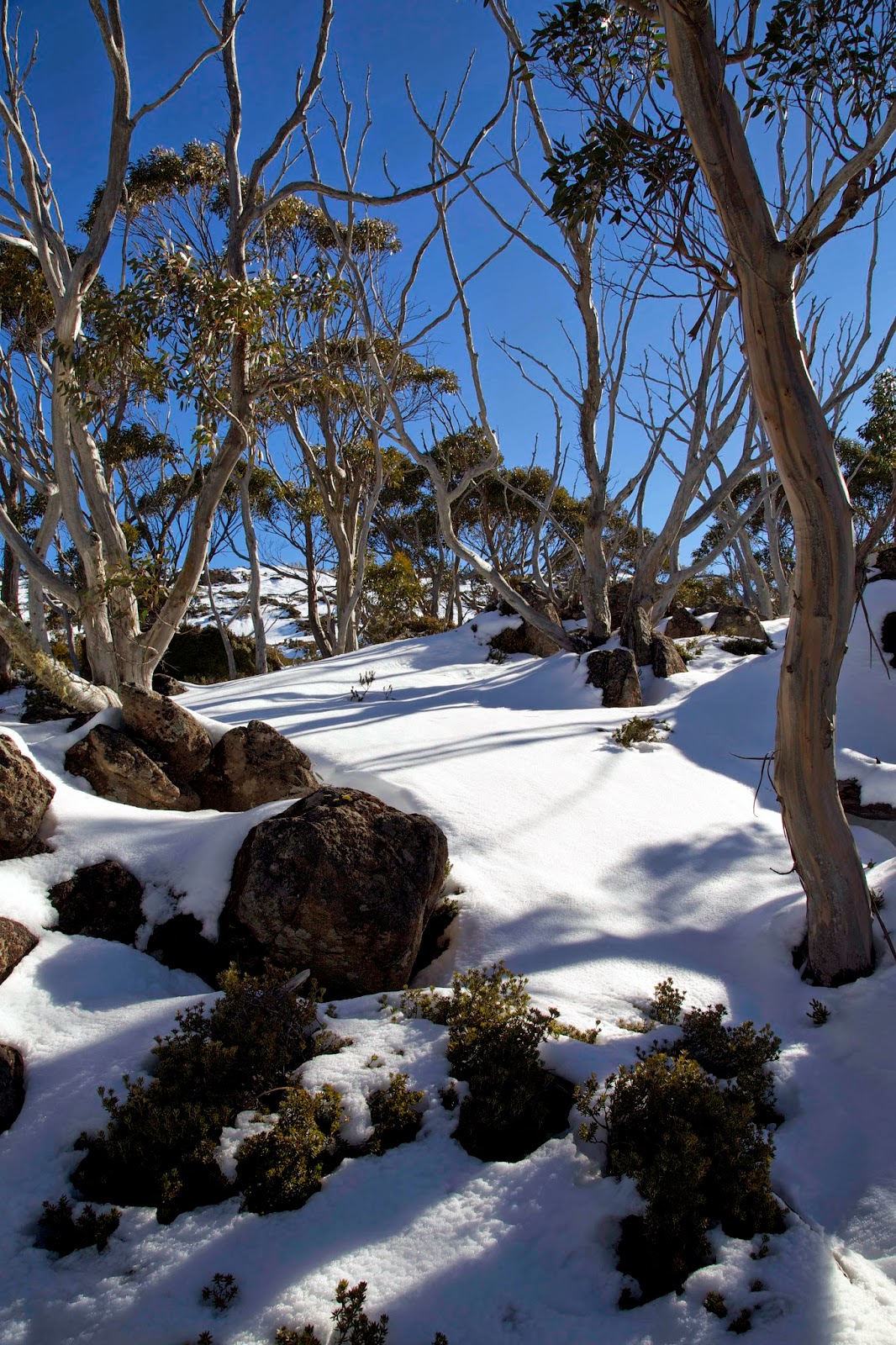
[A picturesque amount of snow: Mt Field National Park] 
The short answer is: quite a lot. Deep snow can make your progress perilously slow; it can exhaust you; disguise the track; cause you to miss a hut. Icy conditions can easily lead to slips, falls and injury. And an immobilising injury in freezing and snowy conditions can quickly become much more serious.

We’re not oblivious to all this. We mindfully, carefully walk on through a magical snowy forest. Its trees shield us from the worst of the freezing winds. The snow is of the slushy Tasmanian variety: not deep enough to delay us; not hard enough to crunch beneath our boots; just slippery, soft and endearingly squeaky. As we trudge beneath snow-laden branches, the occasional barrow load of snow plops down around us: a harmless form of Russian roulette.


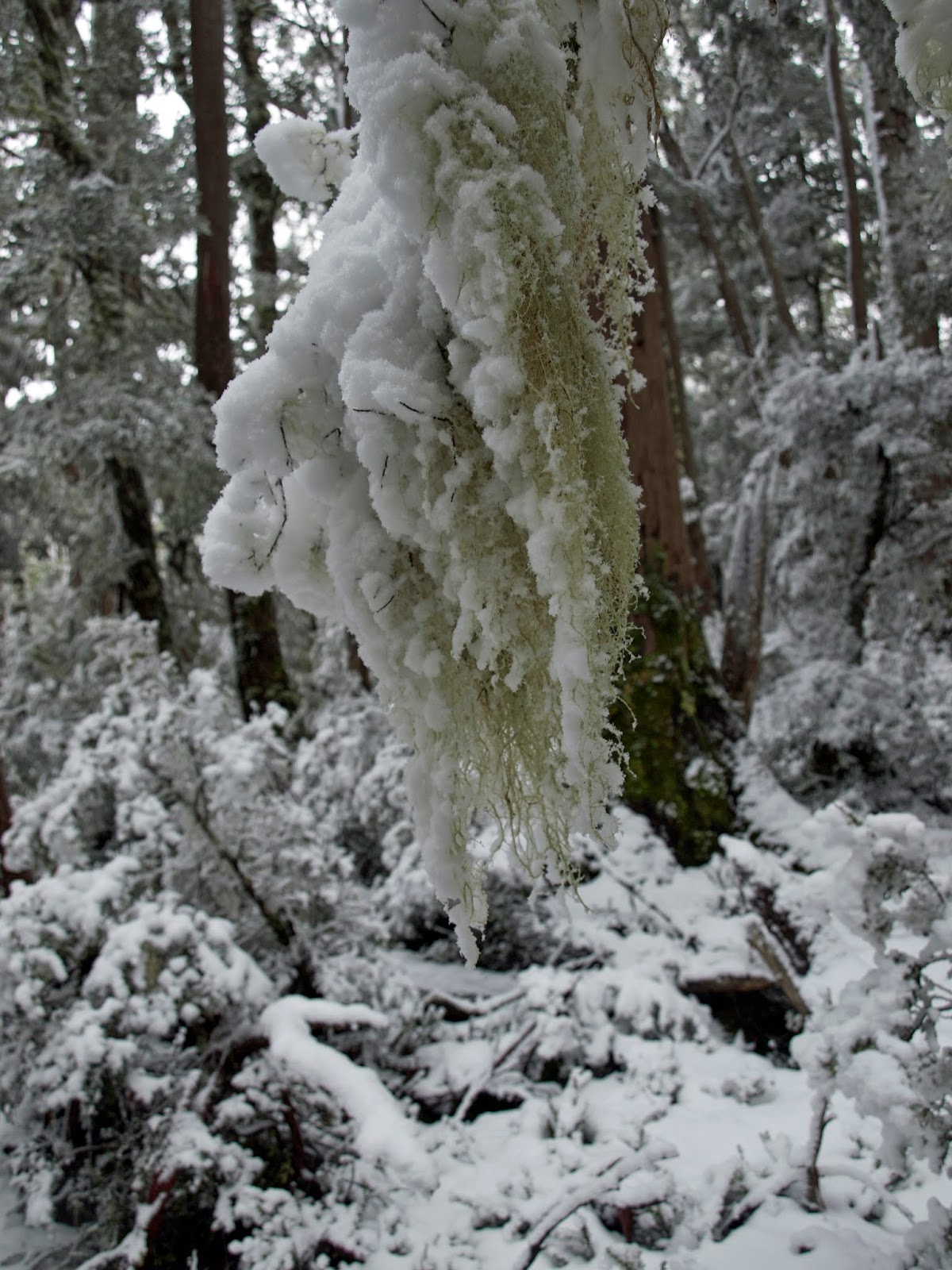
[Old man's beard and snowy forest near Windy Ridge] 
We play a more favourably-loaded, but far more dangerous form of that game on a snowy walk in New Zealand. As we approach a steep, sidling bit of track we see a prominent sign. With typical Kiwi candour, the sign warns us not to stop between this sign and the next. A local tells us this is an avalanche zone that's especially active in winter and early spring.


He cheerfully adds that a football-sized chunk of snowy ice whizzing down that vast slope could take our heads off. This is a little worse than risking  a bit of snow down our collar. Even though it’s late spring, and the snow is thin, there’s an extra zing in our steps as we cross that slope! We’re not keen to meet the hard reality of snow literally head-on.