Showing posts with label climbing. Show all posts

Sunday, 25 September 2011

Climbing With Darwin


The summit of Kunanyi/Mt Wellington from the southern side 

In February 1836, while on the voyage of the Beagle, Charles Darwin climbed a mountain. It happened to be Tasmania’s Mount Wellington. For years it had been blandly labelled Table Mountain, but in 1832 it was renamed in honour of the victorious Duke.

Darwin’s ascent of the mountain took him five and a half hours. He blamed this slowness on the “stupid fellow” who guided him via the wetter gullies on Wellington’s southern flanks, rather than up the drier northern slopes.

I look out on those same wetter slopes from my writing desk. Although much has changed in the 175 years since Darwin’s walk, the gullies remain damp. It gives me some sympathy for the man struggling up the same creek lines that harbour the same tree-ferns, that produce the same “gloomy shade”, he described.

But Darwin also carried some of that gloom with him. He had been at sea for nearly five years on what was supposed to be a three year voyage. Sea sick, home sick, perhaps sick-at-heart over the implications of his ideas, he was described by the Beagle’s Captain FitzRoy, as “so much the worse for a long voyage”.

Certainly he was in no mood to be impressed by Hobart and its mountain when the Beagle docked. After comparing the town unfavourably with Sydney, he went on to describe Mt Wellington as “of no picturesque beauty.”  Yet he was still determined to climb the mountain. And rather than be easily put off, Darwin made two attempts to reach the summit, succeeding only on his second try.

On that fine and warm February day he was kitted out in walking clothes that would horrify the modern walker. They were basically the same as any 1830s gentleman’s street clothes. Ankle length woollen trousers were tucked inside leather boots; a coarse long-sleeved shirt and woollen waistcoat covered the body; a neckerchief covered the throat; a sunhat covered the head. He may well have discarded his heavy outer coat and pocketed his neckerchief, but his clothes would still have been heavy and cumbersome, his boots poorly suited to mud and slippery surfaces.


Dicksonia antarctica: lover and creator of "gloomy shade" 

I picture him on those slippery slopes, a scratched, muddied, puffing, sweating gentleman, tetchily at odds with his incompetent guide. Certainly in his journal he summed it up as “a severe day’s work”.

But once at the summit Darwin seems to have recovered some of his appreciation of life. “The day was splendidly clear, and we enjoyed a most extensive view” he wrote. He stayed on the summit for some hours, not returning to Hobart town till around eight in the evening. I smile at his inability to resist noting in his journal that he’d found a better way down.

Nonetheless I resist poking fun at the famous gentleman from this safe historical distance. It may seem fair to say that getting to the top of this particular mountain is nothing out of the ordinary. But in the context of his time, his health, his equipment, his food and the rigours of a long sailing voyage, he showed great stamina. Not many of us actually continue to push ourselves; to explore; to edit out the pain and sweat; the march flies, the heat, the sleet, the wind, the fog, the fear, the fatigue or whatever else might be involved in getting to a mountain summit.

That stamina in itself is enough to earn some small esteem from me, a fellow walker who has trodden some of the same fern gullies, reached that same unspectacular yet uplifting summit. That alone I can admire. And of course there is the person who this Darwin became, the famous Darwin whose mind and body ranged over some of the wildest terrain, and grasped at some of the hardest ideas possible.

But there is another Darwin, a kind of ghost-Darwin - one that is far more like you and me - that I fancy is always climbing that mountain. It mutters its way up the gullies; it heaves towards those summit cliffs; it humphs at inept companions; it mulls over its deep and dangerous thoughts; it is uncomforted over the absence of its loved ones.

Perhaps one day it will reach that summit again, and get some sense of rest and peace as it looks out over a world far grander than it - or any Darwin - could imagine.


Charles Darwin around the time of the Beagle's voyage 

Tuesday, 27 October 2009

Cradled

[a beautiful day in a beautiful place - with a sting in its tail!]


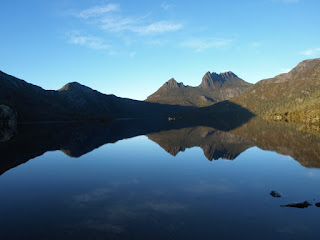
[Cradle Mountain reflected in Dove Lake]

At 1545 metres, Cradle Mountain is Tasmania’s fifth highest mountain. That’s not particularly high, even by Australian standards. But by those same standards it is a delightfully shaped mountain, satisfyingly “peaky”, and justly famous for its lopsided twin towers separated by a hammocky ridge, the whole often reflected in the flawless waters of Dove Lake.

I’ve succumbed to the appeal of its summit at least four times over the last three decades. Each climb has been different, but the most recent was more eventful than I’d have preferred.

Three of us were there – with dozens of others – on a rarely-perfect October day. There had been so much rain over winter and early spring that the creeks here had begun to flow clear instead of their normal beer colour, the tannins diluted to the point of invisibility. And if it wasn’t raining, wind and snow showers had gone to work. But on this day the weather gods had put aside their tools and gone for a smoko.

The mountain draws many walkers, not all of them ready for the challenge. We passed a number of walkers having difficulties with the steep dolerite scree that leads to a snowy amphitheatre beneath the final tower. One couple chose, not unanimously, to be satisfied with the northward view from the scree rather than the 360 degree summit vista. While there is nothing technically difficult about any of the scree, it does involve a certain amount of rough-house hauling of yourself up fridge-sized boulders. The contrast with the duck-boarded approach walk is too stark for some. On the other hand the dozens heading for the summit this day included children as young as seven or eight.

Once over the hump of the scree approach, there’s a steep side-slope to traverse. Except in the height of summer there is usually some snow here on the south-east facing slopes, over-towered as they are by tooth-like pillars of dolerite. The day was mild and sunny, so at this point the metre deep snow was soft and slushy. We took out trekking poles to help with balance and gingerly began to cross the side slope.

A year ago, almost to the day, I had paused here with my son and sons-in-law to slide down the forty degree snow slope in our wet weather gear. The few seconds of exhilaration had to be backed up by a far longer and more tedious slog back up the slope. Twice was enough for me, although some of the next generation tried it a few more times.

This time we were intent on the summit, so we by-passed the obvious sliding section. I was in front, and began to head up the very steep climbing chute, choosing to go to the left of a large rock. I remember gripping the rock with both hands, although one must have also been holding the trekking poles. From that semi-fixed position I kicked a step into the snow just beneath the boulder, and tested it briefly, before trying to heave myself upwards.

The step held only until I put real weight on it, then gave way, sending my left foot a metre lower than I was expecting it to be. That ripped my hands from the rock, flipped my feet skyward, and sent me careening backwards down the slope. I completed a one and a half backward somersault, landed on my back, then slid head first down the chute at what might have been described as an exhilarating pace. Did my life flash before me? Did I pray, or fling my arms over my head for protection? I quite honestly didn’t have time to do anything more than to think “Oh ... my head is likely to stop me by hitting a rock!” I’m not even sure an expletive popped into my mind, although I can think of a couple that would have been very suitable.

After a very rapid slide of maybe 25 metres, I stopped quite suddenly as my back – thankfully cradled by a day-pack – crashed into a suitcase-sized rock. I lay there, for the moment pain-free, thinking “ooh – I think I’m alright”. I then conveyed the same in response to Jim and Tim’s yelled query. Their next shouted words disconcerted me. “Don’t move!” Spinal injury? A huge drop just beneath me? No. “Gotta get a photo!" followed by “Bugger! Wish we’d got that in movie-mode.” Then I knew I was going to be okay.

A few careful minutes checking myself, talking with the boys, and righting myself, was followed by an extra cautious crawl up-slope to the start of the climbing chute. Twenty minutes later we were out on the summit - the sun shining, the breeze a mere zephyr - with me yabbering nineteen-to-the-dozen as you do when the adrenaline kicks in after even a mild shock.

And at the end I had no badge of honour, not even a decent bruise, to show for my troubles. Being joined on the summit by three youngish girls and their family seemed to underline that we had done nothing even slightly heroic. I think I can get over that. Two days later, such thoughts are already being replaced by a strong thankfulness that I was somehow cradled during my fall. I will live to walk another day, God willing!

Sunday, 19 July 2009

Federation Peak - Part 1

[part 1 of a 15 part series describing an ascent of Tasmania's Federation Peak]

1) A Mountain on My Mind

Hobart, Tasmania, January 1991

Tasmania’s Federation Peak lurks at the back of every Australian bushwalker’s mind. It is the mecca, the holiest-of-holies for those who seek for what is high, wild and scarce in our otherwise wide brown land. In my case Federation even sits, icon-like, at the side of my desk in the form of Jim England's 1980-something black and white aerial photograph. A sign and symbol of Tasmania’s south-west wilderness, a shrine that draws my mind to those special mountain realms during moments of reflection or distraction.

But holy or not, I know there’s a difference between shrine and reality. I am unlikely ever to experience the real city of Mecca. But I have no doubt that my level of preparation, the company in which I travel, the time taken to get there, the smells, the sounds, the weather; the time of day, the state of my gut and the frame of my mind; all of these would colour my actual experience. It is a pilgrimage whose outcomes are not always those expected or desired. It is not to be taken lightly.

Nor is Federation Peak. It is a serious mountain by Australian standards, a mountain which has claimed lives. Climbing it takes careful mental and physical preparation. After more than a decade of walking in Tasmania, it is one walk for which I am still not ready, even in my late thirties. No, if ever I am to walk to Federation Peak, if ever I negotiate that final massive fang of rock, it will only be when I am considerably fitter and better prepared than I am now. It will have to remain the mountain at the back of my mind.

But then my mate Jim rings proposing a trip to Federation. I am an unemployed husband and father of three young children. That has brought plenty of fears and challenges of its own, but Federation Peak? That is another beast altogether; one quite beyond my current strength. I mutter something about needing years – or at least months – of mental and physical preparation. But Jim isn’t really listening. He says we have the chance now, and as I’m on the “long holiday” of the unemployed, he won’t accept any excuses. I somehow find myself agreeing to go. It only hits me later that we leave early next month. Immediately a knot begins to form in my gut.