Tuesday, 20 March 2018

Crossing the Plateau 2: Downtime


There are some activities that you would immediately associate with off-track walking in the Tasmanian wilderness. Lolling about, playing cards, daytime snoozing and planking might not be among them. When day 3 dawned on our walk across the Central Plateau, those things weren’t uppermost in our thoughts either. Rather, once we’d conferred about when to leave and how far to go, we expected to walk further into the unknown.


[Conference time: Pencil Pine Tarn] 
The forecast was for wind and rain, but mostly later in the day. So getting going early, and finding a sheltered campsite before the change, seemed the obvious choice. But after breakfast, with an ominous build up of cloud and a rising wind, our group conference took an interesting turn. We outlined the options, then asked each person to express their preference. Nearly everyone was for packing up and leaving, albeit without huge enthusiasm. But at the end of the discussion one walker mentioned some hip discomfort after yesterday’s walk. When we combined that with our general ambivalence and inertia, we unanimously reversed our decision. We would stay another night in the shelter of this lovely Pencil Pine Tarn campsite. Ain’t democracy grand?

Having decided we weren’t going anywhere, we promptly went for a long walk around our home lake. We figured rain and wind might soon make that impossible, or at least unpleasant. Apart from anything else, I was curious to see if there were any other campsites near this tarn. (The short answer was yes, but our’s was definitely the Paris end of town.) Nonetheless we found some other fine stands of pine, and a few delightful pools. We also disturbed some swans and their cygnets, and the odd wallaby.


[Mick explores a nearby tarn] 
At one stage I found three of our party down on hands and knees, intently looking at something. I joined them, and found a very large, oddly-coloured katydid. 


[What have we here?] 
It was a mountain katydid (Acripeza reticulata), new to us but apparently common in eastern Australia’s high altitude grasslands. When they’re threatened they lift their wing-covers to reveal bright crimson and blue stripes, and the males emit a warning call. We mustn’t have threatened them overly, as they allowed us quite a close inspection before continuing about their long-legged business.


[A female mountain katydid - photo: Mick Adams] 
Despite our decision to stay another night at our tarn, a few of the group couldn’t resist reconnoitring the potential onward route. Tim D deployed his phone’s map app – a better option than a paper map in the strong wind that was now blowing – and tried to match what we could see with the terrain shown on the map. From where I stood, I was pretty sure I still heard “southish” and “westish” mentioned.


[Discussing our navigation options] 
With tomorrow’s navigation nailed (!) we circled back to the campsite, and settled down to a brew and banter session. At such times our talk normally centres around food (briefly) and bushwalking gear (at great length). But this time our gear chat unaccountably faltered, and we somehow found ourselves talking about walking fitness, including core strength.

Now up until a few years ago, I didn’t know humans had cores. I thought that was purely an apple thing. But I’d recently discovered not only that I had one, but that it could be strengthened. Even more, I’d found that as I get older and my muscle tone isn’t quite what it once was, having a strengthened core is a “good thing”.

So I breezily mentioned my discovery of core-strengthening exercises, and notably planking. What ensued was an hour of (mostly) harmless fun, as we started a plank challenge. While no-one in our group would confess to being competitive, they lie! An hour later, after much pain and huffing, we declared Ken the winner of the Pencil Pine Tarn Plank Challenge. He had somehow managed to hold a plank for 4 and a half minutes. Merran and Libby were the other medalists, not that anyone was being competitive, of course.


[TimO perfects the "tired and prone" position] 
The rest of us took some consolation in our ability to lie prone for even longer. TimO seemed particularly happy to adopt and hold the prone position, even if some claimed he had simply collapsed in an exhausted heap. Either way, he set such a good example that I decided to try the same in my tent. Unfortunately it didn’t work that well, as the next (non-competitive) activity – four-handed 500 beneath the close-by tarp – soon got very raucous.

Late in the afternoon the promised wind and rain gatecrashed the party, and the 500 players retreated beneath the larger tarp. The rest of us stayed tent-bound. And now we could all appreciate the wisdom of staying here an extra night. While the rain pelted down, and the wind roared around us, our tents stayed well protected. We even managed to cook in between showers, and socialise for a time over dinner.

Fresh showers finally drove us – not entirely reluctantly – back to our tents. And before the light had fully drained from the sky, I’d drifted back to sleep. Downtime can be tiring, you know.

Wednesday, 28 February 2018

Crossing the Plateau 1: Starting with the Known


So I am on the plateau again, having gone round it like a dog in circles to see if it is a good place. I think it is, and I am to stay up here for a while. – Nan Shepherd
How blithely we speak about mountaintop experiences, as though there’s nothing but serenity to be had on summits. Certainly I’ve experienced joy, and elation, and a good degree of satisfaction on getting to the top. But like most walkers and climbers I know, I have a dirty little summit secret. Even as I sit there my serenity is tempered by restlessness. I simply can’t resist planning where to go next.


[The Mountaintop where it began, looking to the Walls] 
That’s exactly what happened last December, when four of us sat on top of an unnamed mountain near Tasmania’s Blue Peaks. As our eyes scanned the wide horizon, they were magnetically drawn towards that other favourite walking area: the Walls of Jerusalem. How about we walk across the Central Plateau from Lake MacKenzie via the Blue Peaks and on to the Walls?

If that was the germ, the infection soon spread. Those who hadn’t been on that December walk all wanted in. Via email we discussed potential dates and other logistics. That’s usually where the drop-outs start happening, but not this time. While some of us had previously walked into the Walls from Lake Ada or similar, this exact route was new to us all. And no-one wanted to miss out.

The logistics of making this a one-way walk already required some mental gymnastics. Added to that two of our walkers needed to come in late on the first day, and leave a bit earlier at the end. So the plan was to pick up one of their cars and take it, along with one of ours, to leave it at the Walls carpark. That meant starting off in three walking groups, the car shuffle walkers, the non-shuffle walkers, and the late walkers. Confused? So were we, but it all worked out.


[Sunset-lit clouds, Blue Peaks] 


One of these times we’ll get to “our” Blue Peaks campsite and find someone already ensconced. (Note to self: stop extolling the virtues of this place!) Thankfully, given we were a large group, this wasn’t such a time. In dribs and drabs we finally got to the site, and settled ourselves for the adventure ahead.

If our minds had been ruffled by travel and logistics, the sunset from our campsite smoothed and soothed them. The stunning light show went on for nearly an hour, after which Tim D and I got down to discussing walking route options. 


[Sunset from Blue Peaks campsite] 
All involved the unknown, as well as the unnamed: that is the unnamed peak that was the site of the walk’s genesis. We traced a vague route on the map that would take us between Turrana Heights and the unnamed peak, then down towards Lake Lexie. After that things got fuzzier, with words like “southish” and “westish” featuring. But we did know that we were heading towards Mount Jerusalem, and that we’d have to dodge plenty of lakes and any thicker bits of forest or scrub. Tim’s other general thought was to stick to higher country, to avoid both bog and scrub. Given low water levels in the lake near our campsite, we figured boggy ground wouldn’t be much of an issue.

It was strange to be packing up to leave Blue Peaks the next morning, given it was usually our base for a number of days. Strange too not to know where we’d be camping that night. Internet searches hadn’t revealed a lot about our route, but then that was part of the adventure. We knew about a very old cattle drove route known as Ritter’s Track. But as well as it being south of our intended route, we also knew it was sketchy. And while there were sporadic cairns along the route, the ground trail itself wasn’t likely to offer better going than off-track walking. So off-track it was, firstly around our nearby lake, then off via Middle Lake and Little Throne Lake towards the unnamed peak.

Although slowed a little by carrying full packs where we normally took day packs, the going was easy, especially as the lakes were so low that we could cut across them at times. A couple of hours in, and just before the climb that would have taken us up our unnamed mountain, we veered “westish” and dropped down to a small, pine-encircled tarn. We were now officially walking where none of us had ever been before.


[Low tide on Lake Lexie] 
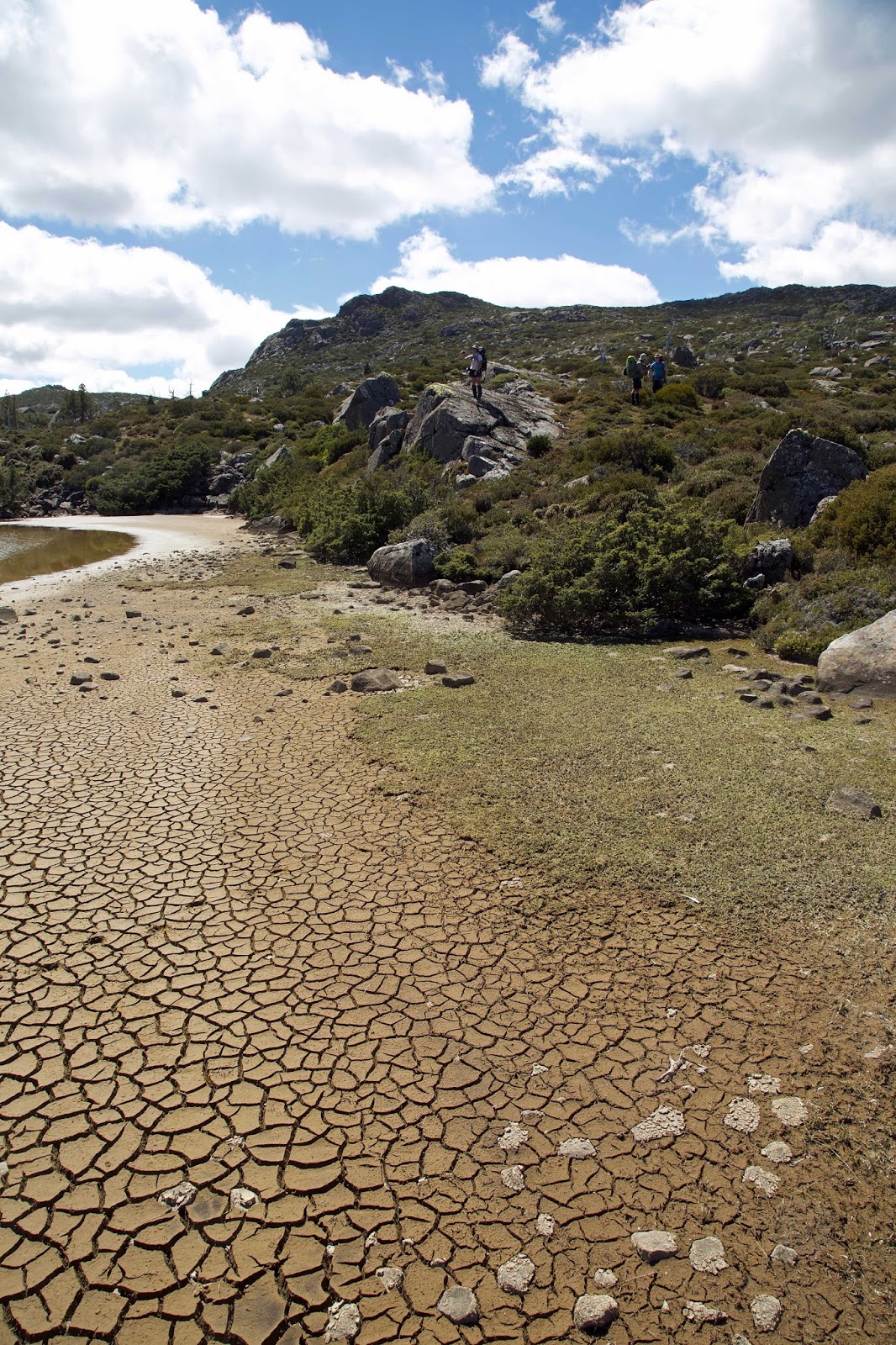
The weather was clear, the sky blue, and out of the stiffish breeze the day was growing warm. After a short scroggin and drink break, we hoisted packs and walked on towards the more sizeable Lake Lexie. We dodged around its long and sometimes convoluted shores, the shallowest of which looked like mud flats at low tide. Some parts had dried and cracked so much that they gave a convincing impression of a desert.


[Yes, the Plateau was dry!]  
Towards the end of Lake Lexie we found a lunch spot that offered some shelter from the growing wind. As we ate we discussed how far we should walk before settling for the night. Opinion here was divided. Some were keen to start looking for sites sooner rather than later; others wanted to head as far towards Long Tarns as we could, knowing that late tomorrow the forecast was for rain and wind. The Walls themselves offered more shelter, if we could get there before that expected weather change.

Sometimes, however, a gift horse appears. And that was the case when we came to Pencil Pine Tarn. To my mind, it being only 2:30pm, this was a bit early to stop for the day. But once we’d wandered up slope to the pencil pine forest that had given the tarn its name, we all decided we’d be mad to miss the chance to camp here.


[The sheltered campsite near Pencil Pine Tarn] 
The beautiful, ancient-looking pencil pine grove offered superb shelter from  nearly every quarter. The site had obviously been used before, with logs and rocks arranged as camp furniture, and (sadly) signs of a past campfire. Apart from fires being illegal across this whole “fuel stove only” area, I shudder when I see signs of fire anywhere near these irreplaceable pencil pines. But I calmed down once I’d spent a few minutes among the pines, breathing in their rich, resinous scent. It seemed we had landed on our feet with this campsite.


[Relaxing at Pencil Pine Tarn camp] 
Once we’d set up tents and tarps, Tim O and I declared we were going down to the lake for a swim. There were two surprises with that. Firstly everyone else said they’d do the same, and secondly the water proved to be only a foot deep, with the tarn bottom’s mud about the same depth. So our “swim” ended up being a hilarious exercise in getting both wet and muddy. At best we managed to float on our backs, propelling ourselves along like inept, over-sized otters. Still a wash is a wash, and even Jim – not a keen swimmer – stayed in the whole time. We all came out glad he’d made the effort, and more than happy to settle back in to our brilliant campsite.

Monday, 26 February 2018

Celebrating 50


-->
At the crowded end of the year; the party end of the year; the too-much-to-do-and-not-enough-time-to-do-it end of the year, my mate Mick came up with an unusual idea. Wanting to celebrate 50 years on earth in a way that didn’t feel like all the other celebrations that jostle for attention in December, he chose to go bush with some mates.

The venue was to be the Blue Peaks, and in his casual come-if-you-can style invitation to his walking friends, Mick said “I cannot think of a better place to spend a few days contemplating life, the universe and everything … Or a better bunch of brigands to spend it with.”


[A campsite for contemplation and celebration, Blue Peaks] 
Three of his thicker-skinned friends managed to put aside any offence, and carve out time from pre-Christmas schedules to join him. (In truth Mick probably has more friends than nearly anyone I know, but most were caught up in just the kind of rush he was keen to avoid.) So … ‘quality not quantity’ it was!

The four of us left Hobart a little after 7am, an almost indecently early departure by our standards. But it did give us the advantage of getting up to the Lake MacKenzie track head before lunch. We’d been walking just long enough to feel some of the sore bits, when I noticed an odd smell. At first it was very faint, but as I tweaked my pack and trudged on, I recognised it: the scent of stale smoke, of burned bush, wafting down valley from a fire that ripped through here in early 2016. Blackened bush soon confirmed that.

I would normally associate the smell with regeneration, fire usually being a means of bringing new growth to Australian bush. And smoke water – with just the scent we’re picking up now – is widely used in Australian native gardening to germinate stubborn seeds. But here, high in the Central Plateau, fire brings death.

It was sobering to experience the lack of new growth; the desolate feel; and the paucity of bird life. Yes, a few plants were making a slow comeback, but not the pencil pines. Their blackened trunks and empty canopies will stand for decades, slowly greying, as a reminder of that fire.


[Pencil pines killed by the 2016 fire] 

We were glad to get out of the fire zone, and into the untouched Blue Peaks area, by early afternoon. Once there, with our tents and tarps set up in the beautiful, familiar pencil pine grove, the bustle and busyness – and some of the sadness – started to fall away. And Mick began to beam, pretty sure that his idea was as genius as it was unusual. On a gently warm, sunny afternoon it wasn’t difficult for the rest of us to agree.


This being a first time visit for the other two, Mick and I pointed out a few of the area’s features to Larry and Ken. While we did so it struck me afresh that the most obvious characteristic of the place is actually its subtlety. Even the “peaks” of its names are understated hills more than peaks. But get your eye in here, and the light, the lakes, the clouds, the wildflowers, the birds, the distant mountains and the depth of the views, will do their work on you.

As it was only a week shy of the longest day, our evening meal was under way hours before sunset. I’d brought along a special birthday wine for Mick, and Larry had brought some brandy, so the celebrations began. Later, feeling suitably mellow, Larry and I decided to explore some of the nearby pools and pencil pines with our cameras. Mick, defying his increasing years, chose to take Ken to the top of one of the “peaks” for sunset.


[Sunset over lakes and pools, Blue Peaks] 
Next day the sun slept in. Given the low cloud and scudding showers, we followed suit. When we finally emerged, a kitchen tarp set up allowed us to breakfast and socialise in the dry for most of the morning. While mosquitoes threatened to keep us busy, they turned out keener to buzz than to bite.

After lunch we overcame our lethargy, put on some wet weather gear, and went for a wander in the light drizzle. We walked westward at a slow amble, the pace determined by the small wonders that kept gripping our attention. Scoparia (Richea scoparia) was blooming everywhere, its delightful flowers the antithesis of its dense and fiercely prickly foliage.


[Scoparia's multi-coloured blooms] 
At our slow pace we began to notice a few unusual things. Here and there we spied skinks scrambling over the prickly foliage to lick and nibble on the sweet blossoms, apparently pollinating them in the process. Wallabies too seemed to have a close relationship with the scoparia. I’ve certainly seem them supping on the sweet blooms. But we also began to notice that many of the bushes had been physically modified – presumably nibbled and trampled by the wallabies – to make highly protected nests.

Traces of wallaby fur and nearby scat mounds were further corroboration of that assumption. And nearly every “nest” – and we saw dozens of them – was sheltered from the prevailing westerly winds. That, combined with the numerous pads and pathways created by wallabies and wombats, led us to consider afresh the definition of the word farming. Such adaptations of the landscape certainly bore some of the marks of basic farming.

[Mick ponders a wallaby "nest" in scoparia] 
Wanting to earn our evening meal, we wandered further off, doing a loop around some lakes and low hills for another couple of hours. It was hardly exhausting work, but it allowed us to feel justified in further feasting once back at camp. Expensive wine, soft cheeses, biscotti, smoked mussels and oysters are hardly your usual bushwalking fare, but we’d all come prepared to celebrate!

The evening turned mellow in more ways than one, as the surrounding hills shrugged off the clouds, and wide, benign skies opened up around us again. Even the mosquitoes seemed to join in the celebration. At one point hundreds – perhaps thousands – lifted into the sky above our campsite, spiralling and swirling like a murmuration of starlings. We watched amazed, unsure what it signified, except that while they were up there they weren’t down here bothering us!

If we needed any confirmation of clearing skies, we had it when the night turned cold, and yet again I had reason to regret taking a summer weight sleeping bag into Tasmania’s high country. A freezing night might have been one reason we got going early. But there was also the sense that Mick and I needed to show the “newbies” a bit more of what the area had to offer. What better, we reasoned, than taking them via a few named lakes (Middle and Little Throne), past a named mountain (Turrana Heights), and to an (unjustifiably) unnamed peak.


[Near the unnamed peak] 
The day was a gem, in more ways than one. The deep blue sky stayed clear all day, apart from a decorative schmear of cirrus cloud. With only day packs, and in no hurry, we strolled easily from lake to lake, hill to hill, chatting, stopping for photos, or scroggin, or just because we wanted to. Still, it was well before midday that we found ourselves scrambling to the top of our destination peak. It was as sensational as we remembered, with literally hundreds of lakes dotting the plateau beneath us, each reflecting the blue sky back to us.

Over lunch our eyes roamed south-west towards the Walls of Jerusalem. On such a day those mountains seemed achievably, tantalisingly close. We looked at our maps, traced a potential route or two, then went back to our lunch. That’s how easily a trip plan is hatched … but that’s another story.


[On top of the unnamed peak, with the Walls behind] 
With so much of the day left, we thought we’d go back “the hard way”, or at least a different way, via a hill we’d never been to, and then on to Little Throne. After a while we fanned out widely, each taking his own off-track route vaguely towards Little Throne. In the process I almost literally stumbled across the most enormous cushionplant I have ever seen. The other guys were maybe a hundred metres away from me, but I just had to call them down to see this spectacular marvel.


[Part of the vast cushionplant] 
Covering an area of at least 30m by 25m, the cushionplant – more accurately a colony of cushionplants – spread gently downslope in one continuous ruckled carpet of vibrant green. The colony had dammed a small stream, creating a shallow pool upstream, with trickling flow beneath, through and around it, creating ideal growth conditions for the moisture-loving species. It’s possible it had grown here for around 800 years, a notion that staggered us, especially given their vulnerability to trampling, drought and fire. We felt humbled to be in the presence of this giant dwarf among plants, and left with the sense that its exact location should be left unspoken. Some secrets are best kept.


[Cushionplant, pool and mountains] 
Before long Little Throne came into view. Mick and I, familiar with the usual route up the slopes of this twin-peaked, mini-mountain, thought we might try a different approach. Given that we weren’t coming at it from the usual angle, that made sense. Or at least it did until we started to ascend. Then the scrub proved thick and unfriendly, and we were hot, scratched and sweating by the time we hauled out on top.

So when we finally got back to camp, we were feeling well justified in helping Mick polish off the last of the birthday food and wine. It was a fine thing to be still in that wonderful place, winding up the 50th celebrations in style. Yet for everything we’d brought to the party, we’d been given far more by this wonderfully generous place. Good choice Mick!