Showing posts with label Lake Myrtle. Show all posts

Thursday, 11 August 2022

Happy Places 2: Tasmania’s Central Plateau

The Central Plateau has been dubbed ‘the roof of Tasmania’, and ‘the land of a thousand lakes’; which is about as nuanced as calling Australia the ‘wide brown land’. There’s so much more to this wild and high part of our island state. 


It owes a great deal of its identity to dolerite, and to a massive sub-surface upwelling of that igneous rock during the Jurassic age. Almost equally its identity has since been shaped by the ice sheet that covered the surface during a number of glacial phases. That covering was more ‘doona’ than ‘sheet’, as it measured hundreds of metres thick in some parts. As that huge amount of ice, at least 6000 sq km in area, slowly jostled and crunched across the plateau, it carved out lakes – many more than a thousand – and left sharp peaks and dramatic clefts. 


[A special spot on Tasmania's Central Plateau]

 While much of that ice-age drama is over, the Central Plateau remains a vast area of largely wild high country. It’s roughly bounded by Great Lake to the east, the Great Western Tiers to the north, and the Walls of Jerusalem to the west. To the south the boundary is more vague, but perhaps the Lyell Highway marks a convenient edge. As this post is about my ‘happy places’, it’s probably okay to leave the big picture fuzzy, and focus in on the subject at hand. 


So … where on this cold, high, wet and wild plateau are my happy places? I’m particularly thinking of smultronställe, a Swedish word that evokes that sweet, semi-secret favourite place; somewhere that – particularly during these cold months – makes me smile just thinking about it.


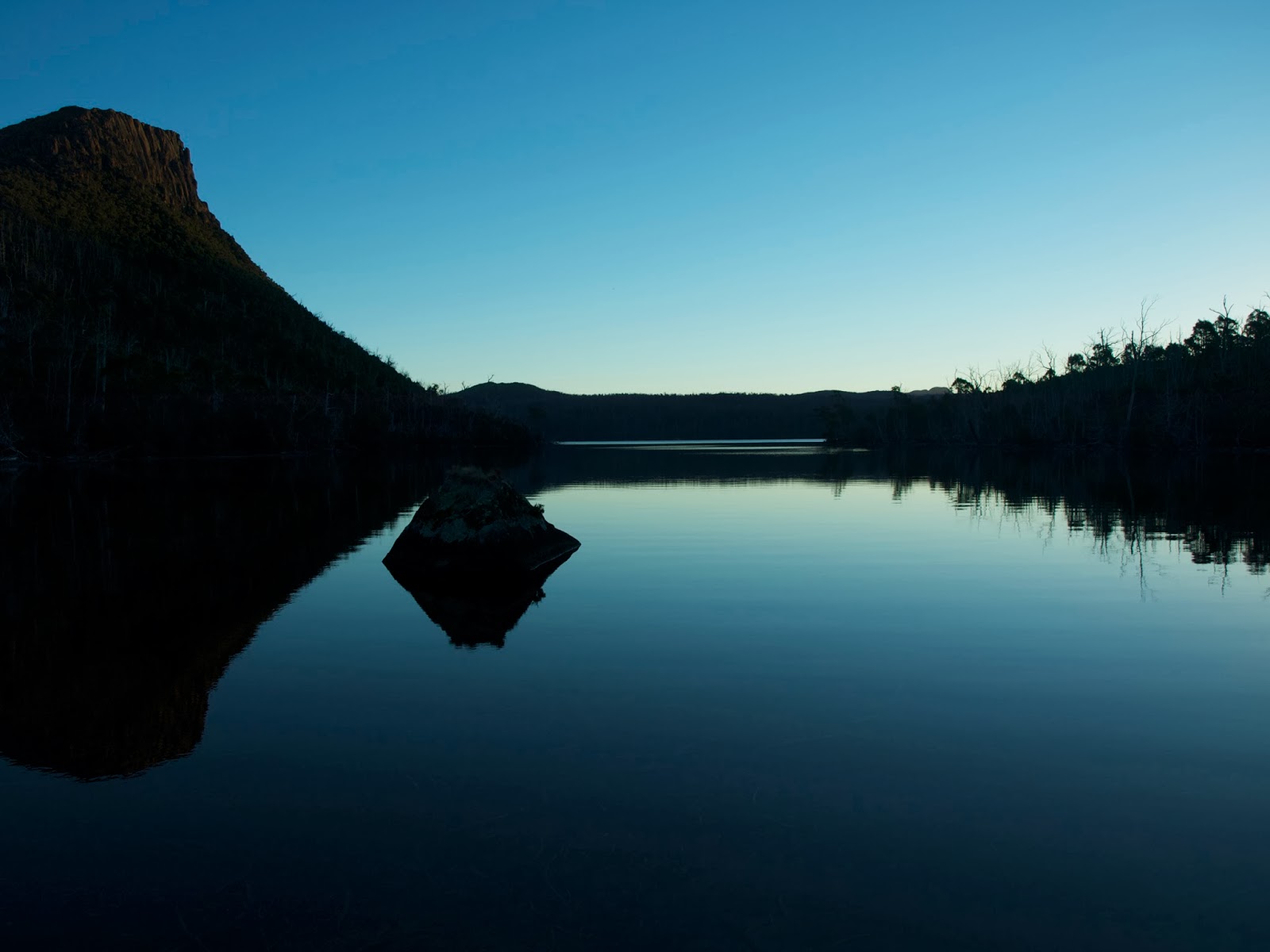
[A sweet end to a lakeside night]

 During more than 40 years of walking in Tasmania, I’ve been privileged to walk across the plateau numerous times, from every direction. I’ve written about some earlier walks here Walking With Ada and here No Lack of Lakes  All that plateau wandering makes choosing particular smultronställe as difficult as naming my favourite child. But if I had to pick just three Central Plateau ‘happy places’, they would be (in no particular order):


1.     The Walls of Jerusalem

2.     Mount Rogoona

3.     Un-named Lakes and Pencil Pine Groves


1) Certainly this choice needs some narrowing down, as The Walls of Jerusalem National Park covers 518 square km! Scattered across this mountain-fringed park are some wonderful campsites, both formal and informal; on-track and off-track. And I could have selected any of those. But because mountains are such a feature of The Walls, I’ve chosen Solomons Throne as my Walls of Jerusalem ‘happy place’. 


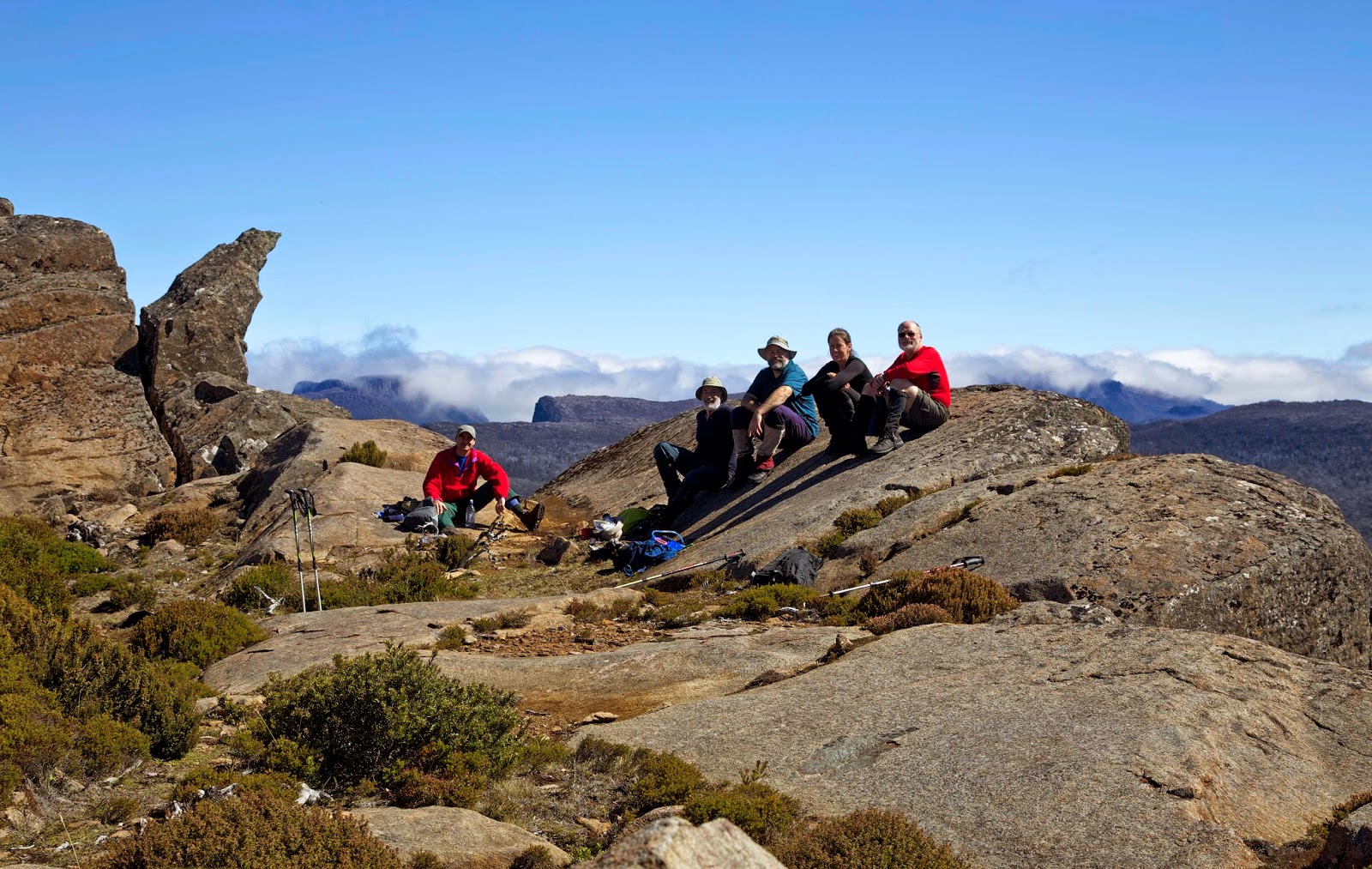
[Friends share special times on Solomons Throne]

The peak is not the highest in the park, nor is it the most difficult to ascend. What make it sit so sweetly in my memory is a combination of my experiences here, and the superb vistas from the top. I’ve been up there in thick snow, and relished views outward towards a snow-bound Overland Track, and inward to the nearby pine-fringed lakes and vales. I’ve been there with family, introducing them to the wonders of our wilds. I’ve been there with friends (many times); with first-time walkers; and with international visitors who thought Australia didn’t have mountains. While I will certainly tire during the steep climb up a rocky chute to the peak, I will never tire of sitting on the Throne.


[Looking towards the Overland Track from Solomons Throne ... click to enlarge]


2) The upper Mersey River roughly marks one edge of the Central Plateau. The Mersey Forest Rd also gives good access to one of the sweetest spots on the western side of the plateau: Mount Rogoona. I first heard about this mountain during the 1980s. A group I walked with had been planning a trip there, but a major fire burned out much of the track and surrounding areas, so we walked elsewhere. It wasn’t until nearly 20 years later that I finally reached that peak.


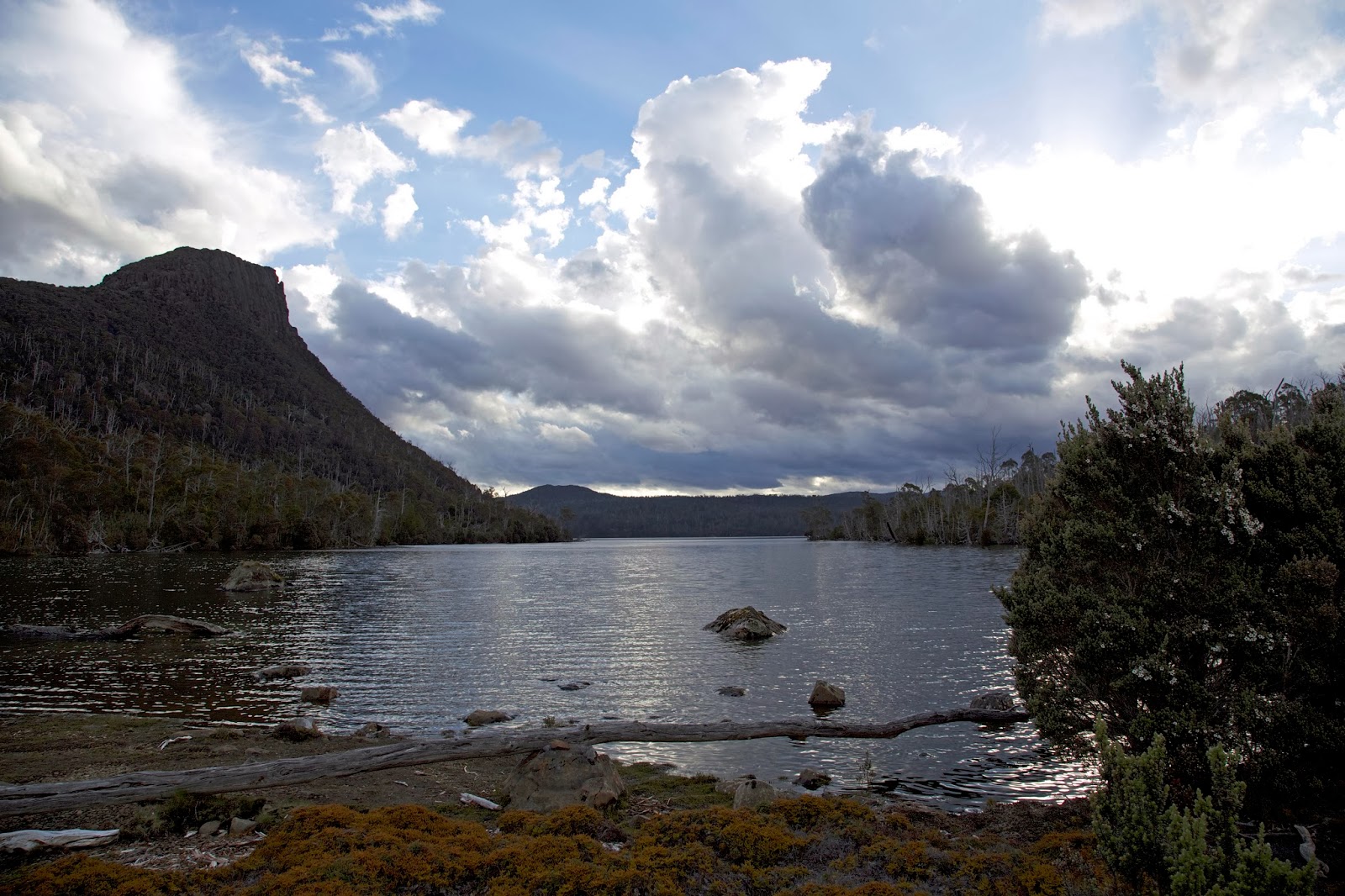
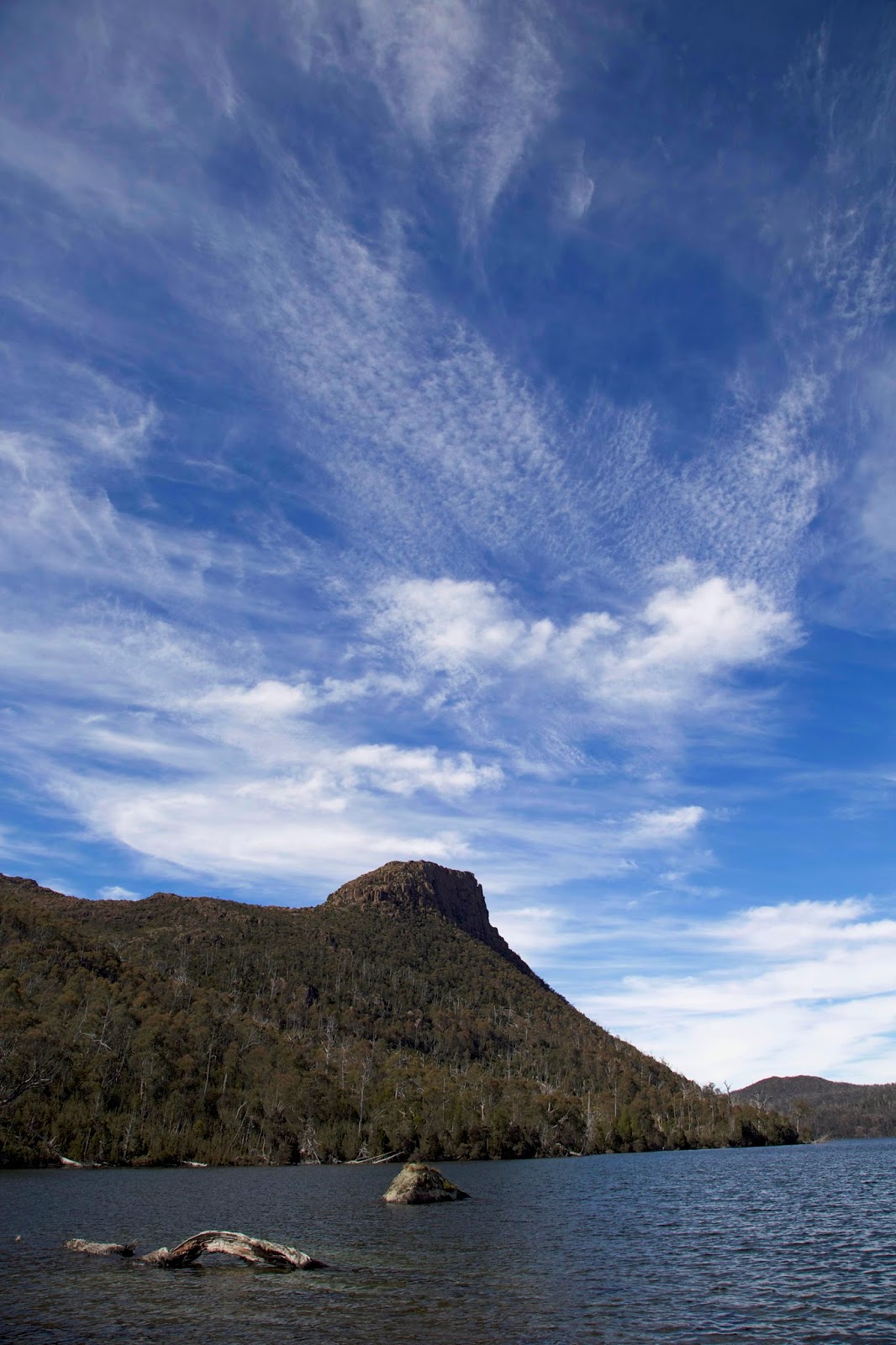
[Mount Rogoona from Lake Myrtle]

And what a peak! It sits, sphinx-like, above the waters of Lake Myrtle, its knobby summit giving way to dolerite cliffs that are like a younger, smaller sibling of the Organ Pipes of kunanyi/Mt Wellington. For most visits to Rogoona, Lake Myrtle is the most convenient camping spot. However direct access to the peak is not easy from the lake. I found this out – in reverse – when a few of us decided to return from the summit direct to the lake. I would not recommend it! Rather the track between Lake Myrtle and Lake Meston leads to an easier slant-wise route to the mountain.
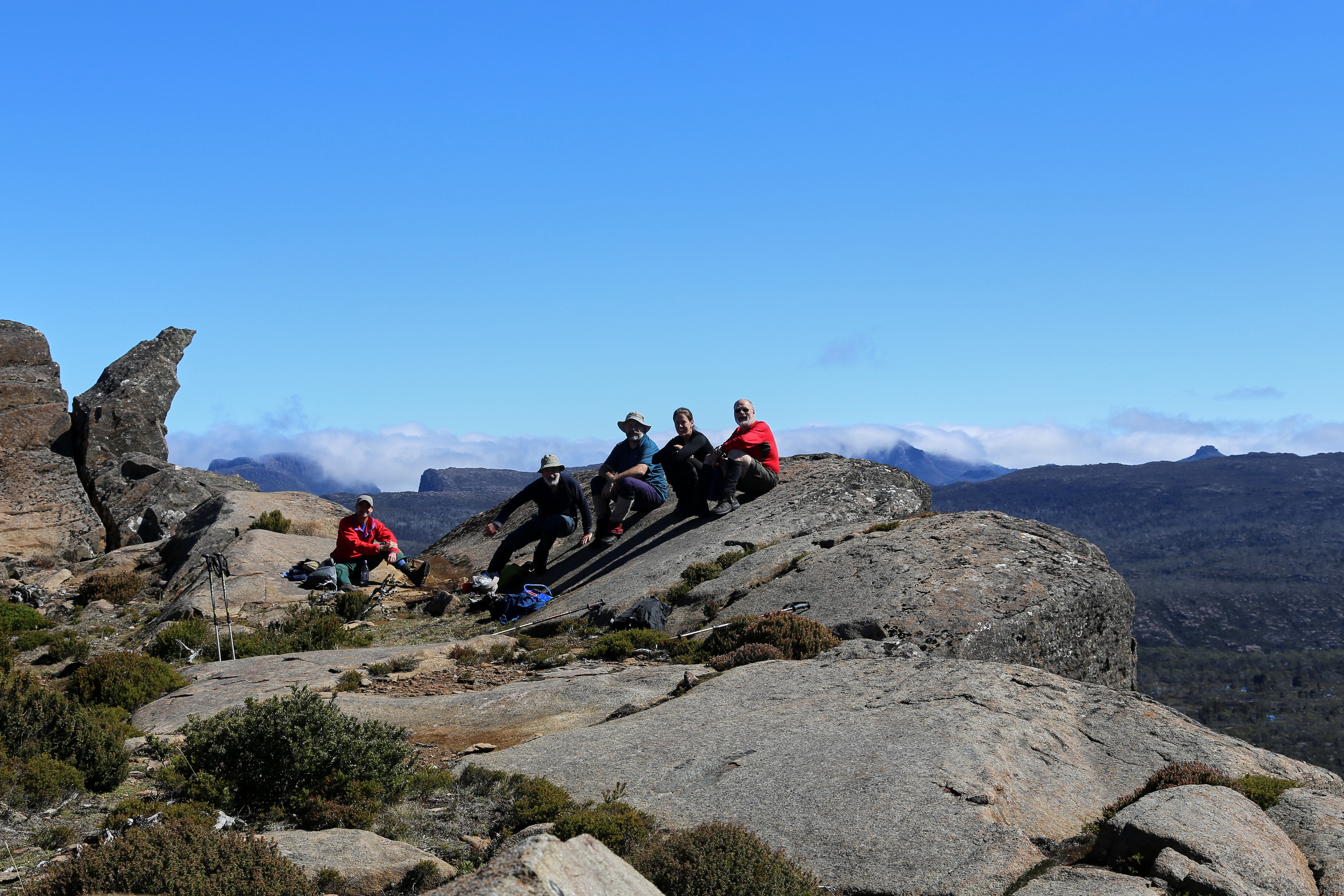


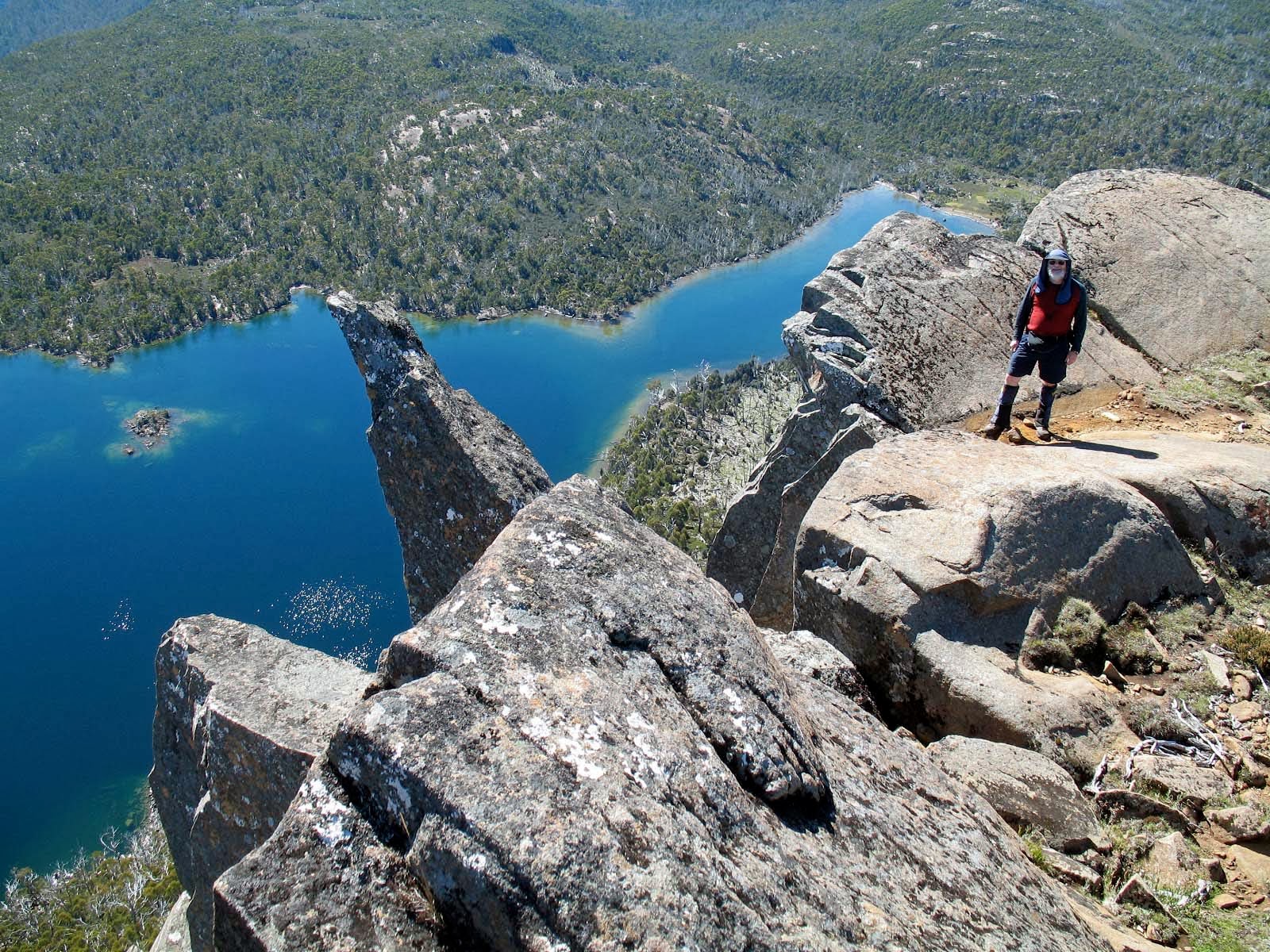
[Summit Views from Mount Rogoona]

Rogoona is essentially a small plateau whose summit is near the sheer dolerite cliffs on its north-western edge. So the views from the top are as vast as they are stunning. Steeply beneath and quite nearby is the tranquil Lake Myrtle. But your eye soon wanders west beyond the lake, over the nearby Cathedral Plateau, to the highest mountains of Tasmania, from Mt Pelion East to Mt Ossa and numerous others further south. 


Not once, but twice I’ve had that view ‘interrupted’ by a wedge-tailed eagle flying over. I’ve written in more detail here Eagle, but suffice it to say that being buzzed and eye-balled by the largest raptor in Australia is one of the greatest privileges of being in remote Tasmania. 


[Close encounter with the Rogoona Eagle]

After you’ve had that kind of mind-bending, time-stretching summit visit, there are few better places to sit and contemplate it than by the shores of Lake Myrtle. I’ve written about one particular experience here Myrtle 1, here Myrtle 2, and here Myrtle 3.


3) If the preceding ‘happy places’ would be easy to locate, the third is deliberately vague. Un-named Lakes and Pencil Pine Groves is a category of smultronställe that invites you to do your own explorations; make your own discoveries. And there could be few better places to wander in search of lakes and pencil pine groves than the Central Plateau. 


I once started the eye-watering job of trying to count the number of lakes just on the 1:25 000 Ada map. I gave up after counting 350 in one typical 10 sq km strip. Given there were 19 such strips still to count, it’d be fair to estimate between 5 000 and 7 000 lakes on the Ada map alone.


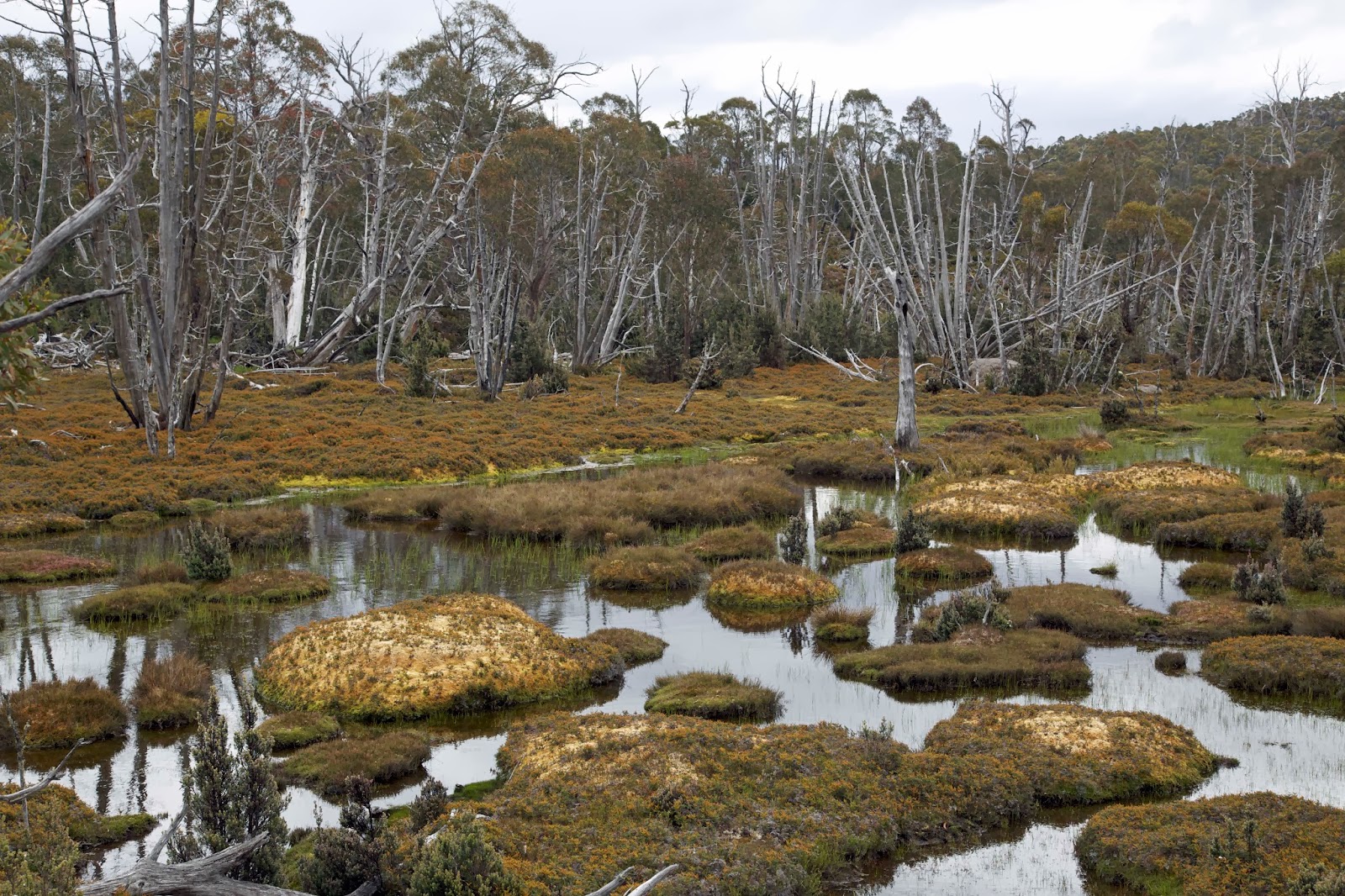
[So many lakes! A small part of the Central Plateau]


Obviously the number of lakes alone makes searching the plateau for sweet spots a lifelong task. But once the search begins, it becomes more subtle than you’d think. Lakes mean water, and many lakes mean a lot of water. That in turn means often waterlogged ground, and camping in such places isn’t much fun – not to mention the impacts it can have on that environment. In my Central Plateau wanderings I’ve seen many spots that looked great from a distance, but turned out to be unsuitably sodden once you got there and looked for tent spots. 


Happy Place searchers also have to consider another weather factor apart from precipitation, and that’s wind. The often fierce winds here further narrow your camping options. What may be a perfect site on a calm night can turn perilous when the wind gets up. Shelter is paramount, which is why pencil pines are often your friend. But there are complications here too. Many pencil pine groves are so dense that there’s no room for tents. And if there is room, the ground is often covered in dense, soggy sphagnum and/or gnarled tree roots. 


[Boots off and relaxing at a secret campsite]

 So … have I found some ‘Goldilocks Zone’ campsites on the Central Plateau? Of course I have. And I’ve spent some of my most blissful days and nights between a lake and some pencil pines. Am I going to share their locations here? Sorry, I’m not. What I can say is that if you haven’t searched for your own version, then you have a baffling, frustrating, but ultimately sublime quest ahead of you. If you have found such sites - or you recognise some of the ones pictured - I’d suggest you share that information sparingly. Let others have the thrill of the quest. Some places just shouldn’t be on Instagram.


[Does wild camping come any better than this?]

Sunday, 26 April 2015

Four Lakes and a Mountain: Part 4

If the weather is going to relent, we’re hoping it will be today. Today we plan to climb Mt Rogoona on our way over to Lake Myrtle. It’s our only mountain for this trip. And while we’re putting in weather requests, we’d quite like it to stay fine for our night by the lake shore. It is a sublime place, but certainly at its best when the weather is calm and kind.


[Climbing Mt Rogoona: It's not always like this Long John!]

We wake to an overcast sky. At least it isn’t raining, and hasn’t since early evening. These are hopeful signs. Then as we finish up breakfast, the grey clouds yawn and stretch, and quite soon they’re taking their leave.

With new optimism we slather on sunscreen, shoulder our packs and step outside to start the uphill climb. The sun strikes the still-wet shingle roof of the hut and generates a swirl of steam. By the time we reach the high point of the saddle we’re doing the same. There we drop our full packs, swig some water, and put essentials into day packs. From here it’s off-track and uphill to the summit of Mt Rogoona.

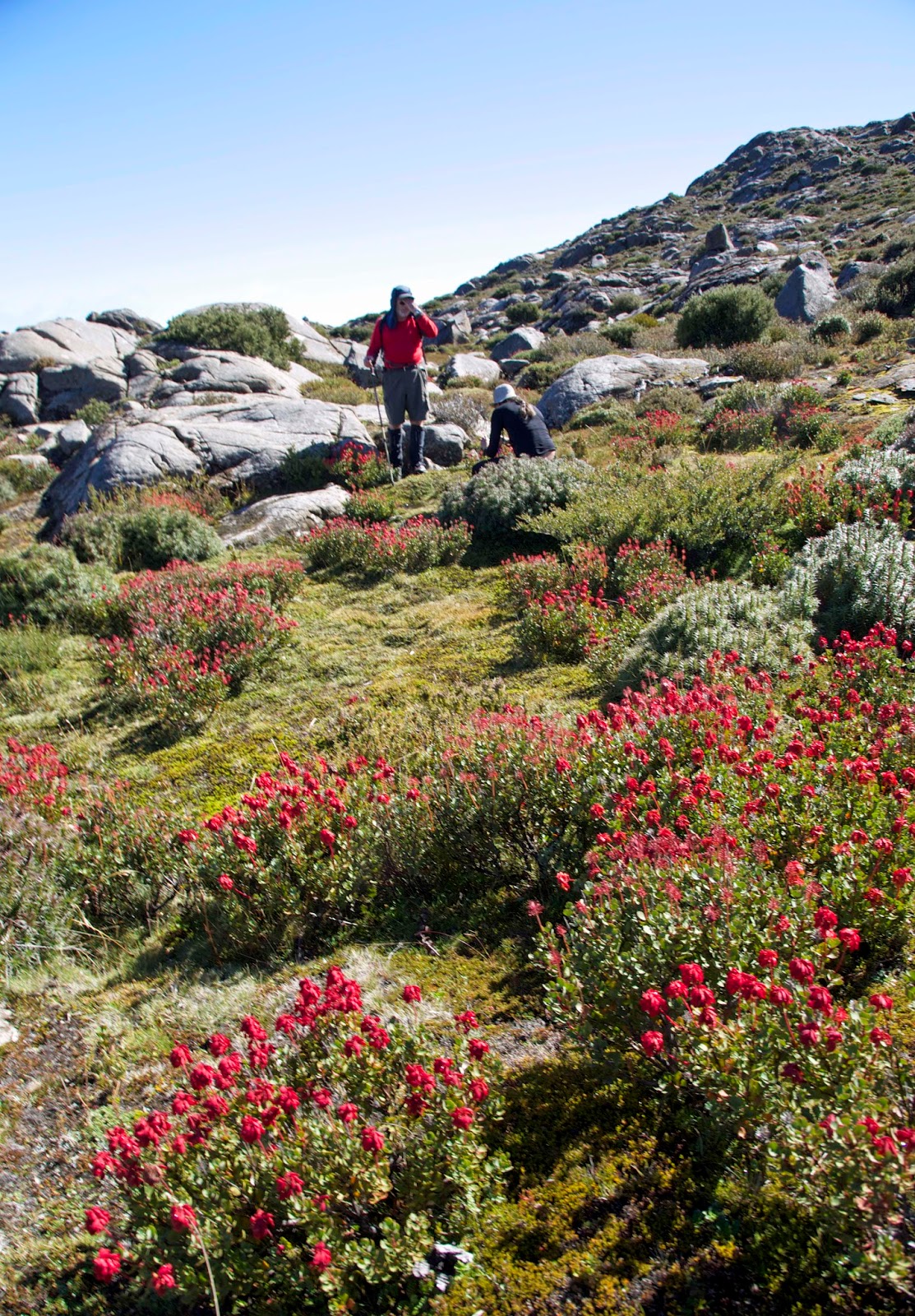
The contrast to our previous days is stark. The rain has been routed, with just a few wisps of cloud clinging to the mountain tops. The sky is an intense cerulean blue, and there is barely a murmur of wind. It would be churlish to complain about the hot climb, but we do have to work hard to gain the summit. If we needed encouragement the intricate alpine gardens, miniature tarns and dappled slabs of dolerite are an ever-varying delight.


[A mountain rocket garden on the slopes of Rogoona]

Rogoona’s is a summit I will never tire of visiting. The views stretch from tonight’s lakeside campsite far below us to the distant peaks of the Overland Track: the Pelions, the DuCanes and even Mt Olympus. As we stand on the sharp-edged summit, Long John and Libby, first time visitors here, are slack jawed, overawed.


[Group bliss on Mt Rogoona] 

Tim, Jim and I are enjoying it afresh, and also reminiscing about earlier visits to the summit. For the three of us a previous highlight was a close encounter with a young wedge-tailed eagle, which had “buzzed” us several times. As we settle down to today’s mountain-top lunch, a shadow falls across our improvised table. The eagle – or another eagle – is back!


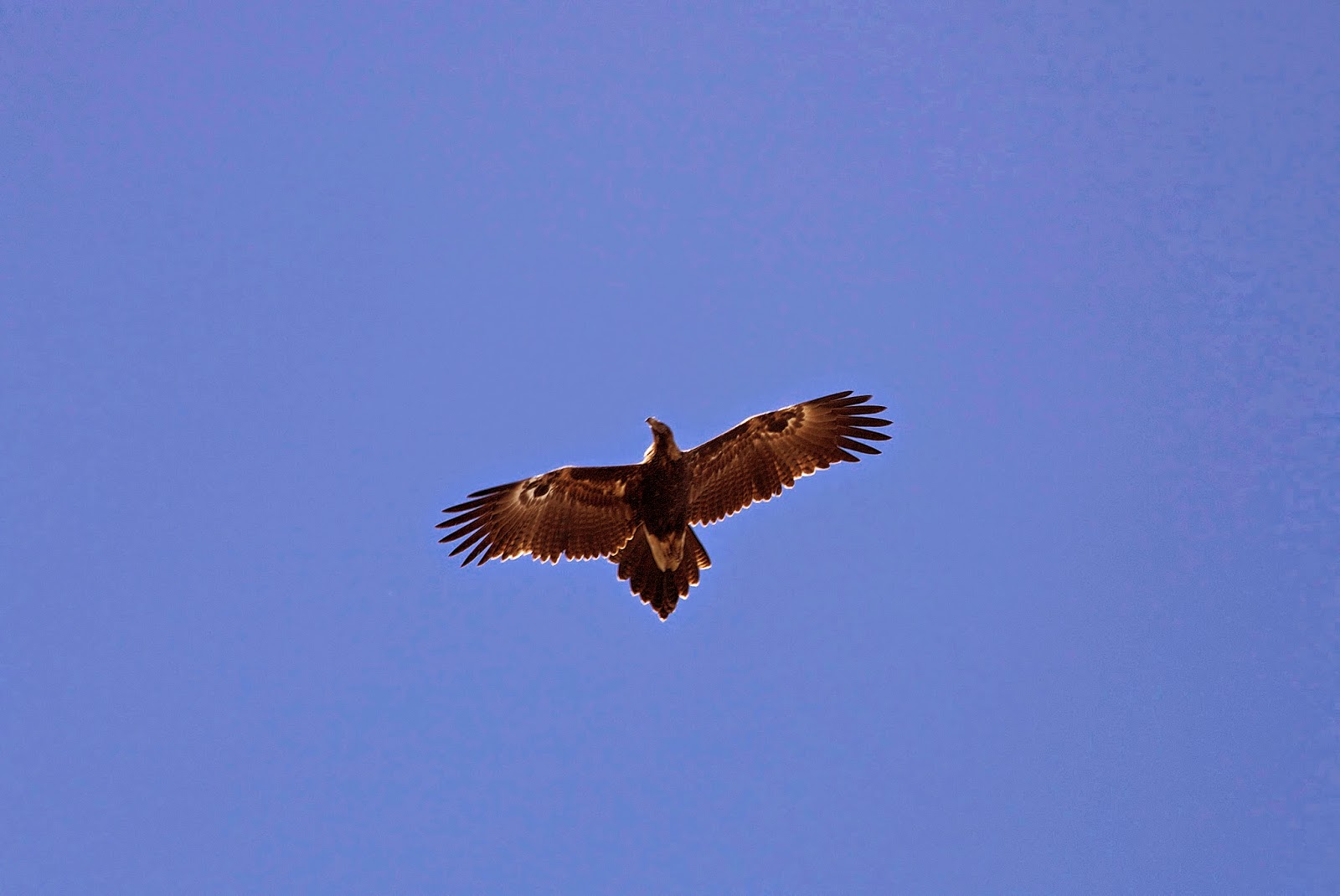
[Close encounters with a wedge-tailed eagle]

Can there be such a thing as calm panic? If there is we approximate it, letting out gasps of awe, scrambling for our cameras, and doing our best to take in these brief moments in whatever way we can. The eagle flies directly over us, less than 10 metres above our heads, glides silently away, then circles back a few times. It has striking eye-like markings on the underside of each wing. It’s as though there are four eyes watching us.

Of course the eagle is just doing what comes naturally to a top predator. It is checking to see what is happening in its range. We could represent food, or possibly threat. For us, seeing an eagle at close quarters is anything but business-as-usual. The Tasmanian wedge-tailed eagle (Aquila audax fleayii) is Australia’s largest bird of prey. It is a larger and heavier sub-species of the mainland wedge-tailed eagle, and has a wing-span of more than two metres. It is among the royalty of birds, world-wide, and we feel deeply privileged to be allowed such an audience. We had merely asked for a fine day on the summit. What kind of excess is this?!

After a few minutes the raptor drifts off westward, and is soon just a dark crease in the blue sky over the Du Cane Range. We return to the banalities of eating and taking group photos, but can’t resist talking about this epiphany all the way back to our packs. Even as we set up beside the still waters of Lake Myrtle, cradled beneath the now more distant peak of Rogoona, we’re reminded afresh of that visitation on the mount.


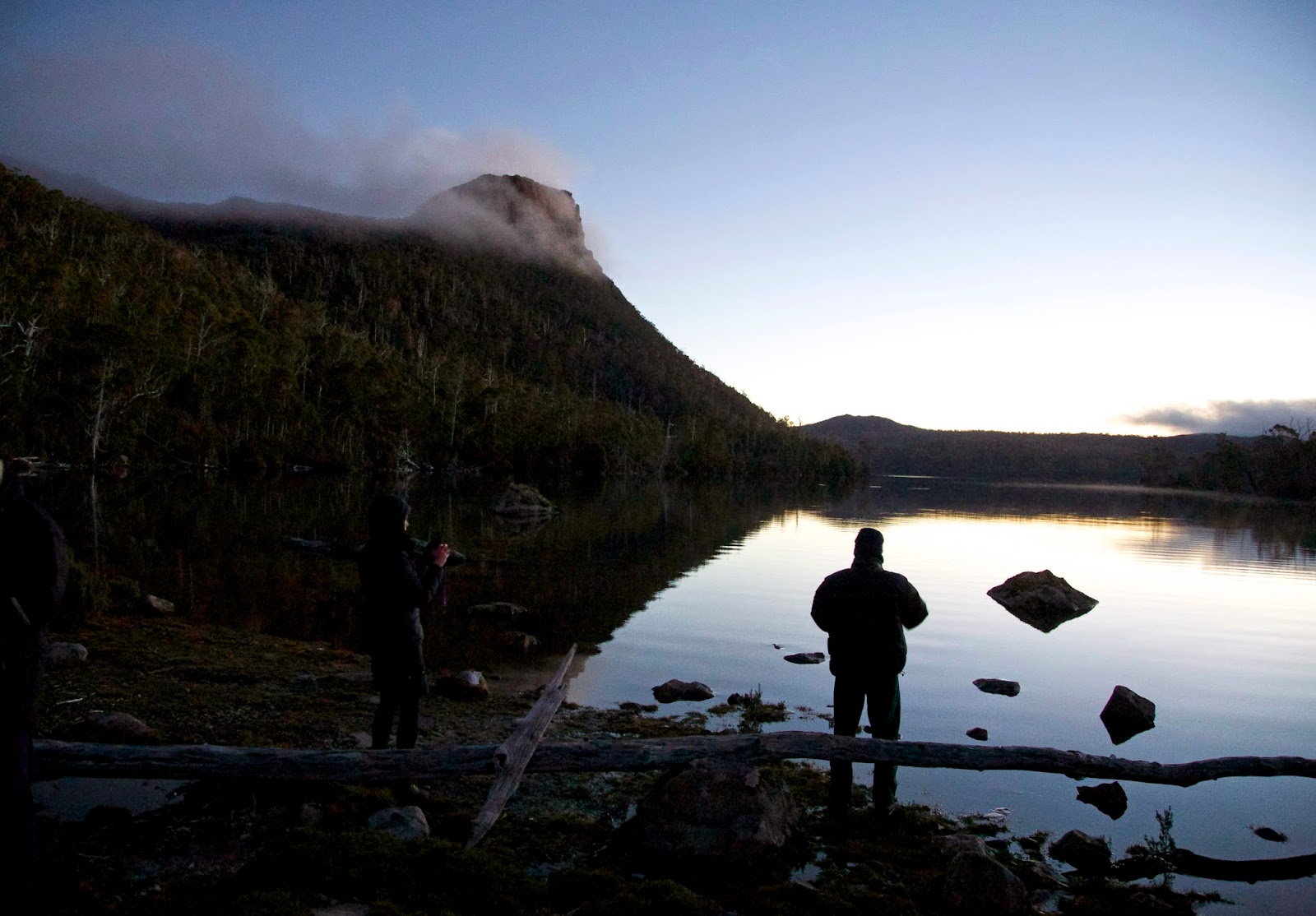
[Evening reflections, Lake Myrtle with Mt Rogoona]

If our hopes for a perfect, calm evening at the lake are realised, the wee hours bring a return to our earlier weather. In the morning we pack up slowly in persistent rain. It may be inconvenient, uncomfortable even, but having just experienced Rogoona/Myrtle perfection, it’s water off a duck’s back.


We follow a lesser-known route down from the lake to our cars. It is steep and wet, and the leeches make a spectacular comeback, keeping our stops to a minimum. But that’s fine, as we’re on a mission to get the Christmas Hills Raspberry Farm in time for lunch. Our bodies have worked hard, our souls have been filled to overflowing. Now it’s time for some hot food!

Monday, 27 January 2014

Nights by a Highland Lake: Part 3

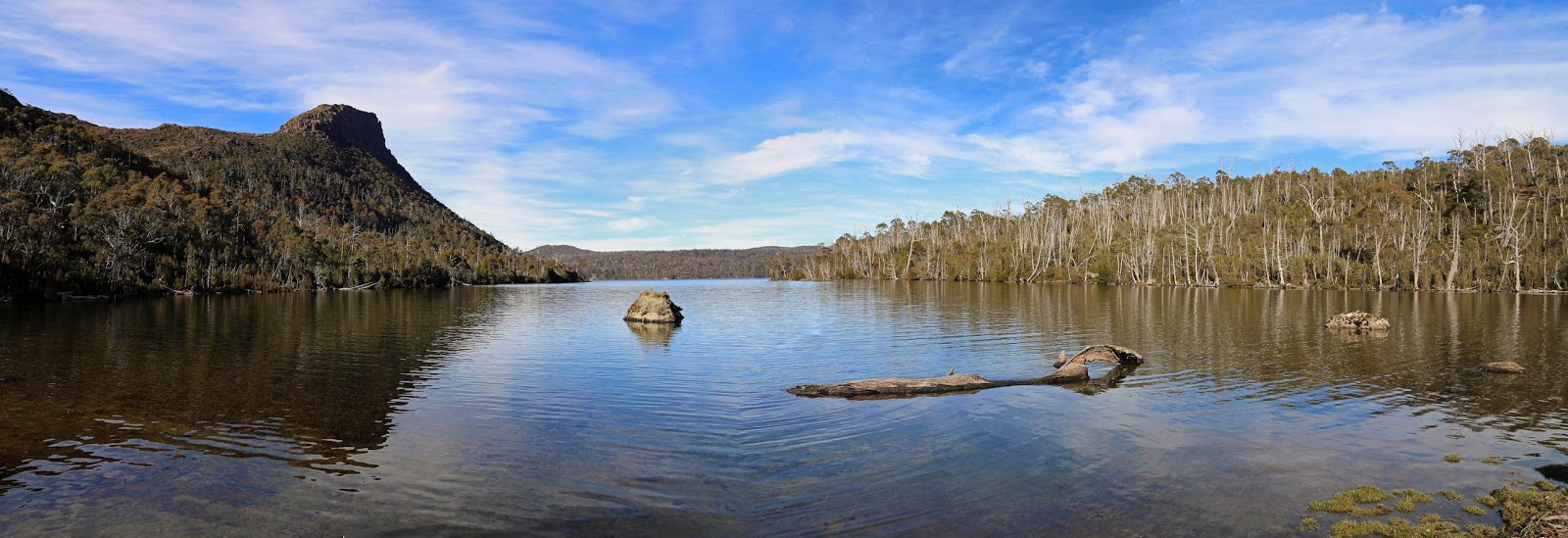
After a day in the mountains and an invigorating swim in Lake Myrtle, our lakeside campsite felt close to paradise. The low sun lay a bright sheet of light on the water. The wind raised only the quietest of whispers, and a second Mt Rogoona slept, perfectly twinned, in the lake.


[Panorama: Lake Myrtle, Mt Rogoona, Tasmania] 

Does there have to be a fly in the ointment? Apparently so. The sandflies that we’d noticed earlier had come back with reinforcements. As we prepared dinner, hundreds hovered around our faces; dive bombed our drinks; got caught in our hair; bit our neck, ears and any other piece of exposed skin.

They had seemed quite harmless at first, but we were soon quoting The Lord of the Rings movie: “What do they eat when they can’t get hobbit?!” Our assumption that these sandflies were only pale imitations of the fierce New Zealand ones was coming back to bite us. And this despite our use of a New Zealand insect repellent especially formulated to combat sandflies.

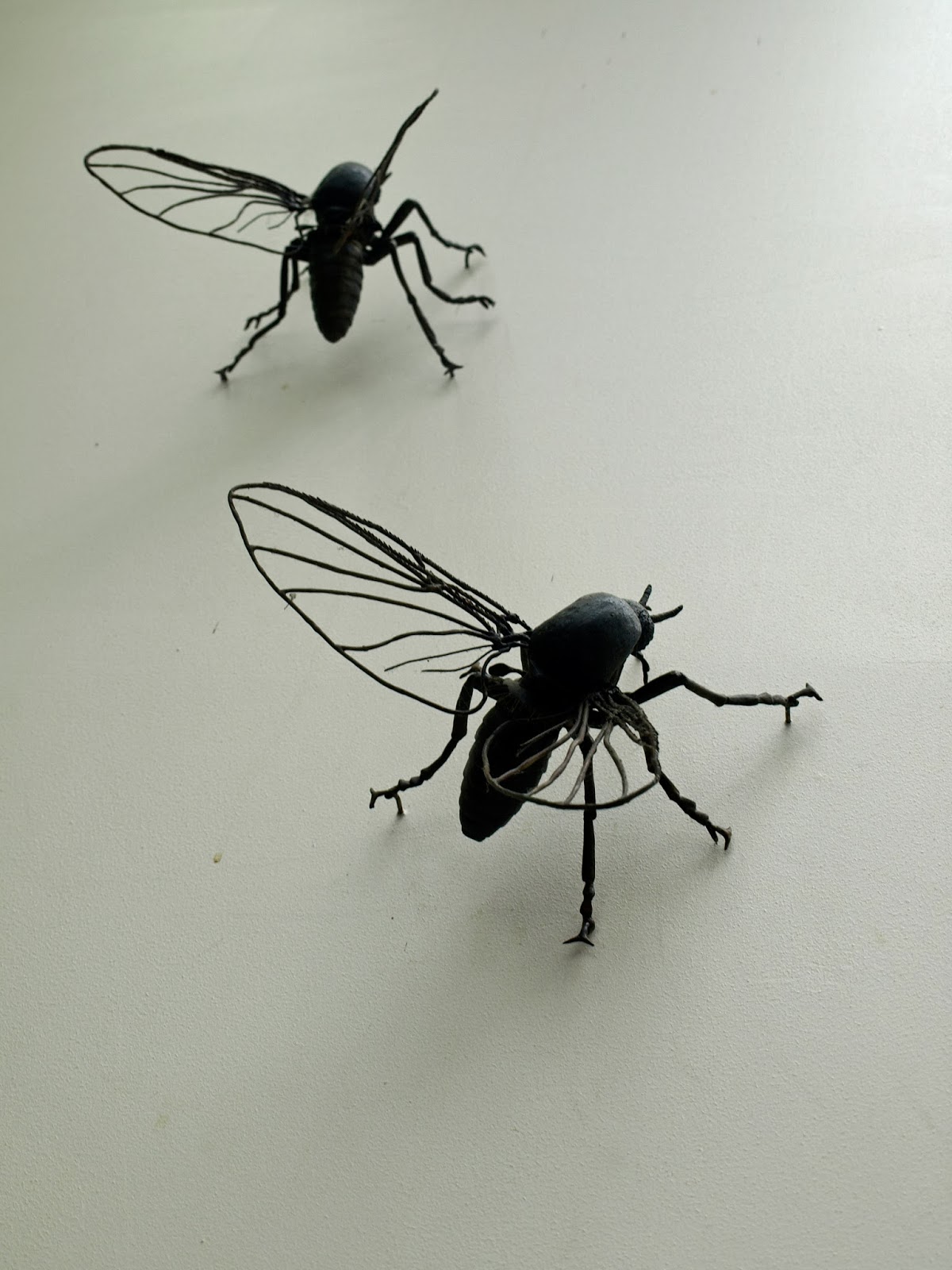
Later I found out that our sandflies come from the Ceratopogonidae (biting midge) family, while the Kiwi ones are Austrosimuliidae (Sandfly/blackfly). Was that why they showed contempt for our repellent? Whatever the facts, we were to find that subjecting your skin to their bite would lead to similar results. I had written about the gory details of NZ sandfly bites previously here http://www.naturescribe.com/2010/04/dragons-in-paradise-part-2.html. We would only re-learn that itchy lesson later, once the full effect of their bites became obvious.


[Models of NZ sandflies at Milford Sound] 

Meanwhile, back at Lake Myrtle, we had to walk around as we ate our dinner just to make the midges work for theirs. Although it was still bright and sunny, an early night in the sanctuary of the tent seemed the best solution. Even then our scurried tent entries took dozens of the little critters in with us. We had to perform the invertebrate equivalent of shooting fish in a barrel before we could sleep in peace. And still the thousands of desperate midges left outside our tent clamoured and hammered as loudly as rain on the nylon exterior. (Perhaps this is why they call it a tent fly?)

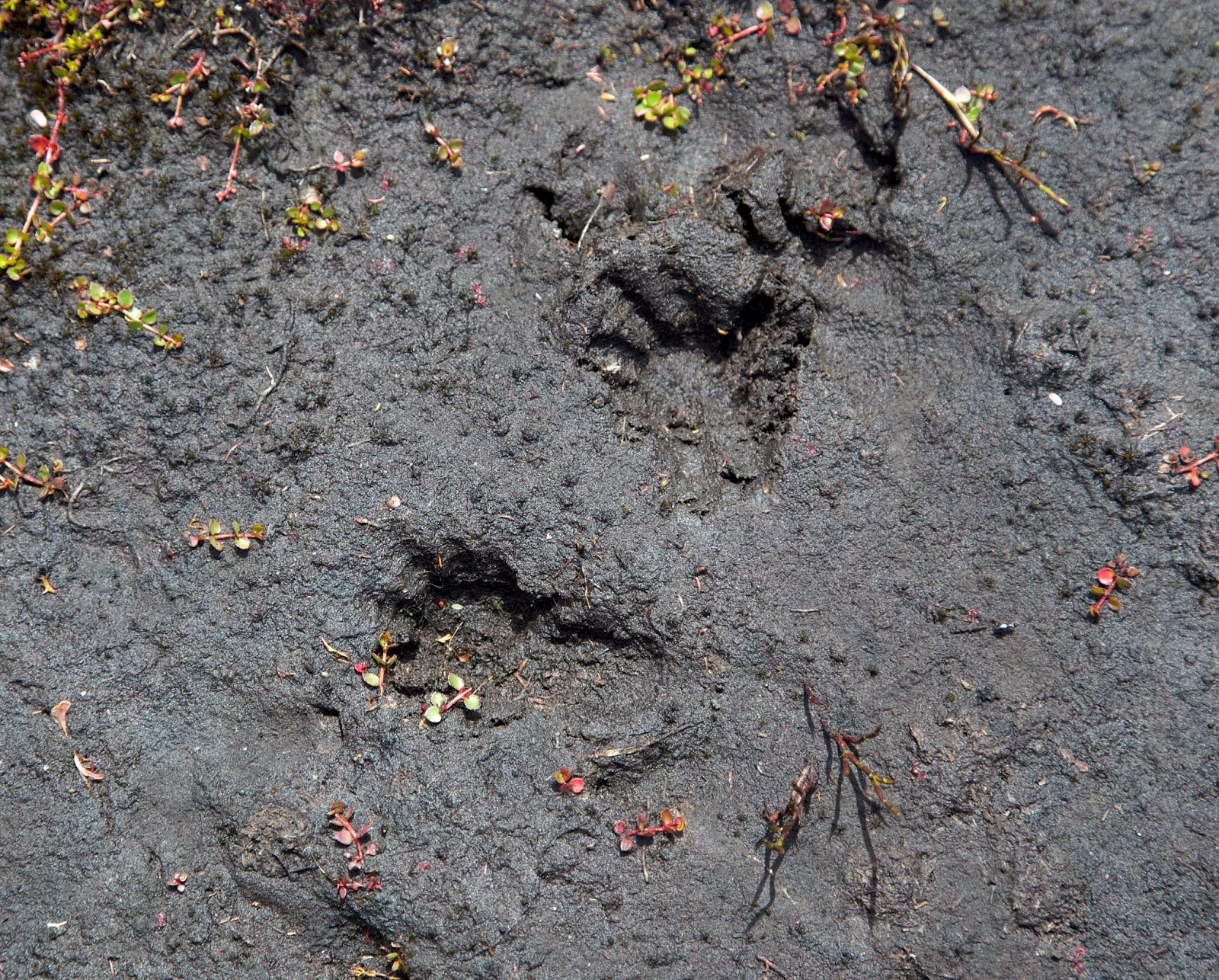
“Midges can be active at night!” became my unwelcome new learning, and “How’s the serenity?” my next movie quote. Somehow, eventually, we found sleep. But the beasts had not finished with us. At 4am a loud clanking of pots told us our outside “kitchen” was being raided. I staggered out of the tent (yes, the midges were STILL awake) and shone my torch on a fat, black possum. He was licking nonchalantly on the muesli we’d been soaking in a pot. The clank had been him removing the hefty rock we’d put on the pot’s lid as defence against just this sort of raid.


[Forensic evidence from the night before] 

I supposed that the damage had been done. Certainly the muesli wasn’t salvageable, but we did have a spare. So I scowled at the possum, scanned for anything else that might be edible, and crawled back into the tent. In the morning I found that our thief had also taken a liking to my trangia bag, and had taken it off for afters.

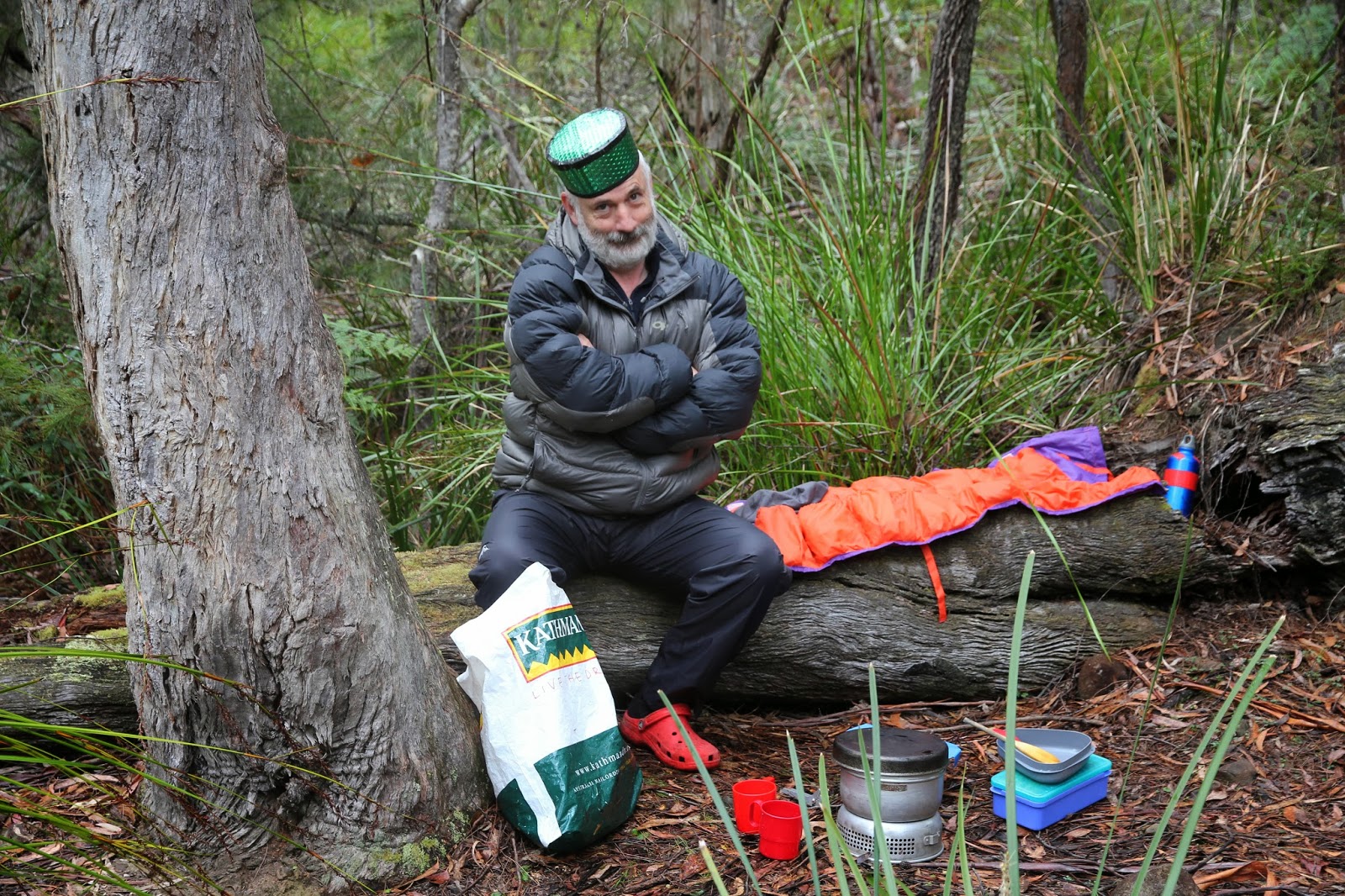
Despite an extensive search of the surrounds, we didn’t find the bag. What, I wondered, would a possum do with a metal Trangia lid, a strap and a home-made pot cosy?  Would stories be handed down the possum generations? Would the shiny green pot cosy be worn fez-like by the boss poss, as he told tales of bravery and bircher muesli?


[Modelling the pot cosy as a fez on an earlier walk] 

As for me, I would return from the walk in need of a new strap, screw-cap lid and pot cosy. But there’s always a bright side. Thanks to the beasts, my burden would be lighter by the contents of that Trangia bag, not to mention a syringe or two’s worth of blood.


Sunday, 19 January 2014

Nights by a Highland Lake: Part 2


The lake says nothing. Nor do the trees, the birds, the mountain. Even the sky is quiet, showing the sun to bed; the moon and stars to their posts.


[Early evening at Lake Myrtle, with Mt Rogoona behind] 

We fuss around getting comfortable, as you must in a tent, before the silence begins to settle on us as well. It is a profound thing to be horizontal and quiet in such stillness.

We surface slowly in the morning; taking our time over breakfast; enjoying the superb scene from the campsite. It is calm and lightly overcast, a perfect morning for walking … and for sandflies. They hover around us in increasing numbers. We don’t have the terror of them that we would in New Zealand, as we’ve not known them to be nearly as fierce in Tasmania. But they are enough of a nuisance to get us thinking about moving.

Our recovery from the previous day’s walk has been good. Although we’re not rushing to heed Mt Rogoona’s “here am I, climb me!” siren call, my optimism is chattering away inside my head over breakfast. Lynne’s is less vocal. She feels good, but a pre-existing knee niggle is lurking.

We decide to go for “a bit of a wander towards” Rogoona. To me that’s code for getting to the top, but I don’t want to push it. We ascend the saddle between Lakes Myrtle and Lake Meston, taking our time, finding much to distract us, from flowering berries to a quickly-disappearing tiger snake.


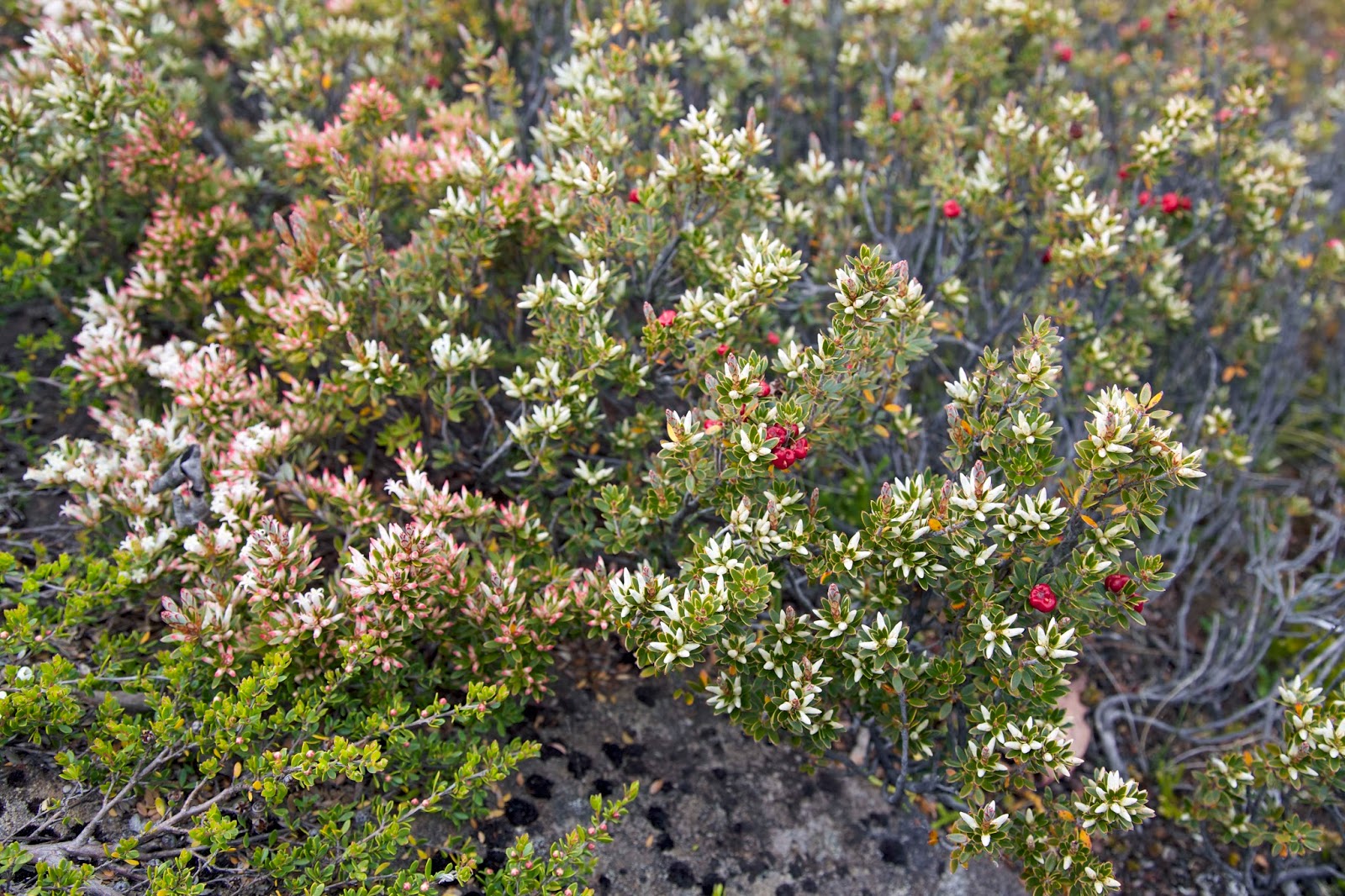
[Cheeseberry (Cyathodes straminea) in fruit and flower]
At the saddle a cairn marks our turnoff. Once off track I’m prepared to follow my nose. This is my third time on the mountain, and the weather and destination are both clear enough. But we find large and obvious rock cairns on our route, and start to lock onto these. I relate to Lynne my tenuous faith in cairns: they may only tell us where somebody else was when they were lost. But being a newbie off-track walker she’s ready to see them as signposts.


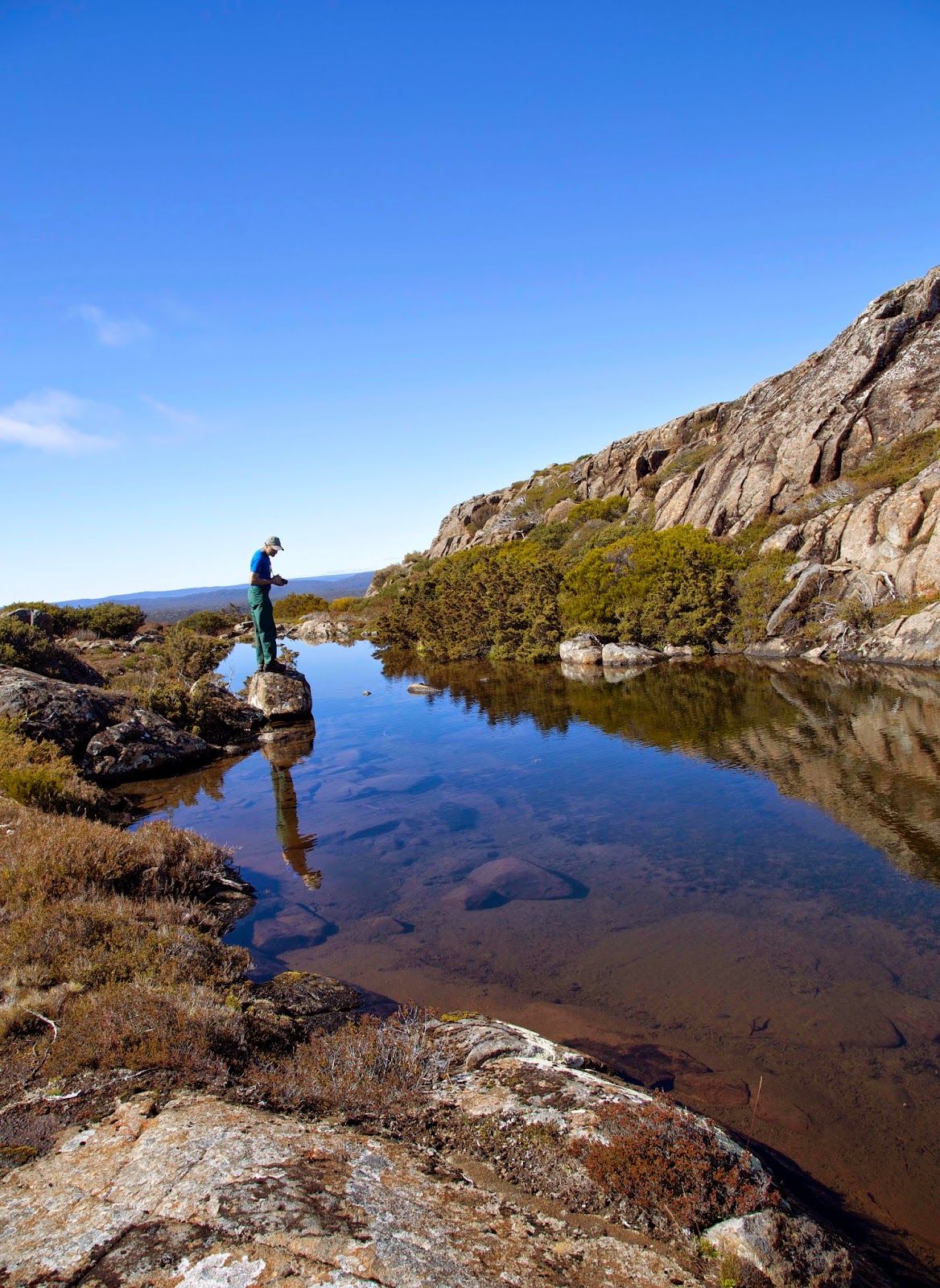
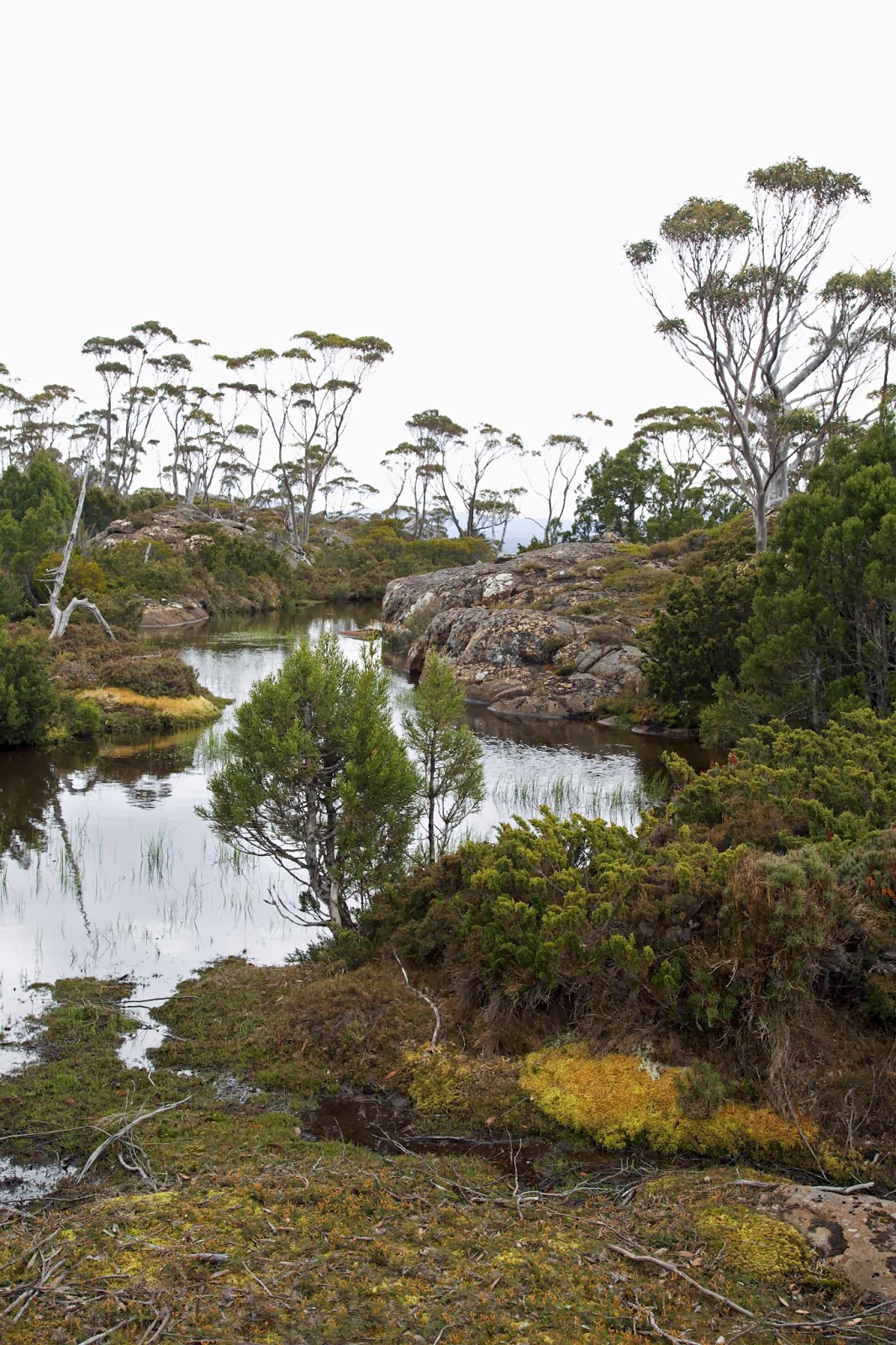
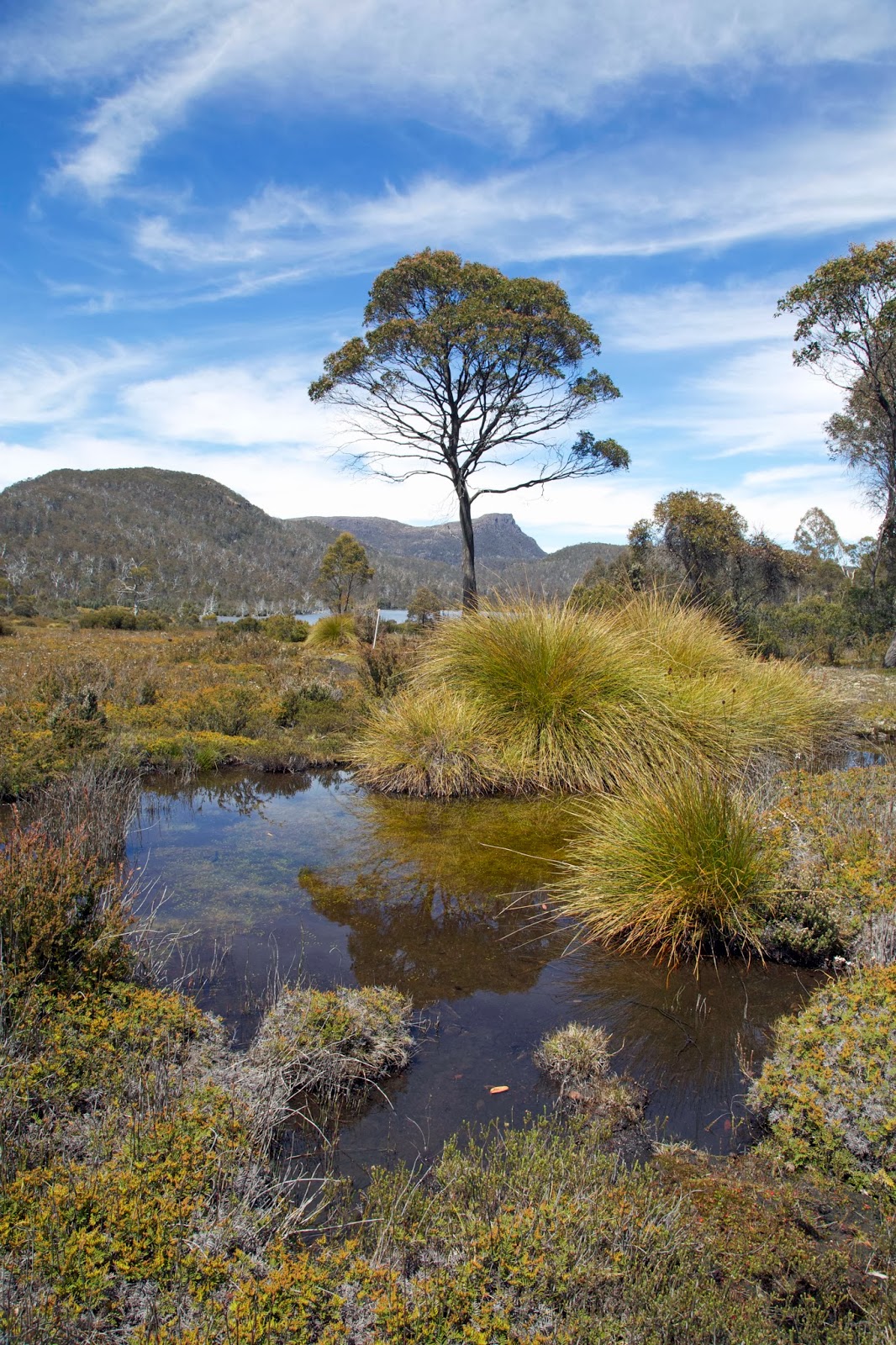
[Pool with pencil pines near Mt Rogoona]
We slow down as the cairns become sparser and the going a little rougher. Our pace is slow, and we seem to spend as much time searching for cairns as actually walking. My for-once-clear memory of the ascent of Rogoona is that it is quite drawn out. And at the top I’m almost sure there’s one of those “oh no … surely not!” extra little scrambles. We reach a high point and sit down for a break. It turns into lunch, and quickly thereafter into our turn-around point. Lynne’s been doing the maths – with an increasingly sore knee in mind – and she realises it’ll be many hours before we get to the summit and back.


[An earlier summit trip, Mt Rogoona with Lk Myrtle below]
I’ve been to the top of Rogoona twice in recent years, so I’m only disappointed that Lynne won’t get to see that wonderful view. On the other hand it’s starting to cloud over again, so we’re not even assured of a view. I make one condition for my surrender: we won’t return via cairns. We’ll take what I’ve always called “the pretty way”. Family legend is that as a young child I used to nag my father to drive home via waterfalls or forested gullies. “Can we go the pretty way Dad??” Some things never change.

By going the pretty way and abandoning cairns we’re soon reaping rewards. The rocky, undulating flanks of Rogoona have been scoured and scooped during the ice ages. At intervals this has resulted in small pools, some fringed with pencil pines.


[Signs of hope: young pencil pines, Mt Rogoona]
For the next hour or more summits, cairns and knees are forgotten as we slowly wander from pool to pool. If we’re “lost”, it’s only in wonder. Each pencil pine discovery is like a significant find. Many hundreds of pines were killed by the 1980s fire in this area alone.

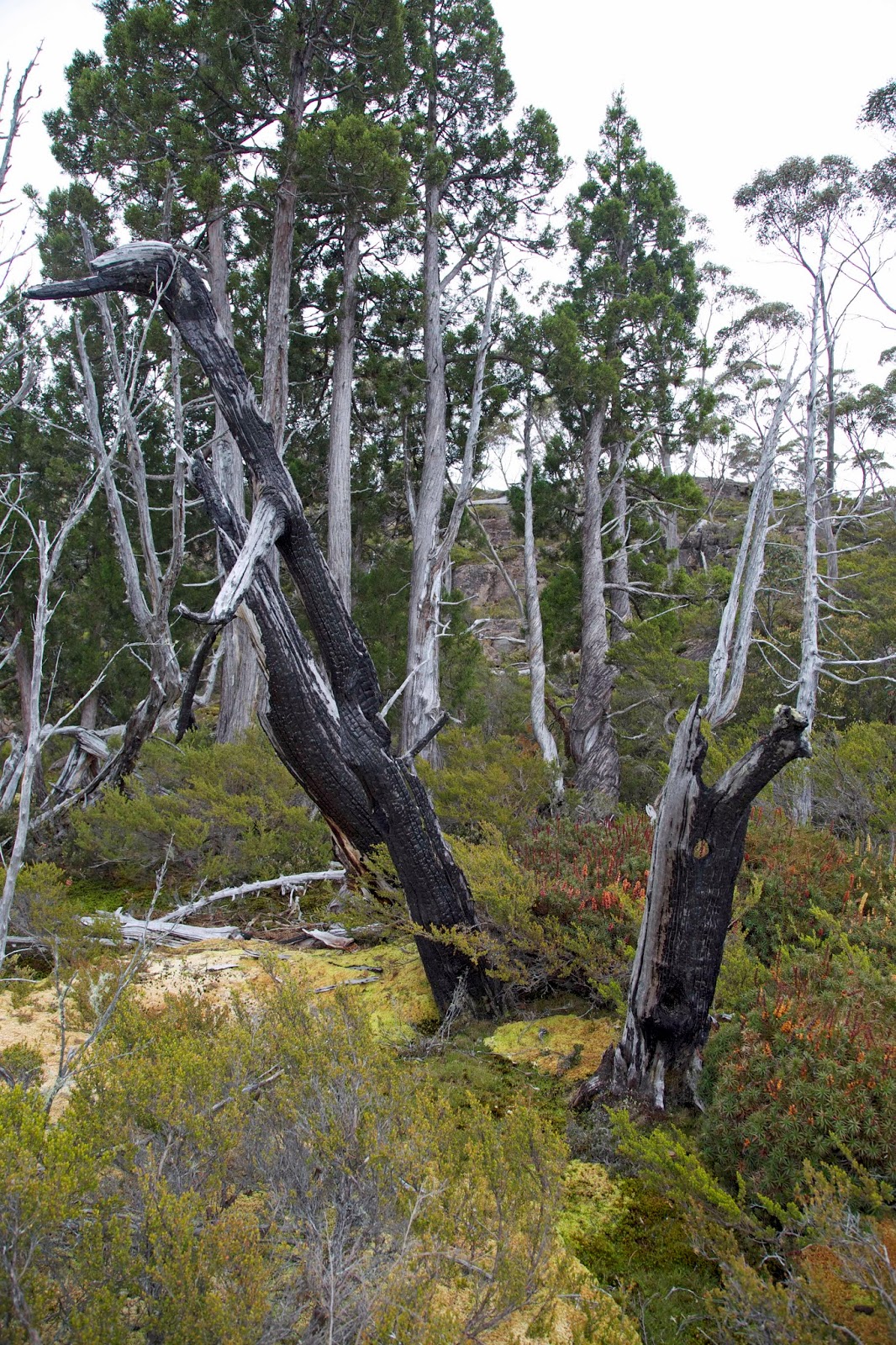
When we find a large mature stand in a sphagnum-filled hollow it feels like a triumph. Upwards of twenty thriving, conical trees are clustered together in perfect conditions. But at the margin of the grove we find several large dead trees. Their blackened trunks signal how close this fire got to taking out the whole stand. Further on we find a few young pines, and are glad at this sign of slow recruitment of trees where conditions are right.


[Pencil pines: survivors alongside victims of fire]
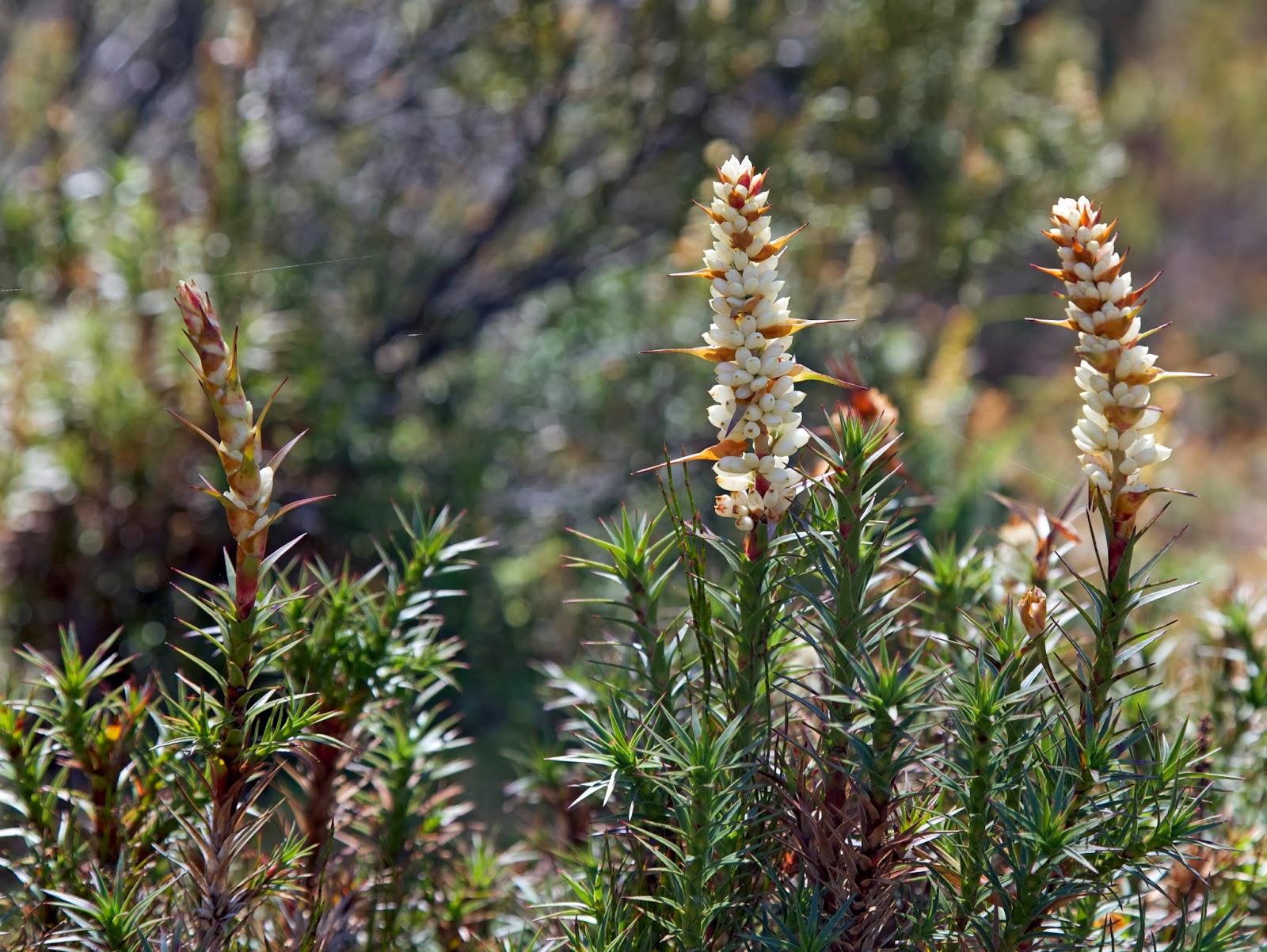
Reluctantly we leave the mountain and wander back towards the lake. But by now we have our eye in, and the return trip is slow, punctuated by stops to take in scoparia here, mountain rocket there, skittering skinks everywhere.


[Scoparia blooms] 
The bonus on our arrival back at the lake is the time and energy for a soak in its immaculate waters. We’ve learned, yet again, that just being among mountains can be as wondrous as being on top of them.


Sunday, 12 January 2014

Nights by a Highland Lake: Part 1


[Mt Rogoona above Lake Myrtle] 
Launceston,1982. I’m one of the leaders of a group planning an overnight bushwalk. Being newish to this part of the state, I’m listening more than talking. We discuss potential destinations, place names that seem ripe with promise, rich with story. Places I too will come to cherish, ‘though that’s in my future.

When the name Rogoona is mentioned, keen looks turn suddenly sad. “No … it’s been burned out. Tragic. No point going up there.” There’s a bit more discussion; some speculation about the fire’s cause; talk of pencil pine groves destroyed forever.


[A burned pencil pine grove near Lake Myrtle] 

It’s the era of the Franklin Dam dispute. Lake Pedder is not long drowned. Nuclear weapons seem to hover over us. We share the pervasive feeling that all that is precious can be threatened, even a mountain like Rogoona.

Fast forward three decades, and I’m headed for Mt Rogoona; my third trip in recent years. In the intervening years much has changed, much has not. We’ve raised three children, and are well into the wonderland of grandparenting. But I always said I’d catch Lynne up on some of what she missed in those years. This beautiful mountain above a glittering lake is high on that list.

One of the positive changes in that time has been weather forecasting. For all that we complain when they get it wrong, forecasters today are able to give us just that: a casting-ahead – even a week to ten days ahead – of likely weather conditions.

So for this trip our weather is looking as sorted as anything driven by a chaos engine can be. Unfortunately my memory is also chaotic. From my previous trips I recall “a little bit of uphill” getting to Lake Myrtle. Pedantically the map insists there are 457 metres of it, but my memory is still more of sidle than grunt. Of course after 5 minutes of sidle, it’s steep for the next hour. And then you’re still not there. Too late I remember that there is a series of false summits – faux plateaux – as we had dubbed them on my last trip.


[Contemplating "a bit of up"] 

Optimism and faulty memories are largely helpful allies in bushwalking. Otherwise we might never leave home. But as we break out of forest onto the buttongrass of Blizzard Plain, with Mt Rogoona in view at last, I resist expressing my “almost-there” thoughts. “Not-even-half-way-there” is actually more accurate. After some buttongrass bog there’s the little lake foretaste provided by Lake Bill. It’s a very pleasant mountain lake, but an ugly step-sister in comparison with Lake Myrtle. It’s only a few minutes off our route, but we’re too tired to drop in on the second-rate sibling.


[A distant Mt Rogoona, with glimpses of Lake Bill]  

Quietly cursing too much Christmas pudding and an unreasonably early start, we stagger on up the slope. We pass a wonderful array of wildflowers, gushing waterfalls, and glimpses of Rogoona without giving them the enthusiasm they deserve.

I’m concerned about our levels of exertion; concerned that I’ve built up the beauty of our Lake Myrtle destination to such an extent that Lynne will be disappointed. I worry too that there will be multiple tents there already, with the best spots taken.


We finally arrive, though only after a tricky last-minute creek crossing, and my optimism returns. The campsite is both beautiful and empty. We slump down on unreasonably soft lake-front grass in bright sunshine. Mt Rogoona sits lofty and sphinx-like above the shining waters. Lynne is beaming through her pain. I’m guessing that in a few days, perhaps weeks, her memory too will become as unreliable as mine.


[Lake Myrtle reflections]