Showing posts with label walking. Show all posts

Sunday, 28 June 2015

Farewell to the No. 47 Bus

Commuting wouldn’t feature in many people’s top 10 list of most-enjoyable-things-to-do. Getting to and from work, especially in cities, is surely a big component of the grumpiness summed up as the daily grind.

Whether we’re drumming the steering wheel impatiently in a traffic jam or squeezed uncomfortably against a stranger on the bus/train/tram, few of us look forward to commuting.


[A typical Metro Bus in Hobart:
pic courtesy MetroTas]
So it may seem strange for me to say, after 24 years of the same work-a-day travel routine, that I will miss my commuting. Perhaps it’s partly owed to the blessing of living in a small, human-scale city. It may also derive from the city-ward half of my commute being always on foot, with part of that along a pleasant track away from traffic and close to bush. But it’s also that I will miss the people I commuted with, now that I have retired from full-time work; now that my commute will be the short climb into my writer’s loft.

Each leg of my commute had its pluses and its minuses. I love walking, so the city-ward trip was a pleasure in itself. I long ago decided, perhaps inspired by a brief student-years career as a postie, that “neither rain nor hail nor sleet nor snow” would prevent me from walking. At times it could become an epic five and half kilometre walk, and a good test of all the waterproof gear I could throw at the conditions. But there’s a perverse joy in pushing through gales and storms.

The walk could also yield joys of a different kind, as I’ve described elsewhere, http://www.naturescribe.com/2014/03/the-urban-platypus.html. Wallabies, birds, even the odd platypus or snake have made surprise appearances along the track. But there were also the regular walkers who I met and chatted with. The foremost, and most deliberate of these was my wife Lynne. She always joined me on her non-work days, and we invariably walked first through our back bush rather than down the road. We found that walking together, side by side, was a very fruitful way for us to discuss any and everything. And sometimes nothing at all. When we'd meandered through the bush back to our road, she would turn left for home. And I would turn right and take the Rivulet Track towards the city.


[Along the Rivulet Track, South Hobart] 
Further down the track, a popular dog walking space, I often seemed to share doggy tales with strangers and acquaintances. At other times I might discuss wildlife, or walking, or politics with other walkers. And just occasionally we’d get personal, and death, grief, love or faith would tread the track beside us.

Of course the down side of the walk was that I was going to work. As good as that work could be, it was still work. And most work has elements of drudgery or conflict or stress alongside its rewards. Given the choice I’d rather have been walking in the opposite direction, towards the mountain.


[The allure of kunanyi/Mt Wellington] 
My usual homeward commute was on the Number 47 bus, and the people on that bus became (literal) fellow travellers – and sometimes friends – on the larger journey of life. Through long exposure and a degree of pushing beyond polite chit-chat, we managed to have some amazing conversations. For us this was never a head-in-my-newspaper type of commute. Births, deaths, marriages, illness, politics, retirements: none of these seemed off limits. And because the No. 47 bus heads towards what some have dubbed “Greenie Acres”, we inevitably talked about environmental issues. It wasn’t that we all agreed on these, but it was something most of us were passionate about.

Soon after I first started catching the No. 47, I remember one commuter growing rounder and rounder as she reached the advanced stages of pregnancy. When her baby joined her on the bus a few months later, he became “the bus’s baby”. That he has now started university is both a surprise and a signal. Perhaps I’ve been catching this bus long enough. Perhaps it’s time to let the next generation make what they will of this ordinary but amazing mode of transport.

As for me, I will keep my “Green Card” bus pass, and will still catch the No. 47 bus from time to time. And the walking will definitely still happen. I even hope to keep in touch with some of the other Rivulet Track walkers, and their dogs. But no-one should be surprised if, every so often, I turn left instead of right, and head up that mountain.


[What awaits on the mountain!] 

Sunday, 19 May 2013

Moving Feet, Bending Time

I am no wizard. Yet sometimes I seem able to bend time, to tame it momentarily. It rarely happens in my everyday existence. There time is a wild and unruly beast, predictable only in its relentless movement in the one direction.

Along the way it gorges itself on busy-nesses of every kind. I hang on, dizzy, ill even, from its mad rush. There’s a name for that malady – “hurry sickness” – and many of us suffer from it. Even so, we remain addicted to what rushing promises, like the possibility of doing twenty things at once.

So how is it that I came to bend time? Quite simply, I walked. Somewhere along my varied journey, I discovered that moving feet can bend time. Typically if I was doing many things, or none, time would fly by. But in doing just the one thing – particularly this one – I experienced an unaccountable staunching of time’s flow, even an expansion in its quantity and quality.


[A sublime summit moment: Mt Rogoona, Tasmania] 

A Scene: Somewhere in Tasmania

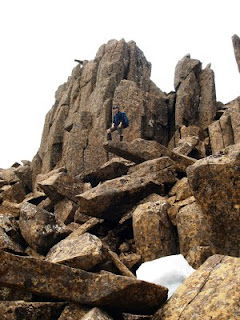
I’m not sure of the hour, it’s probably late morning. There is a cold wind blowing over the small rise between last night’s campsite and our next. We leave the track as we sense – or guess – that our summit route is this way. We drop our heavy packs, put essentials in our day packs, and scramble to the west, mostly up.

There is no track, so we spread out, each picking his or her own way over the rocky terrain. One avoids a thick patch of bush to the left; another to the right. A third stops to examine wildflowers, another presses on. I pause at a small rocky pool, an exquisite tarn-in-miniature. It sits beneath its own doleritic micro-mountains, surrounded by its own micro-forest of sphagnum, pineapple grass and mountain rocket.


[A pool beneath the summit of Mt Rogoona] 

As we grip and grunt our way over grainy, rocky slopes, we slowly pull closer to the high point. After a final sharp scramble, we are there: standing on Mt Rogoona’s summit. The clouds clear, the wheel of the world turns more slowly. We see everything it is possible to see from here.

And more. A wedge-tailed eagle swoops by. It pauses, wobbling imperfectly, almost clumsily, at our eye level. Its tail feathers are a little ragged, not yet fully grown. Is it young, trying out new-found skills? We exchange close, enthralled looks with the raptor.


[A Tasmanian wedge-tailed eagle above Mt Rogoona]

Without effort it lifts on an updraft, drifts away. We exchange a few inadequate superlatives, turn to the stunning view, start to pose for photographs. The eagle circles back for another look. Four, five times more the eagle circles, finally satisfying its curiosity – if not ours – before soaring away. How long this has taken I have no idea.

Doing less, yet gaining more: that’s surely a paradox. And as with most such, it tends to fall apart under analysis. Yet how else to explain the high count of solid, vivid memories that I associate with the simple act of bushwalking? Are they like other moments of intensity – love-making, childbirth, peer acclaim, serious illness, the loss of a loved-one – that can suspend the usual laws of time? Does walking seriously rank alongside those other life landmarks?

The online bushwalking forum, Bushwalk Australia, has an active thread with this question: “What does bushwalking mean to you spiritually?” See http://bushwalk.com/forum/viewtopic.php?f=5&t=10226 The thread has been active for nearly a year, and has attracted a wide diversity of opinion. But even the question alone intrigues me, because I have come to see bushwalking as in part “spiritual”. That is, it has spiritual benefits. That’s not to deny physical, biological or psychological benefits. (Not that I draw sharp distinctions between such categories: we are complex, multi-faceted creatures, after all.) But I have come to see bushwalking as having a spiritual side.


 [Good for your soul as well as your soles]
Japanese theologian Kosuke Koyama makes some tantalisingly grand claims for walking. He says that our normal walking speed is in fact the speed of love, and thus the speed of God. He references that to the Bible story of God walking with the Israelites through their 40 years in the wilderness.

“Love has its speed. It is an inner speed . . . a different kind of speed from the technological speed to which we are accustomed. It is ‘slow’ yet it is lord over all other speed since it is the speed of love. It goes on in the depth of our life, whether we notice it or not, at three miles an hour. It is the speed we walk and therefore it is the speed the love of God walks.” (from Three Mile an Hour God)

If walking is deeply ingrained in our spirit – that part of us that seems capable of by-passing time – then it may start to explain why time sometimes seems to wobble when we don our boots.


Sunday, 27 May 2012

The Fellowship of the Foot


"There will be many footpaths in Utopia." - HG Wells 


[Walking and talking: profound yet simple] 

They are unlike the people you spend most of your life among: family, work mates, friends. The people you meet while out walking may not even have names - or names that you know. Some will meet your eye and greet you, others will keep their gaze steadfastly elsewhere, perhaps groundward, perhaps somewhere over your left shoulder.

Sometimes you’ll try to make a connection with the cautious ones. Just the other morning a woman was walking a dog whose gait and behaviour was so similar to my dog’s, that as I overtook her I had to ask if it was a Staffordshire terrier. I had to ask twice actually, because we were both wearing white earbuds, which can limit things. But eventually we had a 10 second dog conversation, the sort that confirms the dog's breed and gender, and its status as “spoiled”, but nothing much more.

The fellowship of the foot is sometimes that simple. Or simpler even, in the case of a nod or a muttered "Morning". Of course there are others who you get to know much better. Like Dave and Donna, a retired couple who share the backtrack with us. They walk their dog "Fred" there every day and knew our previous dog well enough for them to talk about “Angus” for years after his death.

Donna knows “Noo”, our current dog, well too: knows her nervous disposition, her barks and raised hackles when calm “Fred” is about. Donna carries treats, and rewards “Noo” for coming, and for calming. She gives us hope that our old dog may pick up new tricks.


[Noo enjoying the bush] 
We talk about other things too: the state of the bush, the weather, holidays, mountain bikers (Dave is not keen on them). But if there is one focus among the people along the track, it’s animals. Apart from walking their dogs, and occasionally riding their horses there, some neighbours have even made it a pet burial ground.

Some months back a brightly painted wooden cross appeared beside the track. It was inscribed to “Lucky”, with a few heart-felt words honouring their demised dog. Then a week ago we noticed another similar-styled cross next to the first. This time it was for “Flick”.

We paused beside the impromptu pet cemetery, reading the inscriptions and thinking. Half to herself Lynne said “Flick ‘n’ Lucky”. I couldn’t resist replying “Looks like they weren’t so flick’n lucky”, breaking the mood and sending us both down the track laughing like naughty children.

The backtrack isn’t just used by domestic animals. We see, hear and find evidence of many native birds, mammals and other animals on our walks. And they don’t only limit themselves to the bush.

One morning while on the footpath near the Cascade Brewery, I witnessed an unusual congregation of birds, a kind of avian cold war between sulphur-crested cockatoos and currawongs. It was as though I’d come across an animated “Spy vs Spy”: the cockatoos all white except for their crests, the currawongs all black but for their golden eyes and white tail markings.


[A Black Currawong plays the strong, silent type] 
The two species were sitting on top of open wooden apple bins inside the factory grounds. It was apple harvest time, and the birds knew there were plenty there for the pecking. I paused to watch, counting more than a dozen of each type of bird busy at the apple boxes, with more flying in and out from the tall water silos across the road.

I wondered how the two very different species might interact. The currawong all silent swoop and precision, the cockatoo raucous, unpredictable, manouverable: stealth fighter meets combat chopper.


[A Sulphur-crested Cockatoo. Photo by Lynne Grant] 
As I watched a cocky landed atop a box right next to a feeding currawong. The latter paused and looked up at the cockatoo, just a wingspan away. The cockatoo arched forward, unfurled its crest, and let out an ear-piercing “RAAARRRKK!”. It was too much for the currawong, which flapped off to find a vacant box.

Further down the footpath I came come across Tommy, who walks with the aid of a zimmer frame. We’ve chatted for many years, enough for me to know he’s a war veteran, that he lives in a retirement village, and that he has cancer. Walking is his one freedom. I sometimes slow and walk with him towards town, where he goes for breakfast and a change of scene.

Tommy knows a little of my life too, just snatches perhaps, about travel or grandchildren or walking. It’s enough that we can go a year or more without coming across each other, and then take up again like old friends. And it’s enough that my walks will be just that bit poorer when Tommy is no longer there.

Something as simple as walking side by side, sharing informally while your focus is elsewhere, walking and talking, can make connections whose impact is deeper than time. That’s the fellowship of the foot.


Wednesday, 9 December 2009

Why We Walk

[walking near Crescent Bay, Tasmania]

[some draft material from my walking book]

Why do we walk? And what is it that tempts some of us to walk long distances? Why bother with the sweat and strain of it when there are plenty of other things to do in life? If we must move from A to B, surely there are easier and quicker alternatives than walking. Didn’t our ancestors invent the wheel for that reason?

My granddaughter Sophy prompted me to ask a different question: How can we NOT walk? She had not quite learned to walk at the age of one. Around that time she and her family were staying with us for Easter. Previously a sweet-natured and laid-back child, Sophy seemed out of sorts, and spent quite a bit of the Easter week making an unholy racket for no apparent reason. From her high chair; from the car seat; from the standing, crawling or sitting position, she would squawk without warning a little too loudly for anybody’s comfort.

A month later she started walking, and a few weeks after that we visited her again. The audible difference was amazing. Our sweet Sophy was back. The reason? According to her mother it was simply that now she could walk. Her earlier frustration had arisen from her inability to move in the way most of us do.

We are made for walking.

We are bipeds, and we are physiologically designed to get around on two feet. It’s easy to take for granted, but very few other animals are bipedal. Even our near relatives, the chimpanzees, are essentially quadrupedal. They get around by knuckle-walking on all fours. While that’s more energy efficient than human running over short distances, human bipedal walking is far more energy efficient over longer distances.

In evolutionary terms bipedalism would have conferred an adaptive advantage on hominids, especially when food resources were scarce. Bipeds would have expended less energy moving from one food source to another. And standing upright would have added to that advantage by allowing them to spot food from further away.

As an Australian, in a hot, dry land of dispersed food resources, I can appreciate the need for energy efficient movement. In fact the bounding gait of some of our marsupial mammals is thought to be to an adaptation that allows greater energy efficiency over long distances. The large muscle-bound back legs of kangaroos and wallabies have been shown to use less effort per mile than “standard model” herbivorous mammals such as deer and cattle.

Despite all of that, I can’t see pogo sticks succeeding among the bushwalking fraternity. But it is fascinating to think about how we and other animals move. I once intently watched sea gulls flying. Their undulating and ragged progress reminded me of our walking. Instead of preventing falling by putting the next foot forward, the chubby birds stop an altogether more catastrophic surrender to gravity by the flapping of their wings. Each time the belly is hitched skyward, only to droop again towards the ground at the end of the upward stroke, before again being lifted higher by the downward movement of its wings. Presumably all this is done on a bellyfull of fish, and without any more conscious thought than our own walking.

Wednesday, 11 November 2009

Dancing on Dolerite

[excerpt/draft material from "the walking book"]


[dolerite scree, Cradle Mountain]

They could never get me to sing. My parents tried, bribing me to sing “Within the Shady Thicket” with my sisters to Christmas aunties with names like Beryl, Tress and Eva. “Jazz” Buck, our somewhat militaristic music teacher at high school tried too, although his trick didn’t work. He got the class singing to a record and then walked around the room tapping a few of us on the head. I was chosen, though whether for detention or something else I didn’t know until the choir list came out. Me, in the choir? At a boys’ school, at the age of 12 or 13? My ears reddened at the very thought of it, and I swiftly arranged for my mother to come and bail me out. It was one of the few times I knew she was truly displeased with me, but I was not going to sing.

The trouble was I could sing. And now, do I regret not singing, and not taking music further? Of course I do. It is one of the most heart-lifting activities I know and a way of expressing your soul that has few peers. But as a shy boy trying to make his way in a school full of robust, rugby-loving males, singing just didn't seem an option.

These days music is virtually everywhere in my life. I work to music; relax to music; cook to music. My love of music led me to review music and to present a weekly music show on radio. Music even goes with me when I walk. Sometimes that is literal, as when I walk to work attached to my iPod.

Failing that it is in the form of what I call “head tunes”. These may be the musical equivalent of mad voices and of possible interest to a psychologist. But who hasn’t had one of those annoying tunes follow them around unbidden and unwanted? The Germans have coined a very apt word for it: ohrwurm – literally “ear worm”.

More usually, and very thankfully, my head tunes are of the welcome variety: music that I’ve heard recently that somehow fits with what I’m doing and pops back into my head as a kind of soundtrack for my life. Just occasionally, usually while doing a hard walk, I will even make up tunes. I don’t set out to do this, but something about the ambulatory rhythm, and perhaps the pleasure/pain of what’s involved in walking, resolves itself into musical form. When I’m in the bush my spirit is lifted – even if my body is burdened – and it looks for ways to express itself.

This shouldn’t surprise us, when we think of the working songs that have always helped people of all cultures to get through their daily chores. In Scottish Gaelic culture some of these are called waulking songs. Waulking involved stretching and proving cloth by pounding it against a board or trampling it with your feet. It was carried out by groups of women in Gaelic Scotland, particularly the Hebridean islands.

After more than a decade of presenting a Celtic music program on local community radio, a lot of the music in my own collection – and so in my head – is Irish and Scottish in origin. There seems to be something very true and real about the songs, jigs, slip jigs and reels that typify the music of the Gaels. Perhaps because of its origins in the ups and downs of simple life in remote and beautiful places, it lends itself perfectly to the moods and rhythms of walking – just as it once did for waulking.

Thankfully some waulking songs, especially those of the Hebridean islands, have been kept alive. Contemporary world/folk musicians like Scotland’s Capercaillie and Canada’s Mary Jane Lamond are among those who have both preserved and modernised such songs. Capercaillie even managed to get a waulking song into the UK Top 40 charts with their 1991 version of “Coisich A Ruin”. The more recent “Mile Marbhaisg” on 2003’s Choice Language illustrates this was no flash-in-the-pan. Gaelic culture isn’t in aspic where Capercaillie is concerned. So in the above song (which translates “A Thousand Curses”), they somehow manage to combine a funky, danceable Celtic swing with what I’m sure are savage lyrics. And yes, it makes a great walking “head tune”.

The Scottish dance known as the strathspey is another example. Originating in the Scottish highlands – in fact in my clan’s home territory – it has a complex 2/4 or 4/4 “dotted” rhythm. The short “Scots snap” notes can make it tricky to follow, but as a rhythm to accompany boulder hopping in the Tasmanian highlands, I could ask for nothing better. The tumbling, near-to-tripping feel of hopping across dolerite scree slopes seems to have found perfect musical incarnation in the strathspey. I’m always accompanied by a strathspey – internally if need be – when bounding over boulders.

Thursday, 27 August 2009

Walking Like Water

[a new and experimental piece, potentially for my walking book]

It is my habit, practice perhaps, to walk the five and a half kilometres from home to work every day.

The first few times it felt a very long way. It was months before I did it more than a couple of days a week, and then only in fine weather. I’ve now been at it for over a decade, and tend to walk it every week day, whatever the weather. I find that on the days I don’t walk, I feel sluggish all morning.

Walking gets my blood flowing, starts my brain ticking over, helps shift mental roadblocks. It has become a kind of meditation for me – a great steadier, a creator of perspective, a moving still-point in a sometimes complex life.

Each week day I walk away from the mountain – often with a germ of regret that I’m not walking the other way – and with the flow of the Hobart Rivulet towards town. This is Australia, where creeks and even rivers often fail to flow, yet in 23 years of living in this catchment, I have never seen the flow stop. It’s why the earliest white settlement of southern Tasmania shifted from the drier eastern shore of the Derwent to this wetter western shore. The waters flowing from the cloud-rich mountain are plentiful and reliable.

The Hobart Rivulet is a narrow, brief, rushing thing, literally cobbled together from dolerite boulders torn off the crumbling flanks of the mountain. Steep-banked, scrubby-sided, pocked and youthful, it is a duckling with few prospects of a serene swanhood. We get along companionably.

One morning, walking alongside Cascade Gardens, I glance left towards the Rivulet where its usually cobbled course is smoothed and funnelled into a concrete race that plunges into a broad concrete pond. The pond has a large metal grate on the townward side which jags boulders and logs, reducing the risk of flooding downstream.

But this particular morning, as the jouncy, glistening water courses over the elevated race towards the pond, what catches my eye is that I am moving at the same tempo as the water: both of us flowing from mountain to sea at the speed of water.

The phrase “at the speed of water” makes me smile. I’m aware that the speed of light is fixed and known, but what of the speed of water? I walk on, the thought coming with me. Maybe I haven’t just walked like water this particular morning. Perhaps I am always walking like water.

When I’m exhausted, slowed to a trickle like ooze through the peat of the south-west; boulder hopping with glee down a dolerite scree; making plain progress through duck-boarded buttongrass; trudging and huffing towards yet another false summit; resting still as a pool during a welcome pause from walking; all my movements and thoughts, inward, upward, downward, sideward, outward, sometimes vapour thin, sometimes glacially solid and slow, have something of the fluid about them.

At a purely physiological level, I recognize that there’s plenty of water within me. The human body is made up of between 60% and 70% water. In fact a new-born baby is 78% water: amazing and fancified water, but H20 nonetheless.

And like water, I am restless even in rest. I find whispers of the eternal in the water cycle: evaporation bearing rumours of resurrection; freezing and thawing mumbling of metamorphosis.

Wednesday, 15 July 2009

First Steps

[draft introduction to forthcoming book about walking]


Photo: Resting on Mt Oakleigh, Tasmania

I have no memory of my first steps. But my first recollection of childhood has me walking in a garden. I amble between rows of gladioli, their flowers towering above me like wonky trumpets. There is a rich organic smell from my father’s home-made compost. I cannot have been much more than 2 years old.

Anyone who has witnessed a child on the verge of walking will appreciate what a perilous act it is. What skill and will is required to prevent our pumpkin-weighted, top-heavy heads from bringing us smashing back to earth. Two-footed walking is the constant prevention of toppling by the placing of one foot in front of the other. Only familiarity and continual practice disguise its wonder: that and the fact that most of us have more or less mastered the art to a basic degree. Few primates and even fewer other mammals can boast as much.

I was born in the afterglow of Sir Edmund Hillary and Tenzing Norgay’s successful ascent of Mt Everest. Common or garden walking – the same sort by which I had negotiated my way through the gladioli – had taken them to the top of the highest mountain on our planet. As a child of that time, it meant that anything seemed possible, if only I kept at it.

But there were other events, both global and familial, that meant I didn’t take for granted that my legs would always work. The same year Hillary and Tenzing reached the top of the world, around 10 000 people in Australia contracted Poliomyelitis. The disease killed more than a hundred of those, and left thousands unable to walk. My great uncle Gwesyn was one of them.

For many years his presence, metaphorically more than physically, was a powerful and fearful one for me. On Sundays our family would sometimes visit Gwesyn and his sisters, my fraternal grandmother and my great aunt. But we would seldom see any more hint of great uncle Gwesyn than a wheelchair or discarded walking cane in the darkened hallway.

On rare occasions we would hear his voice from the end room. It added a frisson of excitement to the atmosphere of drawn curtains, whispered conversation, doilies and polite cups of tea at Grandma’s. For some reason, it could have been fear or shame, but was more probably a misguided desire to “protect” us from his suffering, it was many years before we properly met Uncle Gwesyn.

Whispered conversations seemed a standard part of our family life, especially when it came to health and money. I knew the meaning of sotto voce before I wore long trousers. There was secrecy about my mother’s kidney disease and my father’s pleurisy, both potentially life-threatening. Being unable to discuss such things openly, we developed an unhealthy fascination with health matters. My older sister dabbled in hypochondria, faking her own appendicitis so expertly that she had the perfectly healthy appendix removed.

In my own case I developed what was apparently known as hysterical paralysis. For a day or two my legs simply refused to work, locking up and causing me to stay in bed until our doctor friend – in a whispered aside – told my parents it was nothing to be worried about. A few promises of treats and a bit of jollying along soon got me walking again. But to this day I wonder whether it was a phantom paralysis brought on by a morbid fear of Uncle Gwesyn’s polio. Though he became so much more, during those formative years he was a powerful reminder to me that walking was a gift to be cherished.

And if I could walk, I desired to walk among mountains. From my childhood home in Sydney’s inner north we looked across bush towards the distant Blue Mountains. On clear days, with a westerly wind sweeping haze from the air, the plateau formed a blue margin between bush and sky. The bulk of Mt Tomah – how important it always seemed to know a mountain’s name – would sometimes be enhanced by an afternoon build up of white storm clouds. If I squinted the clouds became snow-capped peaks above the blue foothills of a Himalayan range. Starved of true mountains, these were the mountains of my mind.

One Sunday afternoon I had my first chance to ascend this squinty mountain range. Even aged seven or so I understood that a picnic with your family, including a grandmother and a couple of elderly aunts, was not the standard build-up to a climb. But armed with my father’s word that “the Blue Mountains proper begin when you cross the Nepean River”, I knew what I had to do.

While the elaborate picnic lunch on the Nepean’s banks was being packed up, I quietly slipped away. Avoiding stinging nettles and cow pats, I waded into the shallow sandy waters of the river, gasping slightly at its sudden cold. I was sensible enough to remove my sandals for the crossing, buckling them back on once I was on the far side. Then with gritty wet feet and a thumping heart, I climbed the steep bank and began my ascent of the Blue Mountains.

The climb was cruelly interrupted when one of my sisters started following me, giving the game away. With so many overly-sensible adults on the look-out, it should have been no surprise to me. But I still felt thwarted, convinced I was within reach of my goal.

Nearly half a century later, I haven’t grown out of this early love. Mountains loom larger and closer than ever. My childhood fascination has drawn me to live almost literally in the shadow of one particular mountain. Kunanyi/Mt Wellington is my muse, my barometer, the visual shelf for my half-formed thoughts. It draws the rain – God’s sprinkler we used to call it – and keeps a dogged doleritic watch over Hobart and the valleys, hills and waterways around it.

From such a base, with more than 40 years of walking behind me, it feels high time to pause and celebrate walking. I want to reflect afresh on the wonder of where feet can take you, and what you can experience along the way. In part this book is an attempt to repay a debt owed to a mountain – a mountain that became my own Everest, and made a difference to how I have faced the rest of my life. It is also an attempt to explain in words an activity undertaken by millions which consistently hovers somewhere between the ordinary and the extraordinary; the pedestrian and the celestial. What follows then is the story of one particular walk as well as an ode to the wonder of walking in general.