Showing posts with label Lake Pedder. Show all posts

Sunday, 11 January 2015

A Mt Anne Epic 1: Some Like It Hot

Some like it hot. I’m not one of them. So when the forecast for our planned four day trip in the Mount Anne area suggests a hot first day, I push our start time as early as possible. That way we might avoid the worst of the heat on the steepest part of the climb.

I’m hoping the forecast cloud will delay the heat. But as we turn onto the pale gravel of the Scotts Peak Road, well over two hours after leaving Hobart, the sky is clear and blue. In south-west Tasmania that’s usually a cause for celebration. Nearby Strathgordon averages two and a half metres of rain a year, and Mount Anne considerably more. There are only 16 clear days a year, and this is one of them.
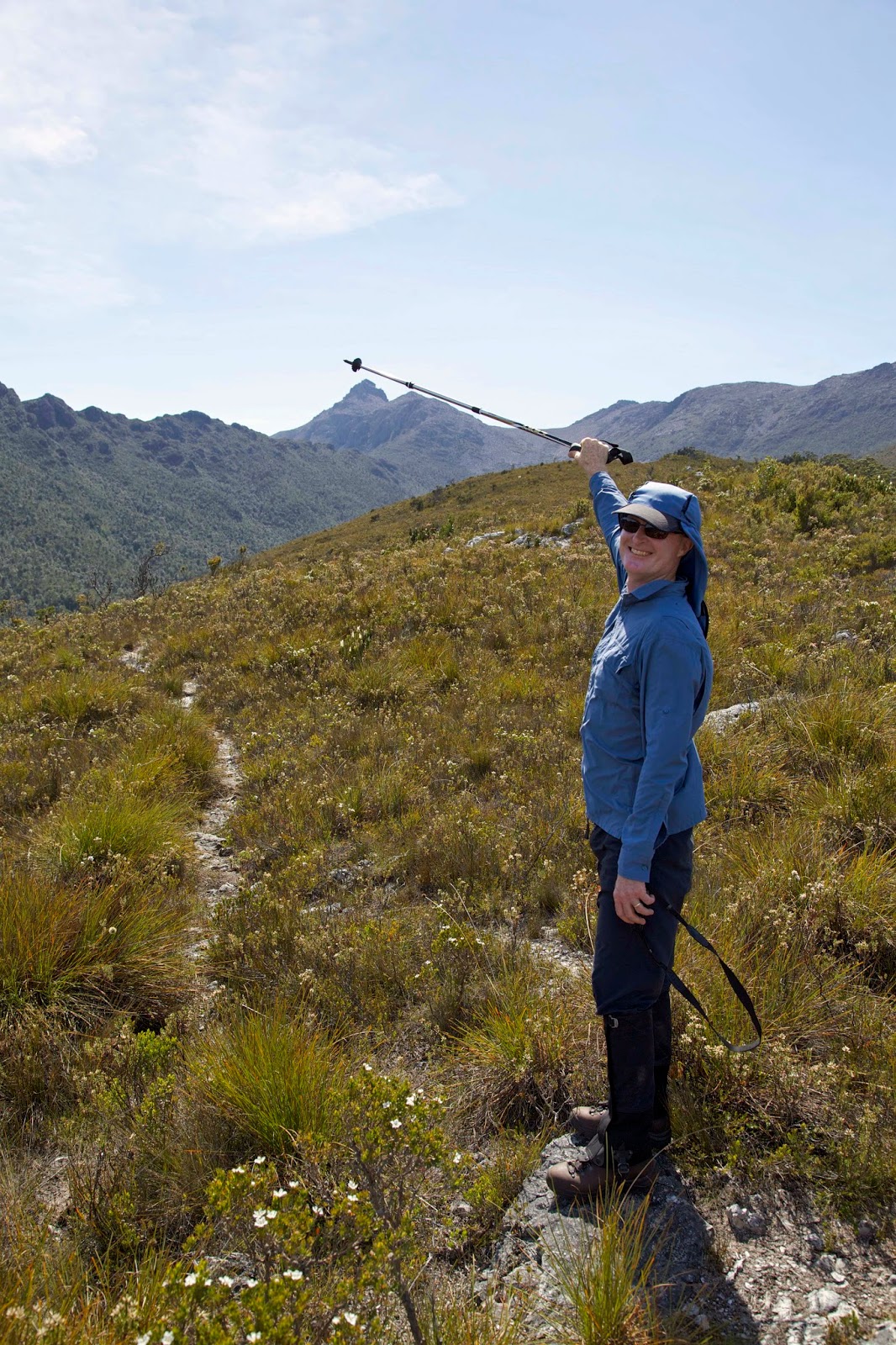

[Tim points out Mt Anne from the lower slopes] 
Considering a 680m climb carrying full packs, we’re not as excited as we might be to see the mighty pyramid of Mt Anne stark against the blue. After a car shuffle and the usual mucking around, we heave our packs on at around 9:30. It’s already over 30 degrees, and our plans of avoiding the heat have melted before us.

We have little time to settle into our packs before we hit the brutal climb up the shade-less buttongrass slope. We’re carrying plenty of water, are slick with sunscreen, and have hats tugged over our faces. Still, it’s inescapably hot. Between heaving breaths Tim and I fantasise about solar-powered air conditioned hats. “There’s a gap in the market” Tim reckons.

We trudge slowly upwards, stopping frequently for water and sometimes scroggin. Over the decades I’ve done this part of the walk many times in all kinds of conditions, but today feels the hardest. Is it Christmas/New Year over-indulgence on top of the heat, or am I just getting older?
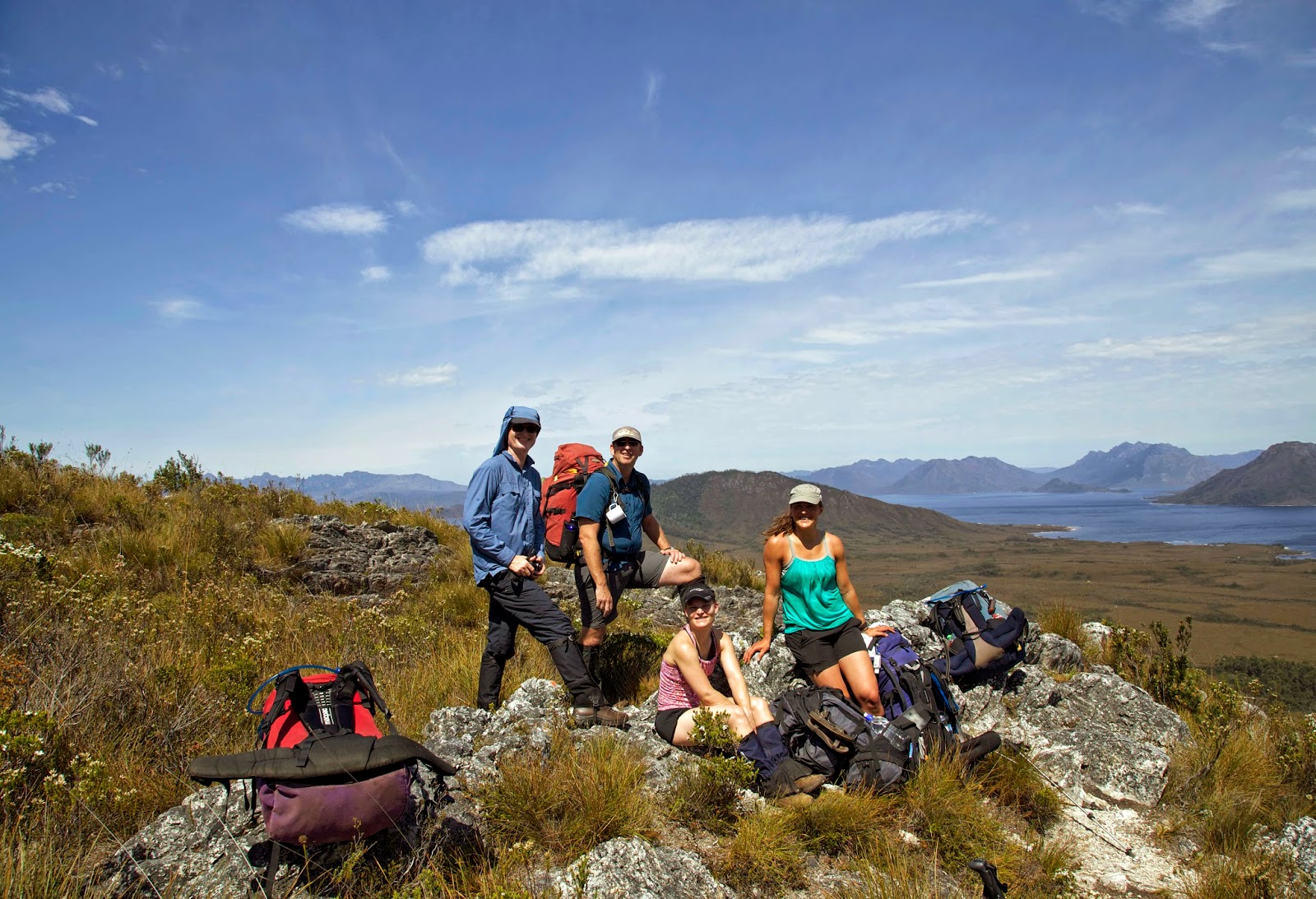

[An early break on the way up Mt Eliza] 
At least the views out over the south-west are as good as ever. We tell Paola and Lina, the two German walkers who have joined us, the names of the various ranges. Tim and I linger over the saw-toothed profile of the Western Arthur Range, remembering separate epic trips there. We recount the story of the original Lake Pedder, and the impoundment that now covers it. They are gob-smacked by their surroundings, and teach us some German expressions of awe and wonder … or possibly they’re just expletives!

We’ve planned a lunch break at the Mt Eliza Hut. I remember it always taking quite a while to come into view, but today it is stubbornly tardy. Mick and the frauleins decide to walk on and wait for us at the hut. Tim stays with me, doing his best to jolly me along. I’m struggling, barely able to put more than 50 steps together before needing to stop again.

There is no respite from the heat, no trees to shade us and precious little breeze. I feel as though my brain is boiling inside my hat. We reach the top of a slope, or what turns out to be a false top. I slump to the ground again, turn my head as far away from the sun as possible, mutter apologetic words of exhaustion to Tim.

[Mick at High Camp Memorial Hut, aka Eliza Hut]
After a while I look up, as though to will the hut to appear. Instead I see Mick coming towards us, without his pack, carrying two bottles. He gives each of us a bottle of fresh cool water. The bad news, he says, is that the hut is still 40 minutes away. The good news is that he’s happy to carry my pack to the hut. I bless him, take a slug of water, and we set off.

I start to realise I’m not just tired when I find walking just as hard without the pack. Tim recounts his experience of heat stroke on a Frenchmans Cap trip. It included nausea and vomiting, but as I’m not feeling sick, I don’t think I’ve got that. But it could be heat exhaustion. Distracted by such speculations, we suddenly reach the hut. It’s only taken 20 minutes. Mick has a sly smile. “Thought it’d be better to overestimate.”


[Is this heat exhaustion? Resting outside the Eliza Hut. photo Mick Adams] 
I drop to the ground outside the hut, in the shade of a myrtle beech tree. I can’t even lift my head to drink, let alone think of eating. I lie there for 15 or 20 minutes before starting to feel human again. We have lunch and discuss the options for the rest of the day. I’m not the only one suffering in the heat, and given we’re only just over half-way to our destination at Shelf Camp, and that rain is forecast, we eventually choose to stay at the hut. We’ll re-assess our onward options in the morning.

Over lunch Paola gives me an orange-flavoured magnesium tablet to dissolve in a bottle of water. It’s supposed to help replace electrolytes after physical exertion, and seems to hit the spot. After an hour or so of rest and rehydration, I feel well enough to join the others on a recce of the track above.
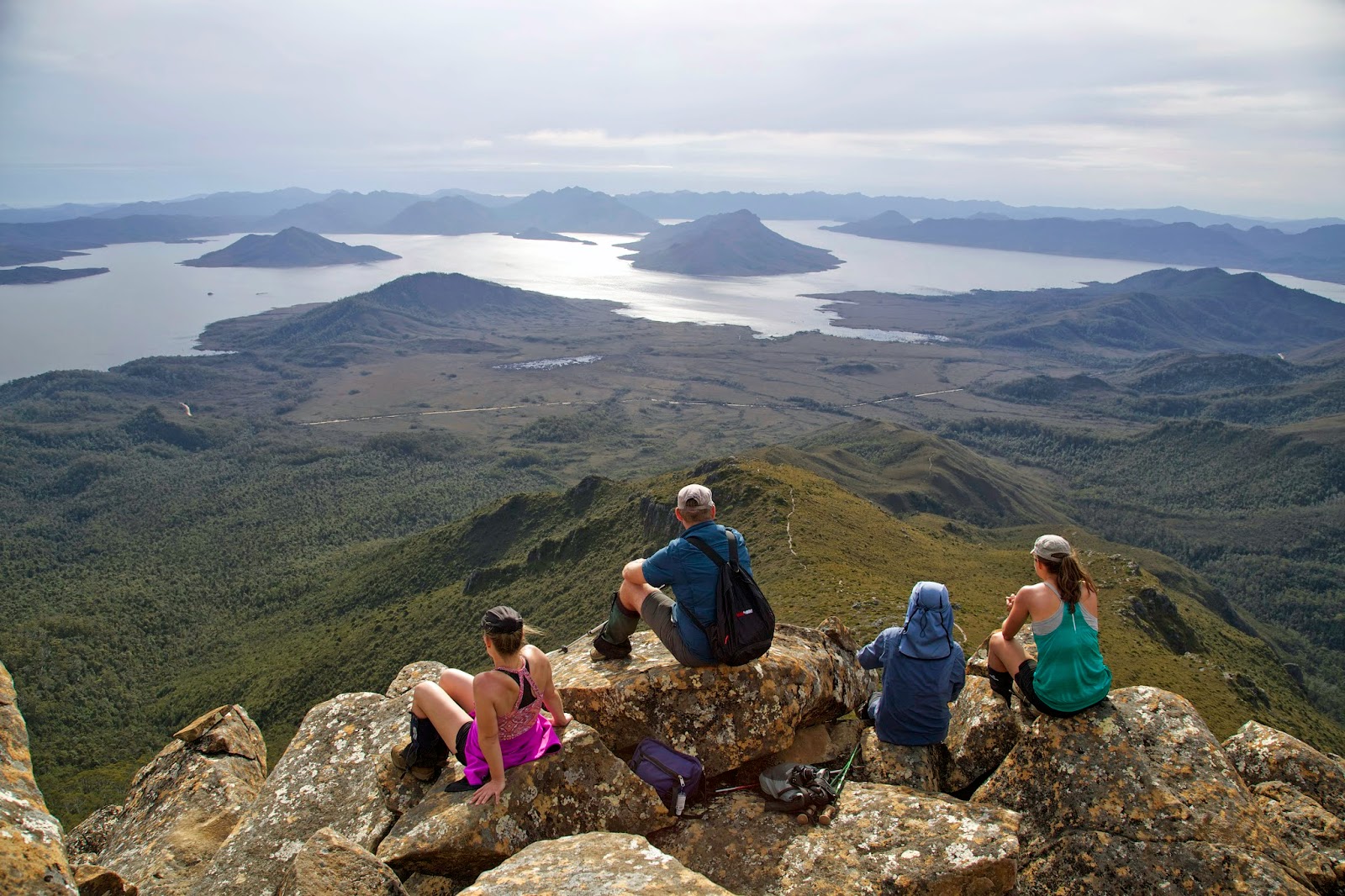

[Stunning views over Lake Pedder from above Eliza Hut] 
The track is steeper and rockier than ever, but with tiny day packs and superb views, it’s surprisingly do-able. But any thoughts of staying up there for sunset views over Lake Pedder are overturned by a coming storm. We turn back and reach the hut just as a long line of bruised black cloud rolls towards us over the lake. Lightning flickers, a veil of rain is draped beneath the cloud, and thunder rumbles. We estimate its time of arrival, then Tim and I tighten our tent guys and retreat to the shelter of the hut for a spectacular show.
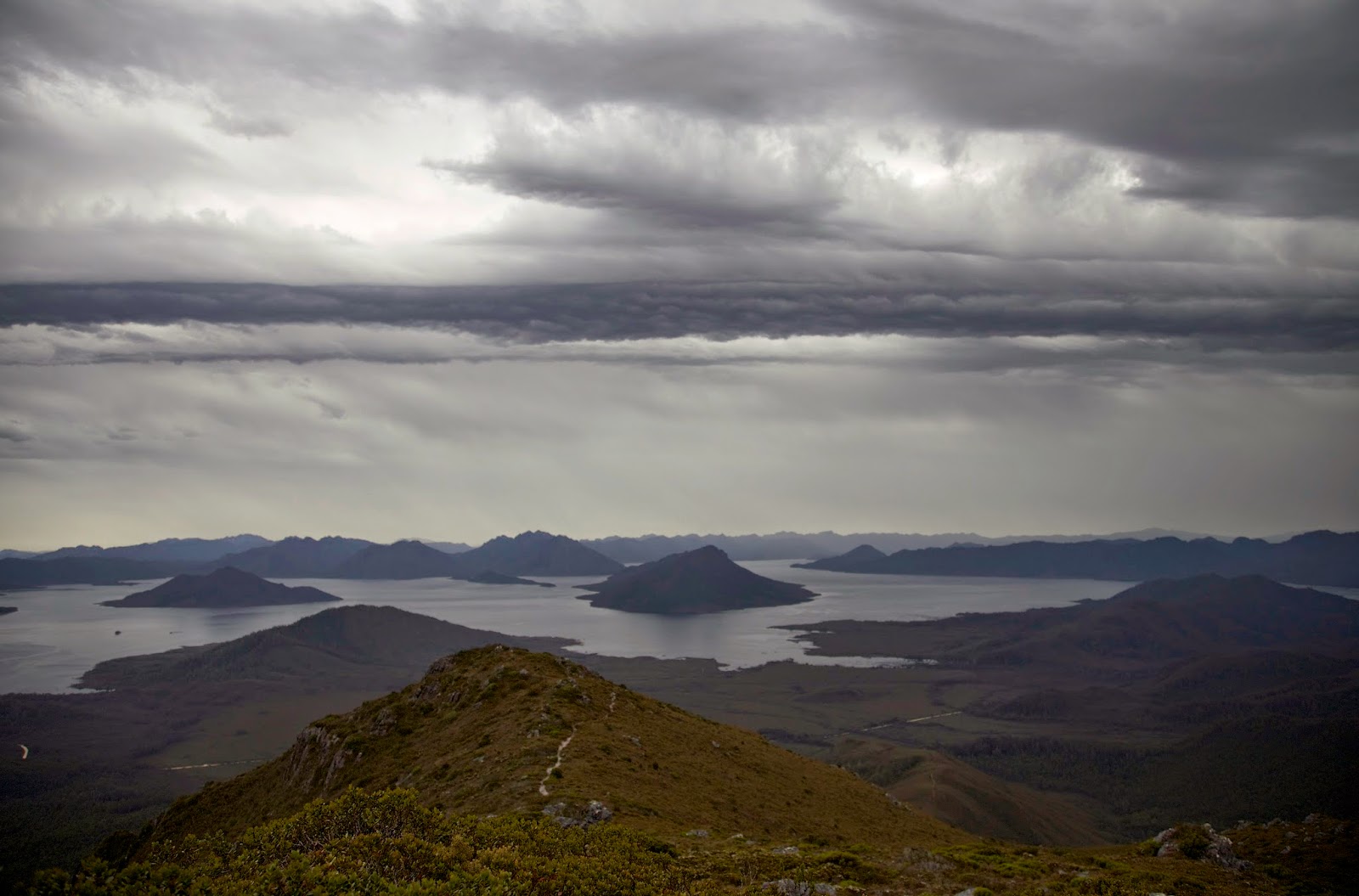

[The storm approaches Eliza Hut] 
The beat of the rain drowns out normal conversation, so we have to shout our gladness that we’re not caught out on Eliza Plateau during this! Perhaps my heat exhaustion was a blessing in disguise. As I share some wine with Mick – a small thank you for his kindness – I raise a glass to dry huts and fortuitous decisions.


Tuesday, 12 April 2011

Returning to Rhona (4)

Part 4: Wasting the Wilderness

Autumn 2011. Trip number 5 to Lake Rhona starts in the kind of summer weather we've not seen during summer itself. We cross a summer river, walk up a summer valley, feel the peat-bound heat of summer reflecting back at us fiercely. We climb that final summer hill and promise we'll slake our thirsts in the deliciously cool summer cup that is Lake Rhona.


Lake Rhona, with Reeds Peak behind. An idyllic scene, but the dead standing pines tell a story  

On every bushwalking trip I carry baggage. I don't mean the sort that fits inside my pack, but the emotional kind. On trips to Lake Rhona, the memory of the tragic loss of Lake Pedder is the heaviest of these, no matter how much I insist that Rhona and Pedder are completely distinct from each other.

I lost a sister to cancer at a tragically young age. To this day her now-adult daughters always remind me of her. That's not to say they don't each have their own unique and treasured identity. It's a simple acknowledgement of what gets caught in memory's net.

To walk through any part of the Tasmanian wilderness is to be reminded of its past: what it has lost; the threats it has faced; the threats it continues to face.

For me it starts with a loud absence: that of Tasmania's Palawa. In the 1830s escaped convicts, Goodwin and Connolly, reported seeing many Aboriginal huts in the Vale of Rasselas. Within decades they and their occupants had either died or been driven from the area.

Ironically the absence of their fire use opened the area to greater fire risks. Aboriginal burning was generally small-scale and out of peak season. Its main purpose was to clear localised hunting grounds. European burning was less judicious, and too often of a timing and scale that brought landscape-wide devastation.

Early on this was for exploration, mining and grazing. But later forestry burning had a huge impact too. Even Ernie Bond, who was not averse to burning his grazing grounds, was aghast at the effect of post-war forestry fires in the Gordon, Florentine and Rasselas valleys.

On my first trip to Rhona there was another piece of heavy "baggage". The summer before a hazard reduction burn in the Florentine had gone drastically wrong. The fire had escaped, burned through the Vale of Rasselas, and found its way up to a defenseless Lake Rhona.

The great majority of the stunning King Billy pine forest that lined its northern shore was burned and lost. Dead stumps still stand there today, the pines' residue resin keeping them preserved from rot, vertical but lifeless. Nature abhors a vacuum: eucalypts have largely filled the void, with just a few King Billys left alive to remind us of our folly.


A King Billy pine clings to life on the shores of Lake Rhona 

Meanwhile, back in autumn 2011. Exhaustion and a late arrival prevent us from keeping our promise to drink Rhona's cup dry. But on the way up we've also been discussing the touchy issue of toileting in this area. It has started us thinking about the quality of the water in the lake. By our back-of-the-envelope calculations, bushwalkers deposit around 1 000 "number twos" around the lake shore every year. This being an alpine area, we've learned that decomposition of solid waste is very slow. Essentially most bushwalkers here are "pooing in their own nest", to borrow some technical ornithological terminology!

Our inspection of the area immediately behind the campsite confirms some fairly squalid toileting practices. Solid waste and toilet paper are not hard to find. Some has been buried in shallow sand, an easy find for the wildlife. The presence of a bold - and very plump - native rat (probably Mastacomys fuscus) at the campsite has us speculating in a very ugly direction regarding its diet!

By mutual agreement our party has decided to walk the 100-200 metres out of the catchment area to do our "number twos". Another solution would be to use "poo tubes". This combination of biodegradable bags and large tight-lidded plastic "pots" (approx. 10cm in diameter) for storing and carrying human waste, is the ultimate "carry in, carry out" practice.


Lake Rhona water: as cool and clear as iced tea ... we hope!

Some find the thought of this as gross as considering the Rhona rat's diet. Many would prefer someone else take responsibility for removing their waste, hence the popular call for a fly-in-fly-out toilet to be placed behind Rhona's beach. Personally I hope we can learn from our wilderness mistakes of the past, and start to take a deeper responsibility for removing unnecessary traces from these wild places.

Friday, 8 April 2011

Returning to Rhona (3)

Part 3: No Substitute Heart


An aerial photo of Lake Pedder, summer 1971. The beach, here at its summer maximum, is around 700m wide. (photo by Lands Department, courtesy  "The South West Book", eds. Janet Fenton and Helen Gee, 1978) 


"I confess I do not believe in time. I like to fold my magic carpet, after use, in such a way as to superimpose one part of the pattern upon another. Let visitors trip.” – Vladimir Nabokov.


It's late 1971. The Vietnam War is grinding on, protest is in the air, and the straggles of my first beard are appearing. School's out forever, and some mates have invited me to Tasmania to climb Federation Peak and see Lake Pedder.

I am keen to test myself on Australia’s wildest mountain, and roused to anger by the impending destruction of this stunning lake. But I am also a penniless student, and ultimately I decline the invitation. It becomes one of the few regrets of my life, a mere lack of money now looking a feebly thin excuse.

By the time a job and money have come along, and I get to see the south-west, it is 1976. Lake Pedder, “the heart of the south-west wilderness”, is 20 metres beneath a hydro-electric impoundment. The new lake is becoming a fishing destination, its amazing golden/pink quartzite beach entombed in water, its new shoreline a beach-less scar haunted by skeleton trees.

To this day Federation Peak and Lake Pedder remain central to my personal iconography. Surely to anyone they could justly represent a wild, post-Pleistocene, dynamic balance; exemplary remnants of Tasmania’s timeless struggle with ice; the yin and yang of our wilderness. The one resistant, forbidding, defiant; the other yielding, welcoming, constantly changing.

It’s in this context, a decade or so after the damming, that I first visit Lake Rhona. Those who lead the walk are partly motivated by the supposed resemblance between Pedder and Rhona. There is still a keen grief at the loss of Pedder, ‘though some talk of the existence of Rhona as some kind of consolation. “Come and see what Pedder was like”, says one old-timer.

I can admit a fleeting, superficial resemblance between the two: both the results of glacial action; both possessing beautiful quartzite sand beaches. Yet as a student of earth science I know that the geological and geomorphological provenances of the lakes are very different. Pedder is in a basin at less than 300m altitude. It is broad, expansive, occupying an out-wash plain with the Frankland Range set back. Rhona sits at 900m, a compact alpine lake occupying a glacial cirque, tightly beset by the tilting Denison Range.

But forget the science! Hear what artist Max Angus says about the experience of Pedder.

No description, however detailed, could remotely convey the sense of awe and wonder felt by those who saw this magic place … the overwhelming sense is of space and light … you look at an infinity of sky and mountains reflected all around in the impeccable surface of the lake.” (from “Lake Pedder”, The Wilderness Society, B. Brown (ed), 1986)

Contrast that with my first experience of Rhona. We stagger down to the lake by torchlight, our group hopelessly optimistic and horribly delayed. We set up tents on a beach that is narrow, set about by trees and surrounded by what we guess to be vast heights, even in the dark. We are so exhausted we barely notice.


Lake Rhona: dark perfection and quartz sand beach nestled beneath the Denison Range 


And in the morning we know that we are in the presence of a beauty that is perfectly its own, and no substitute. Comparisons are odious, although the grief behind them is to be encouraged. In the presence of this small gem, it is fair, for a time, to feel the loss of the great jewel. Even if some future generation pulls the plug on the dam, I feel that it is unlikely I will ever see Pedder. I had my chance, and missed it: a double grief perhaps.

But Rhona remains, and I will not allow it to be diminished by asking it to be a substitute heart. Since that first visit, nearly 30 years ago, I have unrolled my magic carpet and journeyed to this perfect place four more times. Here it seems possible to join Nabokov in ceasing to believe in time.

Friday, 2 October 2009

Finding Whirinaki


[written following a visit to the central North Island of New Zealand, September 2009]

Place names can ring like a bell, although the reasons for this may vary. I once lived near towns whose names I delighted in reciting: Cookamidgera, Mandagery, Mugincoble. The last, pronounced “Muh-JINK-a-bull”, was also a railway town, giving its nomenclature an onomatopoeic perfection.

For passing generations, Passchendaele and Pearl Harbour evoked the opposite of delight, and for some of my generation Lake Pedder still carries a plangent, melancholy note. Across the Tasman Sea Lake Manapouri and Whirinaki Forest sound all the sweeter for what might have happened there.

Whirinaki (the “Wh” is pronounced as a “F”) has long fascinated me. But it is early spring 2009 before I am finally going there. 25 years have passed since the logging ceased. It’s a clear and sun-filled day, and I’m in the company of Joe Doherty, a respected elder of the local Ngai Tuhoe Maori tribe. He and his family run Te Urewera Treks here in the eastern Bay of Plenty area, in the central North Island of New Zealand. Today I have Joe one-on-one.

On the drive up he is as happy speaking about his Irish ancestry as his long and local Maori heritage. But when we reach Whirinaki, the first thing he does is stop and pray in Maori. Or at least that’s my take on the Maori invocation or karakia. He pauses at the forest portal, explaining that he will acknowledge the creator and the spirit of the forest, and ask them to welcome us to this place. His voice is deep and his tone reverent, but the words scarcely penetrate the forest, seeming to be absorbed by the foliage.

We step into the ancient podocarp forest, once dubbed a dinosaur forest by David Bellamy because its ancestor trees were around in the Jurassic. If Joe’s prayer hadn’t already done it, the still, quiet and darkly green place would have quickly awed me. Great vaulting trunks of rata and rimu; matai and miro; totara and kahikatea burst from dense and deeply green fern glades. The sometimes fissured trunks are covered with delicate-leafed creepers and climbing ferns; the upper branches festooned with hitch-hiking epiphytes.

When Charles Darwin first stepped into a Brazilian rainforest, his breath was similarly taken away. “Sublime devotion (was) the prevalent feeling”, he reported, describing:

Twiners entwining twiners — tresses like hair — beautiful lepidoptera — Silence — hosannah.

For us there are no butterflies, but the hosannahs of kaka cascade down from the tree tops, part parrot-scratch, part song-bird melody. All else is muffled – our footsteps, our conversation – as though in a cathedral. As Joe quietly explains his karakia, it confirms my sense of its closeness to prayer. Surely part of prayer is a humbling and grateful recognition of powers far greater than the human.

I pause to wonder why I, as a Christian, do not stop to make this sort of acknowledgement in similar places. Walking through this botanical wonder, I also ponder how Christian notions of sin might apply to the destruction of the great majority of New Zealand’s podocarp forests. In 1947 the New Zealand Forest Service saw it in different terms, summing up with chilling pragmatism that "dairy farming demands such land (and timber) in the national interest and kahikatea forests are therefore impossible."
Against such a backdrop Whirinaki is a miraculous survivor; a virtual tree museum in national terms; a small arboreal throw-back. Today it is surrounded by a vast acreage of pine and eucalypt plantation, tree farms that deaden mile after mile of the drive down SH1 from Auckland to Wellington.

I first drove that road in the early 1970s, a wide-eyed and gormless Australian student on a fleeting visit. But even then I had a sense that the heart was missing from this countryside. Here in Whirinaki, 35 years later, might I have found its still-beating pulse? Here at least, the wonder of water and soil are still in the service of what has grown and flown here since the dinosaurs. As Joe tells me about the long human connections here, the picture widens. I gain a glimpse of a living system of plants and animals; humans and landforms, that indicate it’s even more than just the botanical heart of New Zealand’s North Island. We can have a place in the forests too. Darwin’s hosannah fits Whirinaki.

Thursday, 11 June 2009

A Hymn to Tasmania

[A Welcome Speech to the Interpretation Australia Association (IAA) National Conference in Strahan, Tasmania by Peter Grant, October 3, 2005]

What is this place, this island you have come to that we call Tasmania? In a sense there are as many Tasmanias as there are people who experience it. So I would like to simply share something quite personal of what Tasmania means to me. I call it “A Hymn to Tasmania”, adding a warning footnote that not all hymns are “happy clappy”. Many of the best have a dark or sombre note through which hope and victory must struggle to shine.


Leonardo Da Vinci’s Mona Lisa is universally regarded as a magnificent work of art. In addition to the beauty of the subject, there is something about the enigmatic smile that has sparked both admiration and speculation for as long as it has existed. Likewise there is a certain magnificence to Tasmania. Here is an island – an archipelago of islands as our late Premier Jim Bacon liked to say – that is admired across the Strait by the majority of Australians, and loved by the increasing numbers who come to it from further afield.

Here you will find a beguiling mixture of utter wildness and amiable approachability. As American writer and photographer Arthur Rosenfeld put it “nowhere have I seen such breathtaking contrasts arise so naturally from the dialogue between mountain and forest, clarity and cloud, sun and moon. A person can disappear in beauty like this."

But once you have penetrated the beauty of this island you will find, as with the Mona Lisa, that there is also an enigma. Instead of a smile however, it is an enigmatic frown. On this heart-shaped island, there is a feeling that the heart has been hurt if not broken at times. What is the source of this frown; this veiled heart-ache? For me it derives from a sense that something tragic, something sad, flawed or failed has happened here. A skein of melancholy seems woven into the warp and weft of this beautiful place.

And our history bears this out, starting with the Aboriginal tragedy that unfolded here following European invasion. It is difficult to see how we can use any other word than invasion. Surely “discovery” is just plain wrong, and “settlement” euphemistic at best. Even before 1803 there were skirmishes between the Palawa, the original Tasmanians, and the Europeans – as there were also friendly exchanges. But once the English decided to come, their gaze having turned here following their capture of French information on the island, there was little that could stop them. Aboriginal resistance was blunted by both guns and germs. The Palawa, so long isolated from a host of germs, quickly succumbed to European-borne diseases. It was a victory of sorts merely to survive under such circumstances, but Tasmania’s Aboriginal people have survived … and we will hear more of that story later.

Not only were the English determined to injure, infect or ignore the island’s long-established inhabitants, they also worked to supplant them with convicts. This cargo of human misery was to be transplanted out of the old country – out of sight and mind – to the “end of the world”. A place where nature herself was to be one of the keenest gaolers. Thus were culture and nature dubious allies in old Van Diemen’s Land.

And then there is our more modern history, in which the worst excesses of Van Diemen’s Land were to be expunged through hard labour. But this time the work was not so much for the overseers as for ourselves. We would delve, cut, sow and pluck a new state into being, even changing our name to Tasmania as though to distance ourselves from “the hated stain” of our convict past.

So how have we fared on this rebound from the past? Let me employ an extended analogy. The ancient Hebrew prophet Hosea was given one of the most bizarre jobs in the bible. He was instructed by God to marry a prostitute named Gomer. This was so that he could experience, and then communicate to his peers, what it was like for the Lord to have his “wife” – the people of Israel – constantly unfaithful to him through worshipping false gods.

As I look at modern Tasmania, I sometimes feel a little like Hosea. I love this place, yet Tasmania, like Gomer, seems always ready to run off after false gods. In the post war years this included the idea that we could become a manufacturing centre – “The Ruhr Valley of the South” was the rhetoric of the time – if only we could produce enough cheap power to attract heavy industry. The loss of the irreplaceable Lake Pedder was one result of this short-skirts-and-gaudy-make-up approach. And currently it seems that we are selling off our forests for a cheap drink and a bit of slap-and-tickle, while only the Madam makes any money.

I have recently returned from Alaska, a place with many resonances for a Tasmanian. Alaska is seen – indeed their vehicle number plates proclaim it – as “the last frontier”. (We are “Your Natural State”.) When Alaska was purchased from the Russians in 1867 for $7.2million (about 2c an acre), it was derided by the press and many politicians as a waste of money for a useless “ice-box”. (While no-one had to buy Tasmania, I’m sure some of you consider us to be Australia’s bar-fridge in terms of climate! And doubtless Cascade & Boags would be happy to fill that role for you!)

Despite its inglorious beginning, one of Alaska’s biggest roles today is as a reminder of what the lower 48 used to be and used to have. In Alaska you will find vast forests, huge wildernesses of ice-fields and glaciers, wildlife in unbelievable abundance. Tasmania plays a similar role for Australia, albeit on a smaller scale, especially in terms of intact wild ecosystems. Chief Geographer Henry Gannett, writing of Alaska in the late 1800s, stated that its grandeur, “is more valuable than the gold or the fish or the timber, for it will never be exhausted.“ This quote, more than a century old, sets out some of the alternatives both Alaskans and Tasmanians still face today.

And in neither place is it always a straightforward choice. In Alaska the tourists that come to see the grandeur, especially those in cruise ships, can overwhelm the local populace and the unique local culture. Juneau, the state’s capital, is dominated as much by its plethora of souvenir and merchandise shops as it is by its stunning mountainous surroundings. The locals know that you only have to go 100 metres up any hill – and there are plenty of those – and you will shake off the exercise-shy tourists. Either that or wait for winter! In Sitka, where I spent most of the last month, the best coffee shop in town, a wonderful Bohemian hang-out, is hidden away at the back of a bookshop, and thus protected from the majority of the “boat people”.

Bulk tourism of this kind seems to be a very mixed blessing. Which is where Tourism Tasmania’s “Experience Strategy” seems to me to show the way. Here it is recognised that you will only add value to tourism, and win the word-of-mouth game, if you offer an authentic experience. Can you truly experience Alaska by spending several days in a cruise ship, stopping en-masse in ports that sell food and merchandise that comes from the cruise companies, and is usually made elsewhere? And if you seldom meet a local and go no further afield than the shops, how “Alaskan” is the experience? You could see the same scenery, and more wildlife, by staying at home and watching the Discovery Channel. You would also avoid sea sickness.

Tourism Tasmania, to its credit, has recognised that tourists increasingly demand an authentic experience. Moreover they have seen that the key to providing such experiences in Tasmania is interpretation. And so a circle starts to form, cycling through experience, stories and meaning to authenticity … with interpreters central to the whole process. However it will not remain authentic if we Tasmanians “whitewash our tombs”; if we try to gloss over the tragedies of our past or the inconsistencies of our present.

American novelist David Guterson (“Snow Falling on Cedars”), who himself lives on an island, observed that:

Islands fill mainlanders with an unabashed yearning for a life simpler than the one they endure, a pared-down life in which all that is elemental - sea, wind, sun, love, the last light of day, the sand beneath fingernails - is brought to the fore-front of existence.

In Tasmania we can choose to pander to that illusion. We can try to convey that here you will find only blessed and happy people; the cleanest and greenest of economies; food and wine fit for gods; and bounteous wild and untouched wilderness, all in perfect balance. Or we can tell the truth: that the human drama, with all its pathos, comedy, tragedy, farce and struggle, is played out here in the nature culture of Tasmania, just as it is everywhere.

And yet … it seems to me that there are lessons that can be learned from observing Australia’s island state closely. Our conference theme is Nature Culture: Interpreting the Divide. Here in Tasmania if we have witnessed, and continue to witness, some of the dreadful results of the perceived divide between the two, there are also positives that have been gained. I have spoken of tragedies in relation to our Aboriginal, convict and resource extraction histories. But each of these also shows us a hopeful side. Despite everything, our Aboriginal people have survived. And their culture and presence is burgeoning, as you will witness when you hear Jim Everett or walk the Henty Dunes. Likewise our convict past, as Richard Davey so eloquently reminds us, managed to produce some unexpected – and at the time unwanted – positives in terms of resistance, ingenuity and the triumph of the human spirit. And our natural resources have not been, and will not be, completely pillaged. Here in Strahan you are on the edge of 1.38 million hectares of World Heritage Area – saved and so-proclaimed through the action of individuals who loved this wild home, and told their rulers so.

As you experience the extraordinary places around Strahan, and around the rest of Tasmania, try to resist the notion that this is a place untouched by what happens where you live. And above all reject the notion that you are an alien here. As Gary Snyder has pointed out, nature is not a place to visit, it is home1. Welcome home.


1. The Practice of the Wild, p 7