Sunday, 9 November 2014

Otago Central Rail Trail: Part 4


If we needed reminding that we were riding where only trains had been for most of the 20th century, Ranfurly Railway Station was enough to do it. The large, verandahed station is something of a hub for the town. As well as functioning as an iSite, it also houses a rail museum. All it lacks is trains to fill the generous space beside the platform. Instead its freshly painted exteriors and well-kept lawns function as an over-grand starting point for the handful of cyclists gathered there that morning.


[A reminder of what first used the Rail Trail]
But we were getting used to the grand and generous spirit of the people along the rail trail. After we’d retrieved our bikes, bought lunch and topped up on coffee (no cafes on the trail this morning!) it wouldn’t have surprised us to have been officially flagged off by the locals. Instead we simply straddled our bikes and rode gently downhill into the pretty countryside. Given this was to be one our longer days – still only 32km – it was a good way to start.

For me that idyll was rudely interrupted by a brash Aussie, who deliberately crashed into me just as we were approaching Waipiata. A sudden bash on my helmet had me spinning around in time to see a black and white blur rushing off towards a nearby tree. Yes, a magpie, a bird introduced to New Zealand from Australia in the 1860s, had taken offence at my intrusion into its nesting area.


[Lynne rides beneath a road bridge near Waipiata]
Unlike that more infamous Aussie introduction, the brushtail possum, this feral is a little more welcomed by New Zealanders. The magpie’s beautiful warbling call has even been celebrated in a well-known New Zealand poem by Denis Glover. An excerpt from “The Magpies” gives some of the flavour.

When Tom and Elizabeth took the farm
The bracken made their bed
and Quardle oodle ardle wardle doodle
The magpies said.

Still, despite poetic celebrations, and my own previous experience with dive-bombing magpies, the blow to my helmet left me with a headache. I could only imagine the shape I’d have been in if I’d been bare-headed.


[Our usual audience/cheer squad]
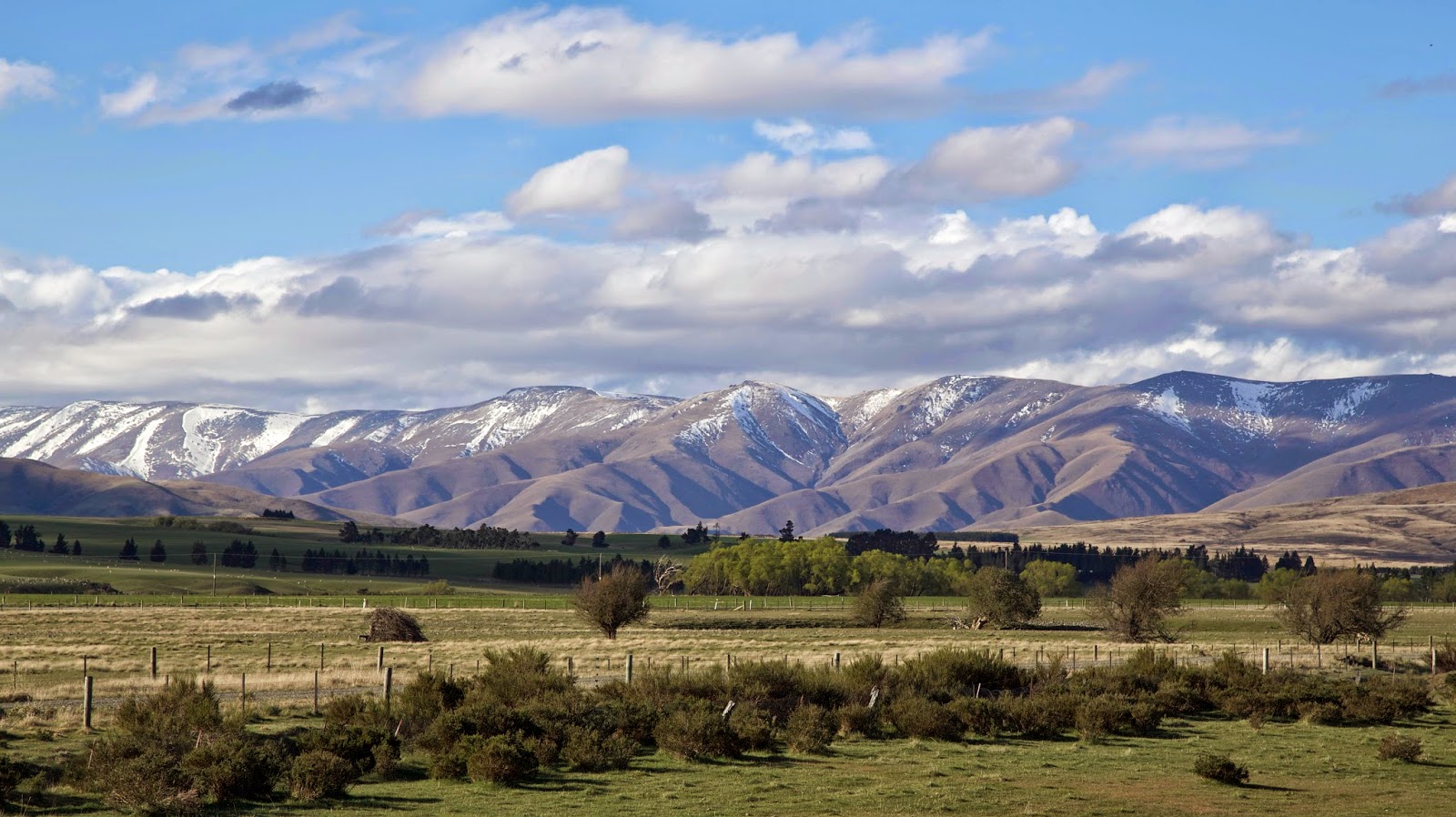
We waited at Waipiata for the others to catch up – keeping a wary eye out for the aggressive Aussie – then cycled off towards our lunch rendezvous with the “support team” at Daisybank. First we had to ride through some sweeping green countryside, with a grand backdrop of the snow-flecked Kakanui Mountains, around Kokonga. Its forlorn former railway station contrasted with the district’s rich irrigated fields and sheep-filled hills.

Arriving at Daisybank we were met by my sister, who looked and sounded as downbeat as Kokonga township. Apparently the car wouldn’t start. Those with a little mechanical nous – and then me – went over to the stricken car. None of us could get any sign of life out of it, and worse, we discovered we were in a mobile phone dead-spot.


[Clouds gather over the Kakanui Mountains]
Fortunately a local farmer stopped and helped us jump-start the car. Jude then drove off to find an Automobile Association garage in Ranfurly, with the hope of getting fixed whatever was malfunctioning. The rest of us, now quite subdued, ate a quick lunch and rode on towards Hyde. We hoped we’d meet Jude there with a functioning car and a smile on her face.

By now we were frequently seeing the Taieri River, which flows beyond the trail’s end and all the way into Dunedin’s outskirts. Seeing it burbling away below our track gave us a sense of going with the flow, and lifted our mood, even if parts of the track bucked the downhill trend and the wind began to blow against us. Over a viaduct, up a hill, through a tunnel, and around a few bends and we were at our destination of Hyde.


[The Trail winds above the Taieri River] 

After we’d downed a welcome drink at Hyde’s Otago Central Hotel, my sister arrived in the hire car. Functioning car: tick. However she wasn’t smiling. The mechanics hadn’t been able to find anything wrong with the battery, the starter motor, or any of the other likely suspects. But the car had kept going, as we could only hope it would next morning, when it would be needed early. Meanwhile there was some serious down-time to be had in the good old-fashioned comfort of the hotel. Tomorrow would have to take care of itself.


[Good old fashioned comfort in the Otago Central Hotel, Hyde] 

Sunday, 2 November 2014

Otago Central Rail Trail: Part 3


[At home in  the saddle: the boys approach the summit] 
It’s as well we feel at home in the saddle by Day 3, because today we climb to the highest point on the trail. Our starting point’s elevation at Oturehua is 500m. Within 7km we must reach 618m. While that’s nothing dramatic, there’s still work to be done. Happily the fair weather and scenic distractions lift our spirits and boost our legs, and we’re soon cresting Seagull Hill.


[The girls at the trail's highest point] 
On the way we have crossed the 45th parallel twice, riding first north-east then turning south. We’re halfway between the equator and the South Pole; and nearly halfway along the OCRT. We can celebrate that at Wedderburn, and cruise down the hill to the Wedderburn Tavern where we plan to keep up our morning coffee tradition.

We meet our “support team” there, and she has to break the bad news to us. The Tavern is closed. There’s a laconic note informing us that they normally open at 10am; or perhaps 11am; or maybe a little later. As there’s no sign of life, we use their outside table for a frugal water and chocolate break. Then it’s back in the saddle for the long stretch across the Maniototo Plain.


[Coffee-less stop at Weddeburn] 

This is a part of the country that defies the idea that New Zealand is compact. Some see New Zealand as the Norway of Australasia: small, full of snowy mountains and fjords, while Australia is more like Sweden: large, spread-out and lacking in vertical relief. Otago poet and essayist Brian Turner sees it differently. “Anyone who tells me New Zealand is a small country hasn’t roamed the hills of Central and rejoiced in its bright sun and clear, crisp air. Clouds assume the shapes of hills and vice versa; there is blue in the hills and white in the skies. Again, vice versa.” (from “Into the Wider World” p. 24)


[Hawkdun Range near the trail's high point]
Yes, this country doesn’t get much broader than the Maniototo. It can even lay claim to a semi-continental climate, with extremes of hot and cold; drought and flood. As we ride through, we seem to only inch our way across the plain. Yet there is never a dull moment. Again Brian Turner captures beautifully the nuances of cycling here in his poem “Cycling in the Maniototo”.

I baa at sheep, 
shout at magpies, moo
 

with cattle, marvel at
the panache of hawks 
riding the air above
 
the Ida Range. And I ride,
 

my legs going round
faster than in months… 


[Big skies, big ride, Central Otago]
While it’s a plain, there are always mountain ranges in view. Majestic Mount St Bathans is behind us, the Ida and Kakanui Ranges to our left, and Rough Ridge to our right. Ahead there are even hints of the Rock and Pillar Range, which will dominate the sky by the end of the trail at Middlemarch.


[Riding towards the Maniototo, Mt St Bathans behind]
But that’s getting ahead of ourselves by a couple of days. Today we have to get to Ranfurly, where we’ll have lunch, explore the rail-themed display in the old railway station, and meet our accommodation pick-up. Our riding will be over for the day, but there’ll be much more ahead. (See the forthcoming post “Off the Rails: The OCRT After-Hours”.)

Sunday, 26 October 2014

Otago Central Rail Trail: Part 2

Our second section of the Otago Central Rail Trail must be brought to us by the letter 'O', as today's ride takes us from Omakau to Oturehua. Of course that's after we've checked out Ophir, an old mining town a few km off the trail near Omakau.

Our start is sedate: we now have our sister-in-law doing her first day with us. In fact it's her first full day on a bike since she was a girl. Besides, there's a cafe near Lauder, just 9km up the track, and we have a tradition to uphold.


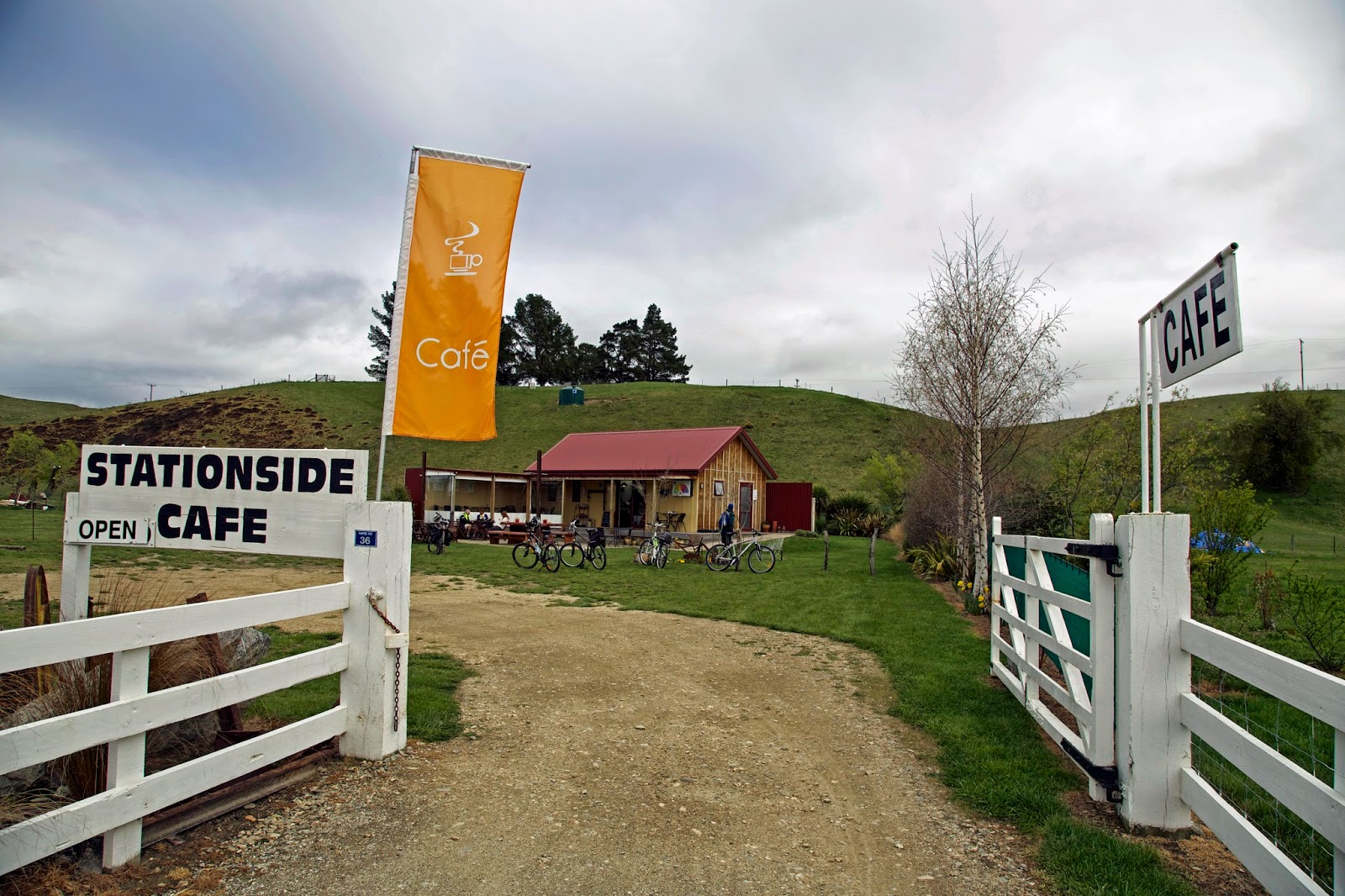
[The cafe near Lauder: it's never too early for a coffee break!] 

The weather has turned fairer, clouds giving way to patches of blue. We feel small in the wide open green of Central Otago, with its backdrop of snow-capped, cloud-topped ranges. In summer this place can bake, drying to dusty, pale stubble fields. In winter it can be killing cold, with frosts and snows that might freeze unprotected sheep solid. But we're here in spring, a gentle one too, and the fields are green and amply dotted with sheep. As we cycle past we occasionally spook a ewe with new lambs. She bleats a warning, and the lambs rush for the shelter beneath, butting hard at her udders. Connection made they vigorously wiggle their long tails as though to turn up the volume.


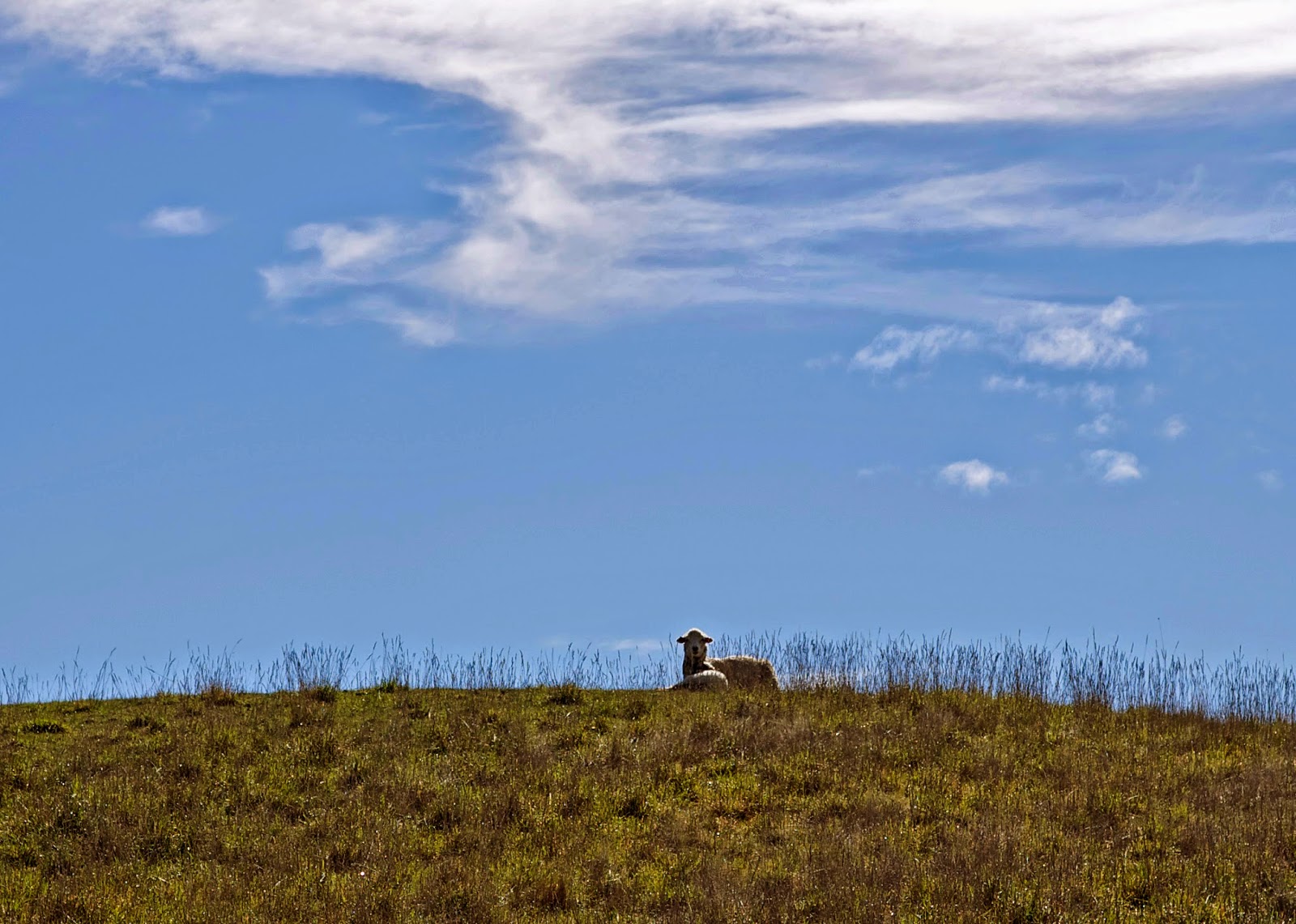
[Lambing time in Central Otago] 

Scenes like this are part of the allure of slower travel. At walking or cycling pace you get to see, smell, hear, feel and more fully take in your surroundings. It sounds simple, yet the experience of it is much more profound than the saying of it. For me at least there is a small exchange at the soul level. Whether a part of me is left in the lambing fields of Otago, or a part of that place has entered me, I am not sure. Perhaps it’s a bit of both.

After Lauder we cross an iron and stone bridge over the Manuherikia River, and climb gradually towards the Poolburn Gorge. We've been told this is one of the most spectacular sections of the OCRT, with long tunnels, a steep gorge and the impressive Poolburn Viaduct. We've planned to meet my sister at the viaduct, although there’s talk of her trying to walk in and meet us at one of the tunnels.

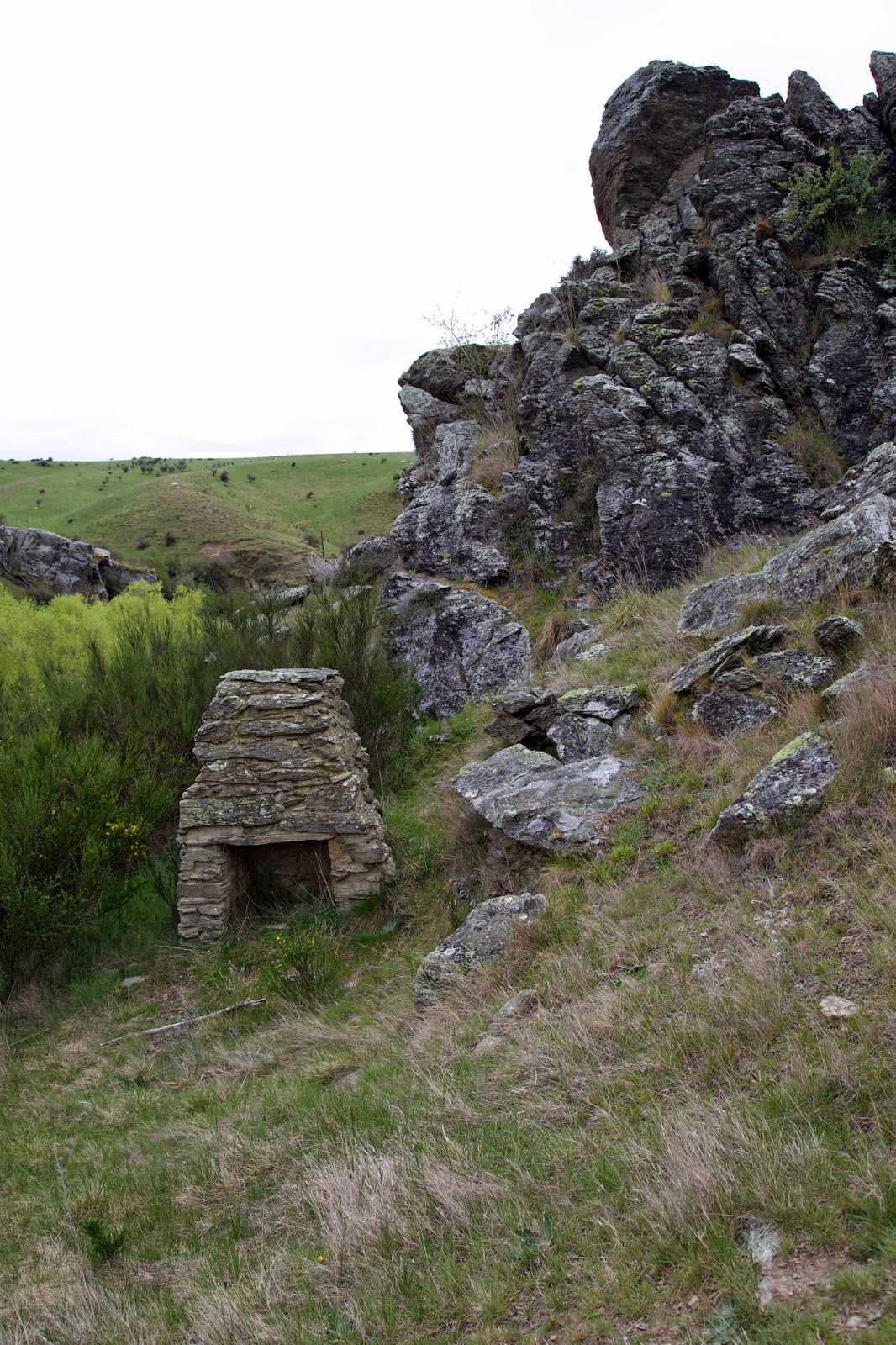
The climb is easy enough without wind, and we soon reach the first tunnel. Before going through, a few of us drop bikes and walk off to explore the former tunnel builders' camp. We marvel at the hardiness of these labourers, living for years on these prodigiously steep slopes above the river. What to us is a spectacle was to them a living trial; doing hard physical work sometimes in burning heat, often in ferocious cold, always on menacingly steep slopes. A couple of us wander down to look at the stone hearths and fragments of hut walls, which are all that remain a century or so after the tunnel works were finished.


[Remains of the Tunneller's Camp, Poolburn Gorge] 

My sister appears from the tunnel just as we’re about to enter it. If it seems like precision timing, it’s only through her hard work. She’s walked about 4km up the trail from the nearest road, borrowing a torch for her walk through the 230m long tunnel.


[Our reunion at Tunnel No. 13] 

Some of us ride slowly, others walk, back to the Poolburn Viaduct where we pause for a picnic lunch. We’re in time to watch a group of Sydney school students hoon by in the opposite direction. They’re on a training ride prior to some hard-core mountain biking near Queenstown. We wonder aloud to their teacher whether they’re supplied with air bags. He joins us in rueful laughter before cycling off to catch his charges.

The last part of the day’s ride is through the Ida Valley. While the slope is gentle, the trail surface is loose and sometimes bumpy, and there are long straight stretches. Oturehua takes its time to appear, ‘though it’s the "support crew' we see first, sitting trail-side with a take-away coffee in hand. Our accommodation, my sister tells us, is “just up that hill”. We grimace and ride on, skirting the not-exactly-vast township, and riding up to what turns out to be a spacious and beautifully set up lodge. A shower, a drink and the views to the impressive Dunstan and St Bathan Ranges are quickly restorative.


[View to the Dunstan Range from Oturehua] 


And so Day 2’s riding is done: 32km, easier going in fairer weather, with enough rugged landscape to make you admire the genius of railway builders past. As for us, there's a sense that we might just be properly broken in to this cycling business.