Showing posts with label Brian Turner. Show all posts

Sunday, 2 November 2014

Otago Central Rail Trail: Part 3


[At home in  the saddle: the boys approach the summit] 
It’s as well we feel at home in the saddle by Day 3, because today we climb to the highest point on the trail. Our starting point’s elevation at Oturehua is 500m. Within 7km we must reach 618m. While that’s nothing dramatic, there’s still work to be done. Happily the fair weather and scenic distractions lift our spirits and boost our legs, and we’re soon cresting Seagull Hill.


[The girls at the trail's highest point] 
On the way we have crossed the 45th parallel twice, riding first north-east then turning south. We’re halfway between the equator and the South Pole; and nearly halfway along the OCRT. We can celebrate that at Wedderburn, and cruise down the hill to the Wedderburn Tavern where we plan to keep up our morning coffee tradition.

We meet our “support team” there, and she has to break the bad news to us. The Tavern is closed. There’s a laconic note informing us that they normally open at 10am; or perhaps 11am; or maybe a little later. As there’s no sign of life, we use their outside table for a frugal water and chocolate break. Then it’s back in the saddle for the long stretch across the Maniototo Plain.


[Coffee-less stop at Weddeburn] 

This is a part of the country that defies the idea that New Zealand is compact. Some see New Zealand as the Norway of Australasia: small, full of snowy mountains and fjords, while Australia is more like Sweden: large, spread-out and lacking in vertical relief. Otago poet and essayist Brian Turner sees it differently. “Anyone who tells me New Zealand is a small country hasn’t roamed the hills of Central and rejoiced in its bright sun and clear, crisp air. Clouds assume the shapes of hills and vice versa; there is blue in the hills and white in the skies. Again, vice versa.” (from “Into the Wider World” p. 24)


[Hawkdun Range near the trail's high point]
Yes, this country doesn’t get much broader than the Maniototo. It can even lay claim to a semi-continental climate, with extremes of hot and cold; drought and flood. As we ride through, we seem to only inch our way across the plain. Yet there is never a dull moment. Again Brian Turner captures beautifully the nuances of cycling here in his poem “Cycling in the Maniototo”.

I baa at sheep, 
shout at magpies, moo
 

with cattle, marvel at
the panache of hawks 
riding the air above
 
the Ida Range. And I ride,
 

my legs going round
faster than in months… 


[Big skies, big ride, Central Otago]
While it’s a plain, there are always mountain ranges in view. Majestic Mount St Bathans is behind us, the Ida and Kakanui Ranges to our left, and Rough Ridge to our right. Ahead there are even hints of the Rock and Pillar Range, which will dominate the sky by the end of the trail at Middlemarch.


[Riding towards the Maniototo, Mt St Bathans behind]
But that’s getting ahead of ourselves by a couple of days. Today we have to get to Ranfurly, where we’ll have lunch, explore the rail-themed display in the old railway station, and meet our accommodation pick-up. Our riding will be over for the day, but there’ll be much more ahead. (See the forthcoming post “Off the Rails: The OCRT After-Hours”.)

Sunday, 15 April 2012

Death By Scenery?


“Up there on a fine day is like being surrounded by fields of gold that fortify and fuel the spirit.”  – Brian Turner*

Otago is a dangerous place. Stretching from Dunedin to Mount Aspiring in New Zealand’s South Island, its diverse yet consistently stunning scenery is so compelling that driving can be quite perilous. How are you supposed to keep your eyes on the road when the province’s wide skies, blue lakes, high tawny hills and higher slabby mountains keep demanding your attention? Why is there no tourist guide entitled “Death By Scenery”?!


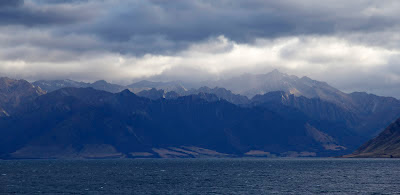
[Looking across Lake Hawea towards Sentinel Peak] 

And it’s not just drivers who are endangered. The same scenery seeps into the soul of walkers, climbers, cyclists, anglers, skiers, kayakers, and all lovers of the outdoors. Whatever the season, whatever the weather, it never quite stops calling you – be it in a whisper or a shout – go out, go up!

We’d gone to Lake Hawea in north-west Otago for some down time. I’ve finally learned not to be surprised at how long it can take to recover from a big walk. There are aches and pains caused by the toxins that build up in muscles during exertion. There’s also the inevitable dehydration, no matter how much you’ve tried to keep up your fluid intake while walking.

And that diet of freeze-dried meals, dry biscuits and scroggin has its effects too. My digestive system usually takes a while to recalibrate itself to things fresh, green and fruity.
Similarly with my psyche. It too needs time to process all the amazements of a good walk.

We were in New Zealand for nearly a month. So after our time on Stewart Island and the Greenstone/Caples Track (see posts here & following), we’d planned a week in a bach (ie a shack or holiday house) at Lake Hawea to give our bodies and souls some recovery time. South Islanders say Hawea today is what Wanaka was a few decades back; a small village with basic facilities in an achingly beautiful lakeside setting.

And there’s the rub. While I love to relax, and enjoying reading, going out for coffee, or tucking into the excellent produce of Otago, after a few days in this setting the siren call of the hills becomes a banshee wail.

It didn’t help that our bach had superb views over the lake towards 2,000m mountains. Nor that our bodies were feeling fit, and wondering where all this indolence was leading. So when the clearest of blue-skied days arrived, we found ourselves having a “leg stretch”. Isthmus Peak, a mere 1,385m, seemed a suitably modest target, promising views over both Lake Hawea and Lake Wanaka.

[An Australasian Harrier soars over Lake Hawea]

As we wound our way towards the tussocky heights, we struck two problems. First there was some ambiguity about the time the walk would take. Was it 3-4 hours each way, or 3-4 hours return? We’d only allowed time for the latter. And then we noticed a small convoy of 4WD vehicles winding up a steep farm track well ahead of us. We guessed they too were headed for Isthmus Peak. We felt cheated! The thought of expending all that effort walking, only to arrive at a peak that others had driven to, was galling.

We sat down for a drink and a think. We had a grandstand view over a high country stations to the lake and the ranges surrounding it. In the distance, at least a kilometre below us, a farmer and his dogs were rounding up cattle. We could just hear him whistling, tooting his ute’s horn and calling, while cows mooed and dogs barked. We smiled at the idyllic scene: hard and honest labour in a sublime setting. But as we watched, the farmer suddenly shouted at one of the dogs. In a clearly audible voice, adding a short Germanic expletive to the word “idiot”, he made it clear he wasn’t impressed with the dog! We nearly fell off our lofty perches laughing, our bubble of bucolic bliss having burst.


[A grandstand view over Lake Hawea] 

The laughter somehow helped us to make up our minds. Rather than going for the named peak, we would leave the marked track and head straight up towards a nearer rocky eminence. When I pointed out that it lacked a name, Lynne helpfully suggested that we could call it “Grants Knob”. 


[Looking towards "Grants Knob"] 
More laughter and some lung-heaving work eventually saw us top out on the newly named “peak”.

“Then the cloud cleared away, the sun came out and we lay in the tussock grass and ate and drank and talked and laughed. The water turned a Prussian blue … The world was transformed into deep blues and pale golds, the robes and heraldry of Central Otago.” *

While these words from Otago writer Brian Turner show us we were not the first to find such a place on such a day, we truly felt that we were. In youth I would have been restless to “bag” the peak. But now, in a setting like this, going further than our own private peak would have felt perverse. Now was the kind of time you would recall for as long as you told tales of wonderful times in wondrous places.

__________________________________________________

* from Brian Turner’s “Into the Wider World: A Backcountry Miscellany”, Random House, 2008