Showing posts with label forecast. Show all posts

Saturday, 15 February 2014

A Vigorous Change: Part 2

As much as I love a good map, it’s not the same as a landscape. Its lines, shapes and colours convey only the vaguest hint, even to the map-literate, of what you might experience when your actual feet traverse the actual land.

Nor are weather forecasts the same as the events they try to predict. You might read the words – even mark, learn and inwardly digest them – but you will have only a shape, a glimpse, a hazy impression of what that will mean when you meet the real weather in the real world.


[Campsite before the change, with the green "Storm Shelter" in the rear]

Back in Jim’s tent, the aptly named “Storm Shelter”, we had some time to ponder such matters. As the early afternoon showers settled into steady rain, we began to consider exactly what “vigorous” – the adjective the forecasters had used to describe the change we were experiencing – was going to mean to us here on the Cathedral Plateau, with nothing but a thin skin of nylon between us and the sky. We had a while to wait.

The afternoon leaked away slowly. We snoozed, chatted, listened to the thunder and the rising wind. At first the latter two were not easy to distinguish, but soon flashes of lightning, followed, one … two … three seconds later by crashing thunder, resolved any doubts. The storm was in our vicinity, if not directly over us.


[Storm brewing over Cathedral] 

The thunder was impressive. My childhood explanations: God moving the furniture; giants playing skittles; clouds bumping into each other, returned to me. The arguably more prosaic truth, that thunder is a greatly scaled-up version of the crackle made by static electricity, does little to dampen your wonder when you’re enfolded by storm. One clap became a round of applause lasting fully sixty seconds as it rolled and rebounded and ricocheted through the surrounding mountains.

Eventually, around 3pm, the show moved on. But the rain remained, keeping us inside. We had set our tent back towards some rocks and pencil pine trees, which we figured would protect us from the forecast strong westerlies. As the wind began to rise, our exposure to the south became an issue. The wet clouds racing over us were coming from the west, sure enough. But the winds were swirling and careening all over the compass.

A roaring gust now smacked into my side of the tent, bowing the short cross-pole and whacking the tent wall down on me. Startled, I looked up at the pole to see if it had bent. It seemed okay, but the winds didn’t let up. No longer a symmetrical dome, the tent had become a skewed, bellying blob with us inside it.

Another gust hit, and this time the diagonal poles were flattened across me. I held my hand up to them, hoping to stabilise the structure a little. Five, six, seven times severe gusts hit. Some were preceded by a warning runaway-locomotive sound; some came with no warning. After each episode I lay back down, hoping for the best. But even the less-than-vigorous winds were still straining the tent’s fragile structure. From where I lay the triangular vent flap looked like the ravening beak of a huge bird of prey, jabbing and probing towards me with each gust.

This kept up for an unnerving hour or more, eventually tipping me over into action. During a slight lull I got out of the tent and went in search of a more sheltered spot. The last thing we wanted to do – relocate the tent – had finally become the second last thing. Being ripped out of the tent by a gust was beginning to look a worse prospect. I told Jim what I thought. We debated the inconvenience factor: a full tent, with gear strewn everywhere, is no fun to pack up. And especially when the wind and rain are as fierce as they were. We moved anyway, into the shelter of a pencil pine grove.


[Our tent sheltered in the pencil pine grove] 
Putting your tent among trees in a gale may not seem wise. But while pencil pines can be blown over, we felt this very unlikely. Alpine conifers know how to bend, and seldom seem to break – at least in comparison with eucalypts.

The other factor in favour of moving because of wind is Murphy’s Law. Getting out of the wind is highly likely to bring about an abatement in conditions. Indeed there was enough easing of wind and rain for us to cook and eat a quick meal just after our relocation. But we were soon driven back into our tents to ponder why the forecast “occasional showers easing” had turned into several hours of continuous rain, including a prolonged and un-forecast thunderstorm. Jim eased our grumps by reading aloud some Bill Bryson. It worked a treat, and laughter became our only post-lunch exercise.


[Morning in the pine grove: photo by Jim Wilson]
When morning came, the rain had cleared and the sun was back. As we packed and left Cathedral, the superb weather felt like a benediction. Only later, once back in mobile range, did we learn how fortunate we’d actually been. Our phones were quickly full of news: wind gusts well over 150km/hour; blackouts and road closures; at least one tent destroyed (on another mountain); and worst of all a fatality due to a tree fall.


[Sunshine in rainforest near the walk's end] 

There’s nothing like perspective to turn your grumps to gratefulness.

Tuesday, 11 February 2014

A Vigorous Change: Part 1

Vigorous is not a word you hear a lot these days, even of people. Strange then to hear it used in a weather forecast.


[Towards the Overland Track from Cathedral, with weather coming] 

Out of curiosity I looked it up. “Vigorous: characterized by or involving physical strength, effort, or energy.” (Oxford Dictionaries) Aha – related to bushwalking, I thought. They added some synonyms: “strenuous, powerful, potent, forceful, forcible, spirited, mettlesome, determined, resolute, aggressive, eager, keen, active, enthusiastic, zealous, ardent, fervent, vehement, intense, intensive, passionate, fiery, wild, unrestrained, uncontrolled, unbridled; tough, blunt, hard-hitting, pulling no punches.” Not MY kind of bushwalking then, I quickly concluded.

Still the words “vigorous westerly change” were part of Sunday's forecast. I suppose I should have got the picture that the middle day of our walk could be challenging. But there were no formal warnings for bushwalkers, graziers, motorists, or any of the other usual out-of-doors suspects. And the change was only expected to bring infrequent showers to the highland area that was our destination. Just in case we took the precaution of planning to camp somewhere that was protected from the west.

We began our walk remarkably early (for us) on the Saturday morning. Weather came into that decision too. It was expected to be sunny and hot, and we had 500m of altitude to gain: not a welcome prospect in hot weather with a full pack.


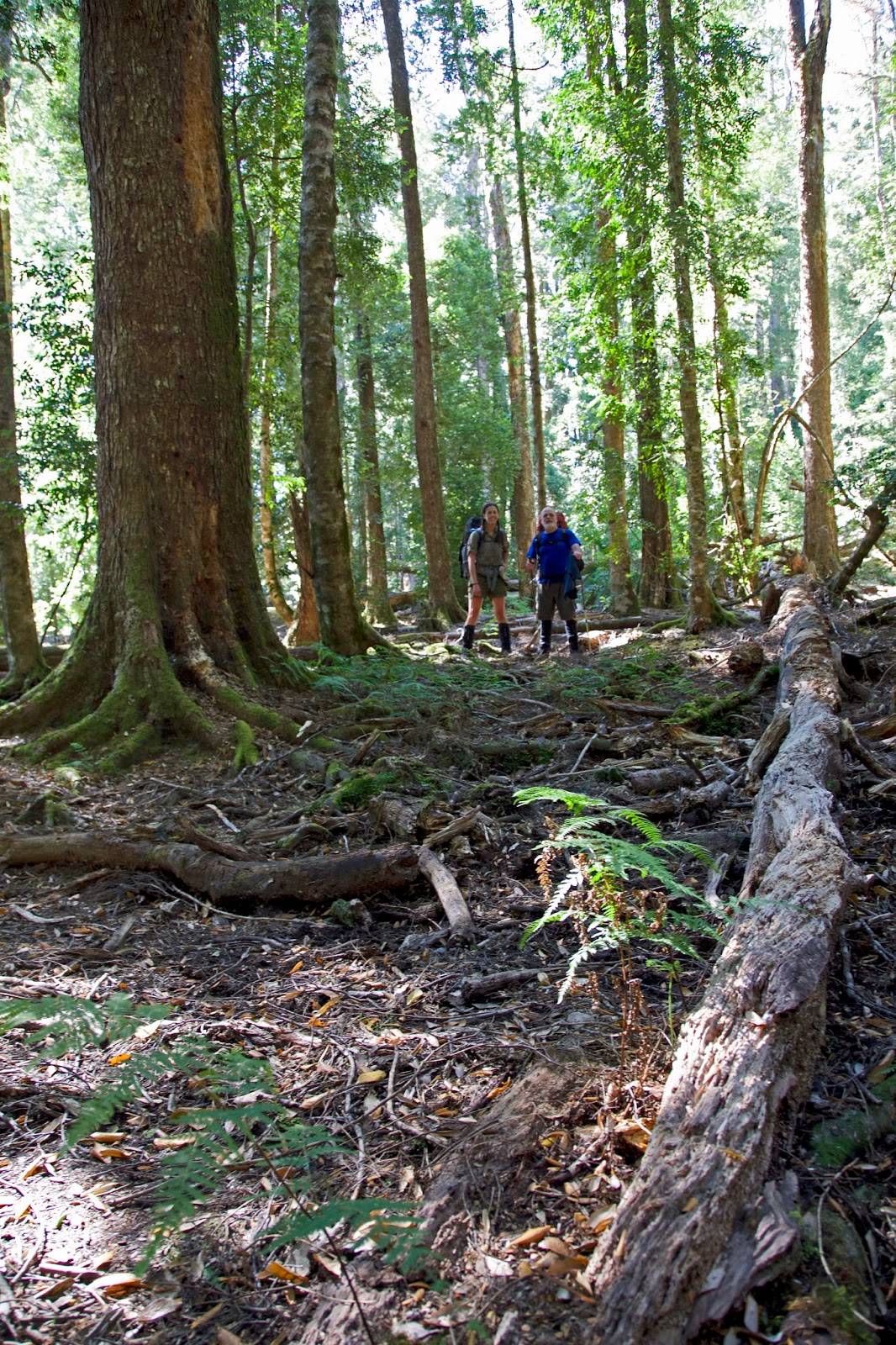
[Respite from the heat: forest on the way to Cathedral Plateau] 

In the end it made little difference. The exertion of the climb created its own heat, particularly the steep pinch from Chapter Lake up beside an almost waterless Grail Falls. By the time we reached Chalice Lake, the first camping spot on the Cathedral Plateau, the three of us were as parched and exhausted-looking as the plateau’s plants. We would happily have put up our tents at Chalice, a place we’d stayed a few times. But we were meeting two friends at another lake, and were bound to push on into the hottest part of the day, with little or no tree shade.


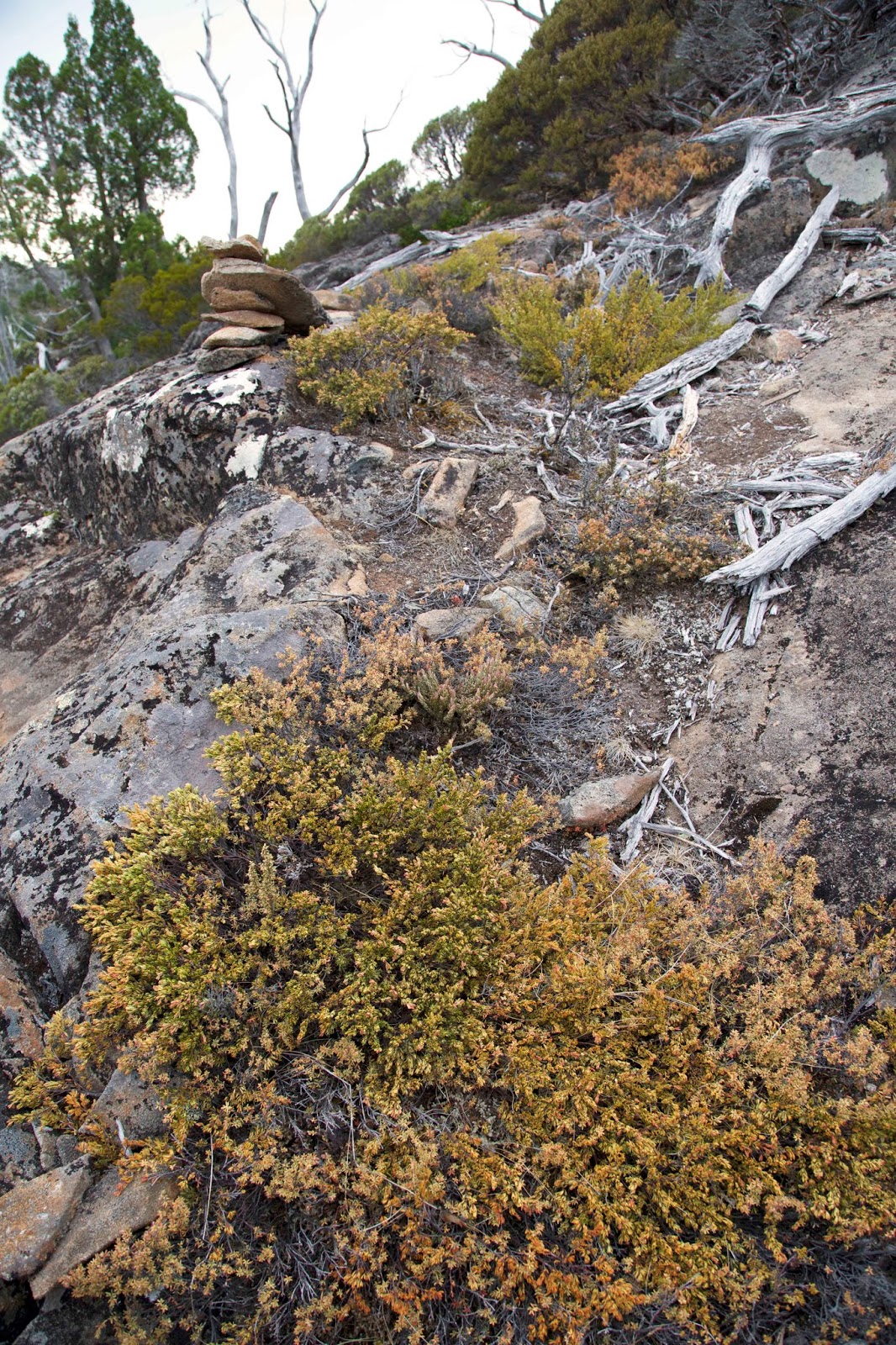
[Drought-parched vegetation, Cathedral Plateau] 

“Tent Tarn is only 30 minutes on from Chalice” a bushwalker friend had told me. In our fatigued state, that became 50 long minutes. “A cold beer, a Sauv. Blanc, or a cheering cup of tea” was Jim’s request on meeting our already-ensconced friends. “In order of preference”, he added, optimistically.

10 minutes later (yes, they had a Jetboil), we were all sipping tea and swatting march flies like old hands. After a half-hearted search for tent sites, we settled on a flattish spot, and turned to the more important business of catching up with Tim and Merran, our Sheffield-based friends, over food and wine.


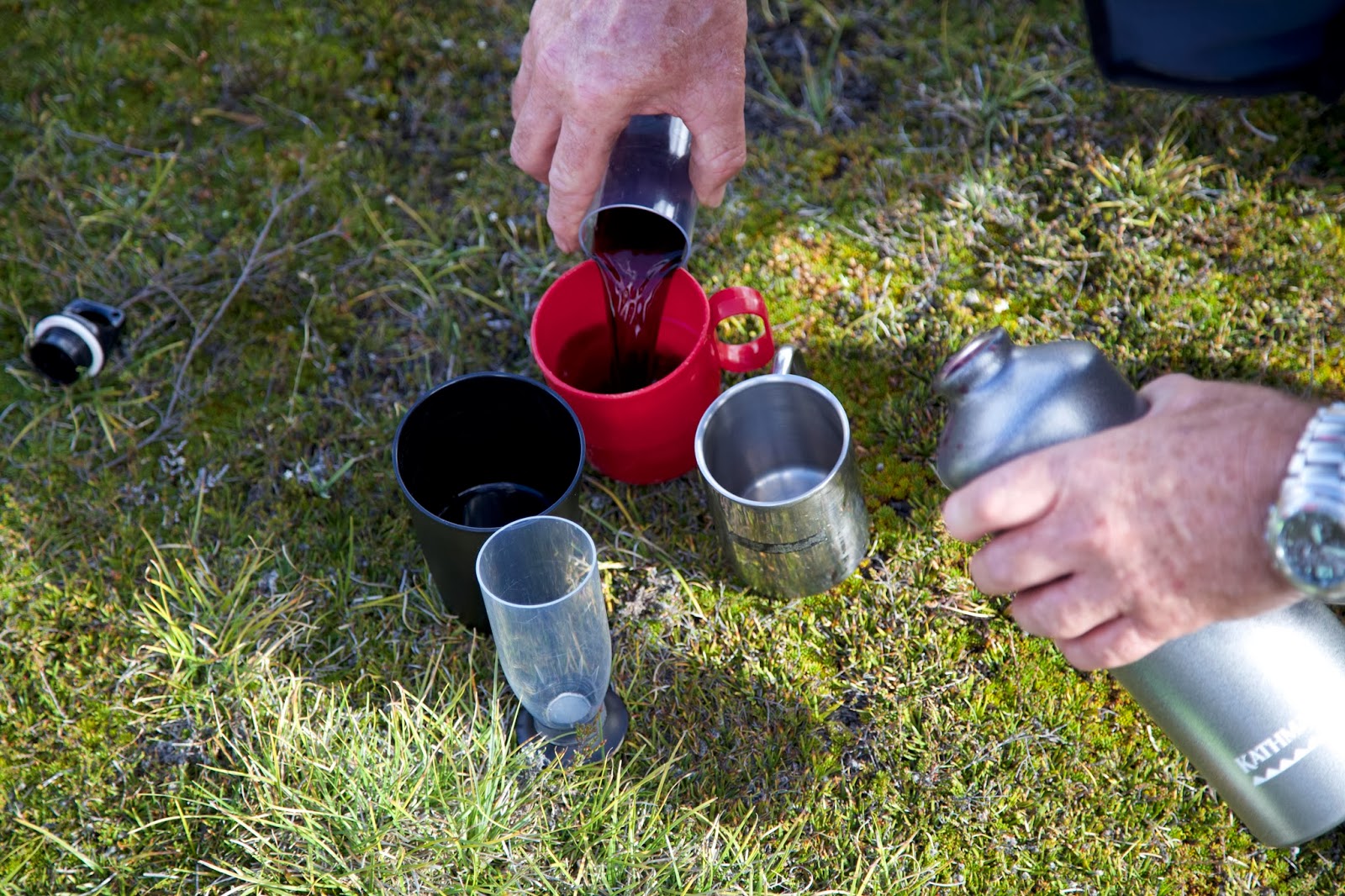
[Jim shares out the wine meticulously] 

Somehow pooling our appetisers and drinks worked to perfection, and under blue skies and high, wispy clouds we began setting the world to rights. We eventually caught our friends up on the vigorous forecast, but still made tentative plans to head up Cathedral in the morning, unless the weather shouted otherwise.  

It didn’t. Despite a rising breeze and an overcast sky, we all agreed it was a good day for being on a mountaintop. And on the Cathedral Plateau you're spoiled for choice. The place namers have had an ecclesiastical field day here, with cathedral, spire, dean, bishop, chapter, chalice, grail, cloister and more church-related titles gracing the plateau and surrounds.

We decided on the high point of Cathedral Mt itself first. Taking in magnificent views over large sections of the Overland Track – and well beyond – Cathedral is a grandstand for the highest parts of our mountain-rich island.


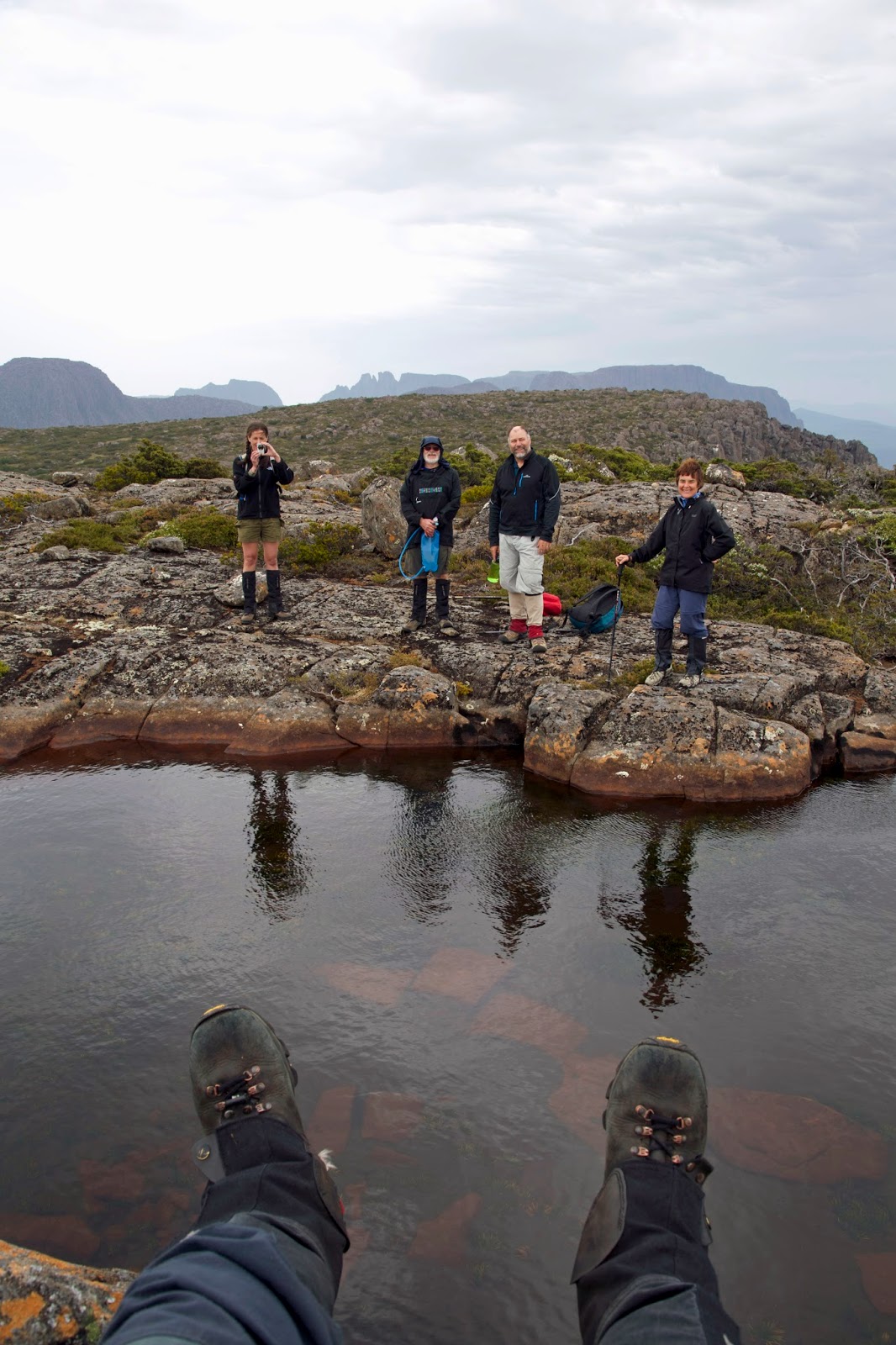
[Walking party and pool, with distant Du Cane Range ... and my boots] 

There is a kind of triangulation of memories when you’ve walked in these mountains for half your life. On Cathedral you’re looking back on several places from which you’ve viewed Cathedral. I have vivid memories of camping near Wadley’s Hut in the Mersey Valley, looking up at Cathedral as it was monstered first by black clouds, then by lightning and thunder. And there have been numerous times on the Overland Track, whether from Kia Ora or Du Cane hut, when I’ve looked across at the hugely impressive cliffs and massive rockfall that mark the western side of Cathedral.

This day, for a little variety, we wandered across to one of the Twin Spires via a couple of delightful pools. Twin Spires are a little to the north of Cathedral proper, and actually a little higher. While the view from them was no worse, the wind was starting to get up, and the clouds were starting to thicken between distant sunny patches.


[Clouds thicken over Mt Ossa, from Twin Spires] 

We had lunch sheltering behind some rocks, and exited the mountain just as thunder started rumbling. While dry to start with, it was soon spitting, then raining. We quickly got back to our camp and headed into our tents, happy to have summitted, happy to have earned some horizontal time in a dry tent, while it rained in a proper though certainly not vigorous manner.


Friday, 11 December 2009

No Such Thing As Bad Weather

[photo: high in the Kepler Mountains, New Zealand]


[more thoughts on walking and weather]

My colleague and friend, Cathie, has waged a war of words with terms like “bad weather”. One of her favourite quotes is from Joseph Wood Krutch:

The good thing about the country is . . . that we don’t have any bad weather at all – only a number of different kinds of good.

And Cathie’s right. The wild parts of Tasmania, New Zealand, Alaska and places like them would not look as they do; would not have the same plants and animals; wouldn’t even have the same topography, were it not for the weather. Mountains, forests and fiords come at a climatological cost.

That’s not to say that we always want to be out in the wilds when it’s blowing a gale and sleeting or snowing. But we recognise that such weather in an inherent part of the wild country that is so attractive to walkers. We adapt to the weather, not the other way around. One way to do that is to have good all weather gear, and/or to develop a positive duck-like attitude. Another is to have the flexibility to walk when the weather is expected to be fine. In that regard long-range internet weather forecasts are a great thing. I use them all the time, and they have made a big difference to my walking. For a start they can give warning of extreme conditions that are best avoided, although some familiarity with meteorology and lots of experience of local conditions is still important.

My ideal scenario in Tasmania is to start a walk on the tail-end of a cold front, especially when it looks as though it will be followed by a large, slow-moving high pressure system. This will usually bring calmer conditions, cool nights, and clear days. So while you may start the walk in cloudy or rainy conditions, the promise is that the high will come to the rescue. If it does the result will be a few days of clear weather when you’re actually among the mountains. With the exception of masochists and wilderness photographers in search of “artist’s light”, this is bliss for a bushwalker. And occasionally it does work out that way, although the weather gods often have the last laugh, and a bushwalker’s best-laid plans go oft astray. In the end we have to accept that we don’t control the weather, and making the most of it bears more fruit than shaking a fist at it.

Four days on New Zealand’s Kepler Track, west of Te Anau in Fiordland National Park, proved a good example. In Fiordland you can wait a long time for a forecast indicating a spell of clear weather. This part of the world measures its annual rainfall in metres, not millimetres, and the roaring forties bite particularly hard around here. But in planning to walk the Kepler Track, I did have some flexibility with dates. So I sat on the long-range forecasts for days trying to pick a four day period that might translate into clear weather for at least the day spent in the alpine section, at around 1400m. As I read the forecasts, I prevaricated, planned, replanned, and prevaricated again. Yes, it was spring, but the procession of cold and/or wet weather systems seemed interminable. And not knowing how this would play out on local weather patterns made it hard to commit. I wanted to pay due respect to the potential for wild weather up in those mountains. But eventually taking both local advice and the plunge, I booked the walk. We chose to do the loop walk in the less usual clockwise direction. Forecasts indicated clearer weather for day 3, the alpine day. If we went in the other direction, we’d be up there on day 2, which looked dire.

It turned out my choice was both right and wrong. Wrong because it snowed on and off throughout our entire alpine day. And right because the day before did turn out to be a savage, wet and windy day. Walkers we met at the walk’s half-way point, the Iris Burn Hut, told us they’d been literally blown over by gale-force winds. Some had even lost equipment, blown off the mountain by the wind. And they’d seen almost nothing through the rain and flying cloud in the head-down hurry to get off the mountain. And our snowy day? Well that was the other part of being wrong. Had I been invited to walk for 8 hours through sleet and snow – more than half of it steeply up hill – I probably would have declined. Yet it turned out to be one of the most brilliant days of walking I’ll ever experience.