Showing posts with label cycling. Show all posts

Tuesday, 5 December 2017

Cycling the Island 2: A Great Eastern Ride


[Great riding along Tasmania's East Coast] 
It’s a shame that the moniker “The Great Ocean Road” was already taken when a Tasmanian committee sat down to choose a name for the route we’ll ride today. The thirty kilometre section of road between Little Swanport and Swansea is literally both great and by the ocean. Arguably it’s one of the most picturesque coastal routes anywhere in the world, and an undoubted highlight of the 176km east coast drive between Orford and St Helens. Sadly our naming committee delivered a camel: the route is now labelled “The Great Eastern Drive”.


[Tim drinks in the views over Great Oyster Bay] 
But that’s the end of today’s sadness, especially when we wake to sunny skies. Most of our gear has dried and we’re refreshed and keen to be riding again. Although we’ll spend most of today’s 55km ride on the busy Tasman Highway, we’ve begun to trust our support vehicle system. Two vehicles, both with bright yellow signs warning “Cyclists Ahead”, are driving behind us. Our other support vehicle, an emission-free Nissan Leaf, is driving ahead of us with a bright yellow sign warning “Cycle Event: Slow Down”.

Today Dion has agreed to drive the campervan so Tim can ride the whole section. It’s a generous gesture, and sets a pattern for later days. We take our time getting ready, as our day is short and the first recharge/lunch stop is only a little over 20km away. Once we’re riding, we spread out along the relatively flat section north of Triabunna, cycling with only mild effort past paddocks filled with spring lambs. Riding single file on the busy road keeps conversation minimal. But I’m feeling very upbeat, and have the perfect head tune in Runrig’s “May Morning”.

“I’m alive again on a May morning” it starts. And though I know it isn’t May, it is the southern hemisphere’s equivalent that we’re riding through.

All the yearning buds are here again
With the the promise of a new life to come
Spring is here again.

Each rider has something different in his or her head. I chuckle as I hear Michael bleating a greeting to the occasional sheep. Others are keeping an eye on the following traffic, or seeing if they can keep the whole group in sight. (They seldom can.)


[Lunchtime at Gumleaves] 
We’re early for lunch at Gumleaves, a nicely old-fashioned accommodation-come-adventure centre a few kilometres off the highway. We’ve booked a kitchen/dining hall, and some of our support team (kudos here to Clive and Sue) have bought food to cook and share. A leisurely lunch suits the recharging of batteries, even if some of us haven’t yet used much. Neville, our oldest rider at 87, has some visitors here. As well as being sprightly in the saddle, he’s an amazingly handy inventor, having made his own e-bike, complete with two bespoke batteries. He takes time over lunch to explain the details, although some eyes glaze over when words like amp hours, watts and watt hours start to be thrown about.


[Neville rides out of Gumleaves] 
By the time we’re riding again the day is sunny and warm, the wide blue sky wisped with high cirrus. Around Lisdillon we start to gain broad views across Great Oyster Bay and out towards the Freycinet Peninsula. It’s hard not to be mesmerised by the scene. 


[Photo stop after Mayfield Beach] 
At one point I call out to the riders nearest me, and arrange to stop for photographs. We end up doing this several times as beach gives way to beach: Lisdillon, Mayfield, Kelvedon, Spiky. All the while the water, the mountains, the sky form a backdrop that’s a rhapsody in blue.


[Dawdling towards Swansea] 
We Tasmanians are blessed with a variable climate. Or to put it another way, this place will not always produce these stunning views. We exult in it while we can, breathing in the blue as we dawdle towards Swansea.

Friday, 11 November 2016

Cycling in Catalonia 2: The Mediaeval Villages

Mediaeval is a fuzzy, ill-defined term. But bumping your bicycle through a cobble-laned mediaeval village, its church, castle or fort hogging the high ground, its bell tower ringing each quarter of the clock, is an utterly tangible experience.


[A cobbled lane in the village of Peratallada]


[Lynne and Chris on foot in the village of Pals] 
After a couple of days cycling around the Costa Brava coast, we’ve been ferried inland, bikes and all, and dropped among the small mediaeval villages that dot the hills between Palamos and Girona. We’re enthralled by the depth of on-going settlement in one place; enchanted too that we can fortify ourselves for the ride, be it with a quick café con leche and pastry, or a more leisurely menu del dia. These are not mediaeval theme parks, they are working villages.


[A wooded country lane between villages] 
As we ride between the villages we see, hear and smell the evidence of that. Cattle are farmed for both meat and milk, ‘though they’re more often smelled than seen, as they’re usually housed in barns. More pungent still are the pigs, surely the favourite source of meat in Catalonia (think jamon/ham; chorizo sausages; even galtes/pig’s ear). It’s also ripening time for grapes and figs, and their sweet tang leavens the other rural aromas. We pause and taste a few figs, with mixed results.


[Looking towards Sant Iscla d'Emporda] 
The riding is mostly easy, on undulating lanes, tracks and the occasional road. Our itinerary is loose, determined partly by the map and partly by the honey-pot pull of what we see ahead. Each distant village is given away by some grand stone edifice on a hill; sometimes a church, occasionally a castle. 


[Riding away from the mediaeval village of Pals] 
And then there’s Ullastret. On the approach to the village of Ullastret, we can see something else, low yet significant, on a hill outside the village. We’ve been told there are Roman ruins hereabouts, and Chris and I exchange “Yep, that’s where I’d build if I was Roman”-type comments. It’s uphill and a bit bumpy getting there, and we’re puffing as we dismount at the historic site’s ticket booth. The entry fee includes an audio commentary and we’re soon learning that the site is more complex and interesting than we’d anticipated.


[An ancient cistern at Puig de Sant Andreu] 
Roman occupation is just part of the story. Puig de Sant Andreu, as the site is called, turns out to be one of Spain’s most significant prehistoric Iberian settlements. The Indegetes tribe occupied the site well before the Romans, from the 6th century BC until around the 2nd century BC. Not much of their settlement remains, as it was largely constructed out of wood and mud. But we get to wander among some water cisterns and grain silos that have been excavated. And the on-site museum contains some other fascinating artefacts, including a beheaded skull pierced by an iron spike!


[Underground grain silos and other ruins] 
The old Iberians must have had the same opinion of the site as we and the Romans did. It commands views as far as the Pyrenees over the well-watered, agriculturally rich Emporda region. We learn that the flatter lands below the site, which are now fields, once had large fish-stocked lakes with small well-defended villages around them. For all of the changes at the site: whether its the demise of the Indegetes, the coming and going of the Romans, the short-lived invasion of the Moors or the rise and fall of mediaeval lords, there has always been a reason to rebuild. Crops, livestock and wine seem to have flowed from this land for as long as records have existed.

Later we sit down to a typically meaty Catalonian lunch in the “merely” mediaeval part of Ullastret. But it’s not only the food that we need time to digest. Our minds are filled with thoughts of the rich life of this place; of its 26 hundred years of continuity, productivity, disruption, invasion, warfare and recovery; of its people living, working, loving, laughing, crying, fighting, dying and giving birth.


[Time for a drink ... and a think] 

[Leaving Ullastret] 
They’re the kinds of thoughts that make history come alive, and that connect us to past lives that may not have been as different as we imagine. That said, we’re very glad to be heading back for hot showers and warm beds at the end of our “mediaeval" cycling days.

Monday, 7 November 2016

Cycling in Catalonia 1: The Tamed Coast

You’d go a long way to find someone with a good word to say about Lance Armstrong. But in Catalonia, in north-eastern Spain, Lance is still something of a hero. For some years he and his Tour de France-winning team based themselves in Girona, training in the tough Pyrenean foothills behind the Costa Brava, and pouring a lot of their dubiously-gained wealth into the local economy.

That’s the last you’ll hear from me about Lance, except to note that the resulting popularity of cycling is a good thing for riders here. Catalan drivers afford cyclists amazing courtesy. It’s also the last you’ll hear about tough hills. The three of us, myself, my wife Lynne, and our old friend Chris, are in Catalonia for some decidedly more relaxed cycling.


[Chris and Lynne at Palamos, Spain] 
The area is not only sunny and beautiful, it also has a maze of off-road cycling trails. Rather than cycle touring, were based for the week in a townhouse in the old village of Calonge, a short ride inland of the resort town of Palamos. From there we can explore a wide area, but return each night to our comfortable base.

We’ve exchanged Tasmania’s spring, a time of wild winds and riotous wattle blossom, for the settled warmth and pale fields of a Spanish autumn. On an early ride we pause in a maize field. Its foliage has browned, and the ripe husks rattle in the breeze. A Catalan flag flaps lazily from a nearby tower, reminding us we’re in Catalunya rather than Spain.
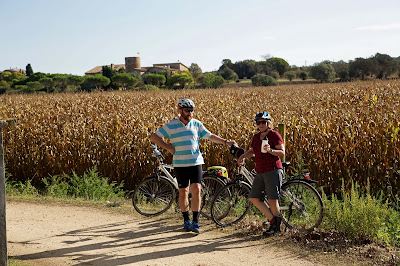

[A drink break in a maize field] 
Our local host has encouraged us to greet the locals with bon dia rather than buenos dias. Given the brutality of the Spanish Civil War, and General Franco’s vigorous attempts to outlaw Catalan language and culture - right into the 1970s – this is no mere nicety. It is strange to be riding through such beautiful tranquility knowing that within my lifetime it’s also been the scene of heartless repression.

More familiar is my feeling of disorientation here in the northern hemisphere. Whereas at home I have an intuitive knack for knowing my way around, in this part of the world I’m easily lost. It probably comes down to where the sun is in the sky. Here it leans in from the south; at home from the north. Without thinking I use the sun to help me to know where I’m going, so here I become Pedro Equivocado*. I’m glad to have Chris and Lynne with me: Chris with his long experience of this hemisphere (originally from Tasmania, he’s been working in England for decades), and Lynne with her more logical take on navigation.
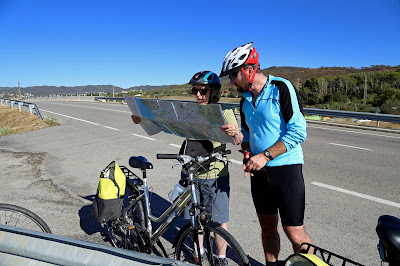

[I leave the navigation to the experts] 
Our days, and our paths, are divided between coastal rides and hinterland rides. We start with some easy coastal rides. Although Costa Brava literally means “wild coast” or “rough coast”, it doesn’t take us long to decide that nomenclature came from sailors rather than cyclists. The broad and pleasant beachfront at Palamos has largely been concreted and tamed, its main street crammed with hotels, shops and eateries. Although we’re not here in the high tourist season, it’s still buzzing with people and bursting with boats. We pause for a coffee and to enjoy the kind of vibe we’re unlikely to choose for the long term.
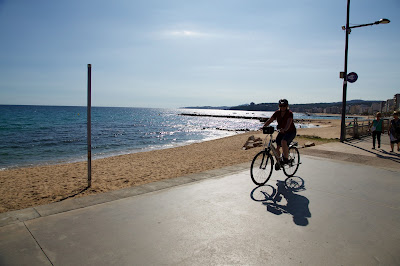

[Cycling along the beachfront at Palamos] 
Of course there’s more to Palamos than the beachfront. It’s one of the few working ports in the region. Fishing boats take pride of place at the eastern end of the bay, where there is also a fishing museum. Nearby the “old town”, with its pleasantly higgledy-piggledy streets, is packed with shops, some for tourists, some more for the benefit of the locals.


[Part of Palamos' fishing fleet] 
We ride around the coast from here, and start to see some of its more rugged aspects. The already contorted metamorphic rocks have been further hammered by wave action, creating a deeply indented and rocky coast interspersed with sandy bays and beaches.

We’ve been told that one, Platja del Castell (Castle Beach), is particularly beautiful, and one of the few “untouched” beaches left in the Mediterranean. We have to work a little to get there, as it’s somewhat off the beaten track and the sun is beating down strongly. Once there we’re happy to pause for a long drink and lunch.


[Platja del Castell from the nearby headland] 
As we cool off, we have to agree that it really IS a lovely beach. But “untouched”? Backed by a little forest, with just two buildings immediately adjacent, the beach certainly retains a natural prettiness. But today there are hundreds of people, dozens of boats, a couple of demountable cafes, plus walkways and toilets. And yes, there are quite a few cyclists too. As we munch our calamari and sip our beer, I have to acknowledge afresh how tamed the Mediterranean is.


[Every little cove has visitors] 
With its ancient record of human settlement and exploitation, and a surrounding population that approaches half a billion, I shouldn’t be surprised. There is a constant human pressure and presence here. You might consider the Mediterranean world a small scale experiment in what we’re doing to the wider world. Forests and wildlife have retreated to remote pockets, mostly at altitude. As for this small sea, its exploitation is a guide to what may happen – has begun to happen – to the vast oceans we’d like to think of as invulnerable.

That’s reinforced a few days later when we decide to have our first swim in a little cove closer to Palamos. As we’re getting into our swimming gear, we notice a group of older men scooping something out of the water with little nets. There’s a language barrier, but it’s clear that they’re removing stinging jellyfish from the water. After a while they signal, and tell us – we think – that we might try a dip in one corner of the cove. We ease ourselves into water that most Tasmanians would find acceptably warm. In other words it’s cold. The sand is coarse and hard on our feet, and its littered with waste. And in the water there’s plenty of plastic flotsam alongside the occasional jellyfish. Soon after we take the plunge Chris winces, pretty certain he’s just been stung. It’s not the perfect recipe for a long swim, and we soon decide we’ve had our Mediterranean swim.

As we click through the gears on the ride home, I see that for me as a Tasmanian, this trip is also about making mental shifts. I have to stop expecting wild, and settle for pretty; to turn down the nature knob and crank up the culture one. Because there’s no doubt the Costa Brava has both of those, as we discover yet again at beautiful seaside villages like Calella and Llafranc. And as we’ll find by the spadeful when we venture into the hills.


[The pretty - and busy - beach at Llafranc]  

 
* = Wrongway Peter

Thursday, 5 May 2016

Cycling the Clare Valley: Part 1

We’re driving north of Adelaide on a warm, dry autumn day. The flat, straw coloured landscape is more parched than usual following a long, hot summer. How, we wonder, can a world famous wine district exist in the unpromisingly dry and low hills ahead of us?


[On the Riesling Trail]  
There’s a bright side. The relative lack of hills suggests easy cycling. And that’s one of the main reasons we’re here. That and the wine. After a little more than two hours we arrive in Auburn. It’s not quite sunset, so there’s time to sort out our accommodation before dinner. We’d expected our hire bikes to be at the hotel. But not for the first time, we find arrangements around here are “relaxed”.

The bikes turn up in good time the next morning, and we’re briefed on the cycling trail ahead of us. It goes by the promising name of The Riesling Trail, and follows an old railway route between Auburn and Clare. We’re on a self-guided trip, with bikes, accommodation, luggage transfers and some meals organised by the Tour de Vines company. Once our bikes and helmets are fitted, we’re off into the morning chill – all of 50 metres to the coffee shop. They did say it was self-guided, and Andrew must have his caffeine hit before the day goes on!


["Hard-earned" stop? Our start is visible 50m behind us.] 
The vineyards commence soon after we do. Although the cycle trail is dry and a little dusty, the vines are surprisingly lush. Some have had over 150 years to get used to the region’s Mediterranean climate: dry and hot in summer; cooler and wetter in winter. Despite their age the vines are blushing with autumn colours. We too are red-of-face as we pump our legs and expand our lungs with unexpected effort. It’s strange how an incline of 1.5% can make you work.

It’s strange too how the names of places and wineries we’re passing are so familiar to me, a relative late-comer to wine drinking. We wobble past signs to Leasingham and its vineyards, but don’t resist the turn-off to Watervale. It may not be midday yet, but we’re up for refreshments, which Shut the Gate Wines supply with style. As we stand at the bar for a tasting, we hear the kind of talk we’ll get used too over the next few days.


[Among Clare Valley's blushing vines] 
It’s not just about grape varieties and vintages, but aspects, micro-climates, minerals and more. It also seems “soils-ain’t-soils”. The depth, type and mineral make up of the soils contributes characteristics to the wines which even we can discern. We thank Richard for the informative tasting – which included cheese and biccies – and promise to be back in a few days to buy some wines. We’re not keen to weigh down our panniers with too much just yet.


[The Old Grammar School, Watervale] 
We have to ride uphill to get back up to the trail, although the fascinating buildings of Watervale give us an excuse to do that slowly. Then it’s on to Penwortham. And now the landscape tightens up, and there’s a greener tinge to everything. It’s the high point of the trail, so higher rainfall might be expected.


[Dining al fresco at Skillogalee, Clare Valley] 
Lunch is booked for us at Skillogalee Wines, a bracing downhill ride from the trail. We don’t want to think about what that means for our post-lunch ride, but it becomes a long, languid lunch, and the wonderful food and setting of Skillogalee fuels us for any coming pain. So too does a stop at beautiful Kilikanoon Wines.


[Autumn at Kilikanoon Wines] 
After the pain of regaining the trail is endured, we cross over the high point and make a downhill beeline for Clare. It’s not quite as simply done as written, and it’s not all downhill. But as the afternoon shadows stretch out, we close in on our overnight stop. And stop is what we do, glad in both heart and buttocks! We only hope we’ll be able to ride again in the morning.

Monday, 19 October 2015

A Hawkes Bay Break: Cruisy

Note to self: sleep is essential. Do NOT imagine you can do without it; that by catching a plane near midnight, flying towards the sunrise, and touching down as the sun comes up, you can simply dust yourself off and launch into the new day. Your body knows otherwise.

The time difference between Australia and New Zealand means we are playing out that exact scenario on a recent trip to the North Island. Despite our attempts to sleep during the 3 hour flight, we arrive in Zombie mode. Neither coffee, nor a rousing breakfast in a café full of All Black fans watching their team win (again), is enough to perk us up for the long drive up the island to the Hawkes Bay region.


[Some contented Hawkes Bay cattle] 
Many stops, many coffees, a snooze or two, and a disproportionate number of oddly-timed snack/meals later, we arrive at our rural accommodation in the heart of Hawkes Bay. Dragging our confused bodies with us, we do a hasty reconnoitre, eat a quick meal, and flop into bed around 9pm. Our muddled brains actually think it’s 10pm, thanks to a mix-up over daylight saving. And that feels more than late enough for bed, and the hope of a standard 8 hours of shut-eye.

Our bodies have other plans, and we wake to the sounds of unfamiliar birds and farm machinery fully 12 hours later. Not since university days has either of us slept the clock around. At first we don’t believe our timepieces, but our mobile phones – which seem to know these things automatically – confirm the time.

I open the curtain onto a scene from a child’s painting. A field of yellow flowers is set against a steep and vividly green hill, which is criss-crossed with animal tracks and dotted with placid grazing cattle. A lone white goat and perfect blue sky complete the scene. People told us this is a beautiful part of a beautiful country, and they haven’t exaggerated.


[Our morning view on a Hawkes Bay farm] 

But country isn’t just for staring at. A small shed hides the means of getting closer to it all: two bicycles. Not just any old bicycles, these are cruiser bikes. AND they even have names. We’re accustomed to 21 speed mountain bikes with hard seats and an attitude to match. “Molly” and “Cooper”, our resident cruiser bikes, have a more relaxed outlook on life. Built for comfort, not speed – and not for hills, let alone mountains – these bikes are just right for cruising along the near-level cycle trails that lace the region.


[Lynne cruises a cycle path aboard "Molly"] 

And so to the stop bank that separates us from the river. We’ve not heard the term “stop bank” before, but it’s immediately clear it’s essentially the same as a levee bank, protecting the surrounding land from floods; in this case from the Tutaekuri River. That's one of several rivers draining east from the Kaweka and Ruahine mountain ranges to the west; rivers whose outwash has created the fertile plains that are key to Hawkes Bay’s agricultural bounty.

As with so many New Zealand rivers, the Tutaekuri flaunts its snowy upland origins, flowing swift, grey/blue and braided through the lowlands. Doubling as our local cycle path, the stop bank leads us gently along the river, winding through pasture, forest and fields of apples, and alongside some of the vineyards for which Hawkes Bay is famous. We blow away the cobwebs before finding some very decent coffee in the township of Taradale.


[The Tutaekuri River near Taradale] 
We then try the cycle path on the other side of the river, which soon passes beneath the impressive Otatara Pä. This series of connected Maori forts on hillocks above the river has fearsome wooden palisades, and we learn later that it was a highly-prized and much fought-over site. Distressingly part of the site was lost in the 1970s and 80s when it was quarried for road metal. Today it’s an historic site managed by the Department of Conservation in consultation with Ngäti Paarau of Waiohiki Marae (local Maori).


[Part of the Otatara Pa] 
On our ride back upstream, we get to try out the three gears on the cruiser bikes. We learn that third gear = “cruisy”; second gear = “almost-cruisy”; and third gear = “still-quite-close-to-cruisy”. Fortunately there are no actual hills, so we are only mildly pink-faced by the time we reach the village of Puketapu. But as it has a famous pub, we decide we’re parched, and stop for an ale in the shade.

New Zealand may be famous for its adrenaline charged adventures, and we’ve had our share of those. But we're learning it also does the cruisy end of things very well. And right now we have no complaints about that.

Sunday, 25 August 2013

Just Add Wheels


[Poppies and wheat, rural Burgundy]  


Every July my thoughts turn towards France. You can blame the Tour de France for that. It’s something I simply must watch, though to be honest it’s not because I’m a rusted-on road cycling fan. Drug scandals aside, I find the intricacies of the sport devilish hard to comprehend. It’s more that I cannot take my eyes off the background scenery while I pretend to watch the race. If there’s a more diverse and beautiful country on Earth than France, I would like to see it!

Yet this July I didn’t spend any time in front of the TV watching Le Tour. I went one better, and was actually IN France for the 100th Tour. But don’t imagine it was so I could stand for hours in all weather with thousands of others waiting to catch a glimpse of a whizzing blur of lycra-clad heroes. Rather I was in France to join my own decidedly sedate peloton for a cycling tour through rural Burgundy.


If walking is movement at the speed of thought, then cycling represents manic thought, with angst, exhaustion, bliss and exhilaration thrown into the mix. I bless the inventors of the modern bicycle – several Frenchmen among them – because they’ve given us a human-powered machine that can get us within a whisker of flying.

Even at ambling speed there’s something inherently pleasing about getting through the countryside on wheels. When that countryside is the Saone valley in Burgundy, that pleasure is multiplied.


[Riding a canal path in the Saone Valley] 

Our group spent a week cycling more than 300km through a landscape with a long and deep history. We rode past villages and vineyards, through fields and woods, alongside rivers and canals. We passed mills and lavoirs, churches and ale houses. At times we wouldn’t have blinked had characters from fairytales stepped out, perhaps a hag offering enchanted fruit, or a donkey asking a favour.


[House and tower in Buxy, France] 

When we paused for food, a boulangerie here, a café there, the food was hardly less enchanting. The baguettes were beguiling, the pain-au-chocolat divine, perhaps only the café-au-lait burst the bubble. The locals were very patient with our fractured French, just occasionally having some gentle fun at our expense, as when a group of rural workers cheered our passing peloton on with a mock “Allez, allez!”


[The "peloton" rides an ancient Roman road in Burgundy] 

Of course this bicycle bliss has a downside, and that downside is the backside. The human bottom was not apparently designed to spend long hours in a bike saddle. We were all saddle sore after a few hours, despite gel seats and padded shorts (which I always think of as “nappy pants”).  We expected we’d harden up after a few days, but every day the pain continued. While riding I took to shuffling my derriere from side to side, in search of relief. Off the bike I developed a cowboy’s bow-legged walk.


[Taking a break from the bike] 

As a long time bushwalker, I found myself contemplating the similarities and differences between cycling and walking. As with walking, the gain to pain ratio of cycling is open to measurement. In both activities I find that the bliss generally outweighs the distress. Crucially for me, both activities offer un-mediated experience of your surrounds. Riding through Burgundy we could smell the cattle; hear the church bells; feel the breeze or sun or rain on our faces. And this being near Dijon, we could smell, almost taste, the mustard crops that matured along our route. Car travel, for all its advantages, simply can’t offer any of that.


[Lunch break beside a mill stream near Beaune, France] 

And as with walking, cycling also offers camaraderie, whether deep conversations, jokey by-play or silent sharing of moments. On this trip we also shared moments of pain – including a few falls – and times of disgruntlement. And of course, this being Burgundy, we sampled together the fruit of the vines through which we were riding, albeit in bottled form.


[Riding through vineyards, Burgundy] 

At the end of it all I found myself in rare agreement with Lance Armstrong. “It’s not about the bike”. No ... it was all about France, and wonderful times shared in a beautiful country. I’m not sure how I will cope next July.