Showing posts with label Marahau. Show all posts

Sunday, 21 December 2014

Abel Tasman Coast Track 4: A Short Walk, A Long Road


Sometimes, on some walks, you’re glad to be getting near the end. Sure signs of this include constant thoughts of showers, soft beds, fresh food and  clean clothes. And of just not walking for a good long while.


[Pleasant walking on the final day] 
Our final day on the Abel Tasman Coast Track isn’t one of those days. The weather is fine, we are feeling fit, and the walking is interesting. We have the bonus of a walking companion in young New Zealander Brad. He is sociable, as Kiwis invariably seem to be. Is it the result of living in an isolated place at the end of the earth? If so it works well for Tasmanians too. We find plenty to chat about as we meander above the nearby coast.


[Looking towards Adele and Fisherman Islands] 

We’ve now drawn level with Adele Island, which we’d paused alongside on our first day’s water taxi ride. That day we’d seen sea birds galore, and were also thrilled to see New Zealand fur seals on the shore. The island is a focus of environmental restoration, with the biggest job being to bring back the dawn chorus. The Abel Tasman Birdsong Trust, Project Janszoon, DoC and various private donors have combined to trap and poison introduced predators such as rats, possums and stoats. Adele Island has been a pilot for a larger project which has seen 70% of the Abel Tasman National Park covered by the trapping program.


[New Zealand fur seals on Adele Island] 
We come across one of the newer humane traps. The traps are powered by compressed C02 gas. The possum version is activated when a possum bites on a lure. The rat/stoat version requires the animal to move aside a leaf to investigate a lure. Either way the animal activates a steel piston, powered by C02 gas, which strikes the skull of the inquisitive animal and kills it instantly. Once the animal has been struck, it drops to the ground, leaving the trap set for the next pest.


[A CO2-activated pest trap] 
Even though this method of pest eradication is much less labour-intensive than the older tunnel traps, there is still a huge commitment required to simply keep pest numbers down. Complete control is but a dream, and the the incredibly beautiful dawn chorus of native birds like tui, tieke, korimako, kakariki and kaka, is heard in relatively few localities.

English botanist Joseph Banks, while in this region aboard Captain James Cook’s Endeavour in 1770, wrote this about the local birds.

‘This morn I was awakd by the singing of the birds ashore from whence we are distant not a quarter of a mile, the numbers of them were certainly very great … Their voices were certainly the most melodious wild musick I have ever heard, almost imitating small bells but with the most tuneable silver sound imaginable.’


Even Cook, not one to wax lyrical, was moved to describe the korimako (bellbird) as sounding ‘like small bells exquisitely tuned’.


[An epiphyte colonising a trackside rock wall] 
As if predatory mammals were not enough of a threat to New Zealand’s native species, pest plants have a significant impact here too. As we walk towards our finishing point, we see signs of wilding pine infestations. These are any of ten different introduced conifers that have gone wild in New Zealand. A significant effort in this park has seen many of the infestations poisoned. For the moment they are evidenced by ugly brown stands of dead trees on the steep green forested slopes of the hinterland. In the longer term the dead pines will be – and already are being – replaced by native bush, much to the advantage of the bird species.


[A local newspaper story on wilding pine] 

By late lunchtime we have reeled in the small settlement of Marahau. We cross the final few bridges across the tidal flats, and walk into the café that marks the start/end of the track. There Brad joins us for a celebratory hot lunch and cool drink. We raise a glass to a great walk on this Great Walk.  

Sunday, 30 November 2014

Abel Tasman Coast Track 1: Time and Tide


It is a promising sign when a walk begins with an “I think we’ve died and gone to heaven!” moment. Especially when things haven’t actually gone according to plan.


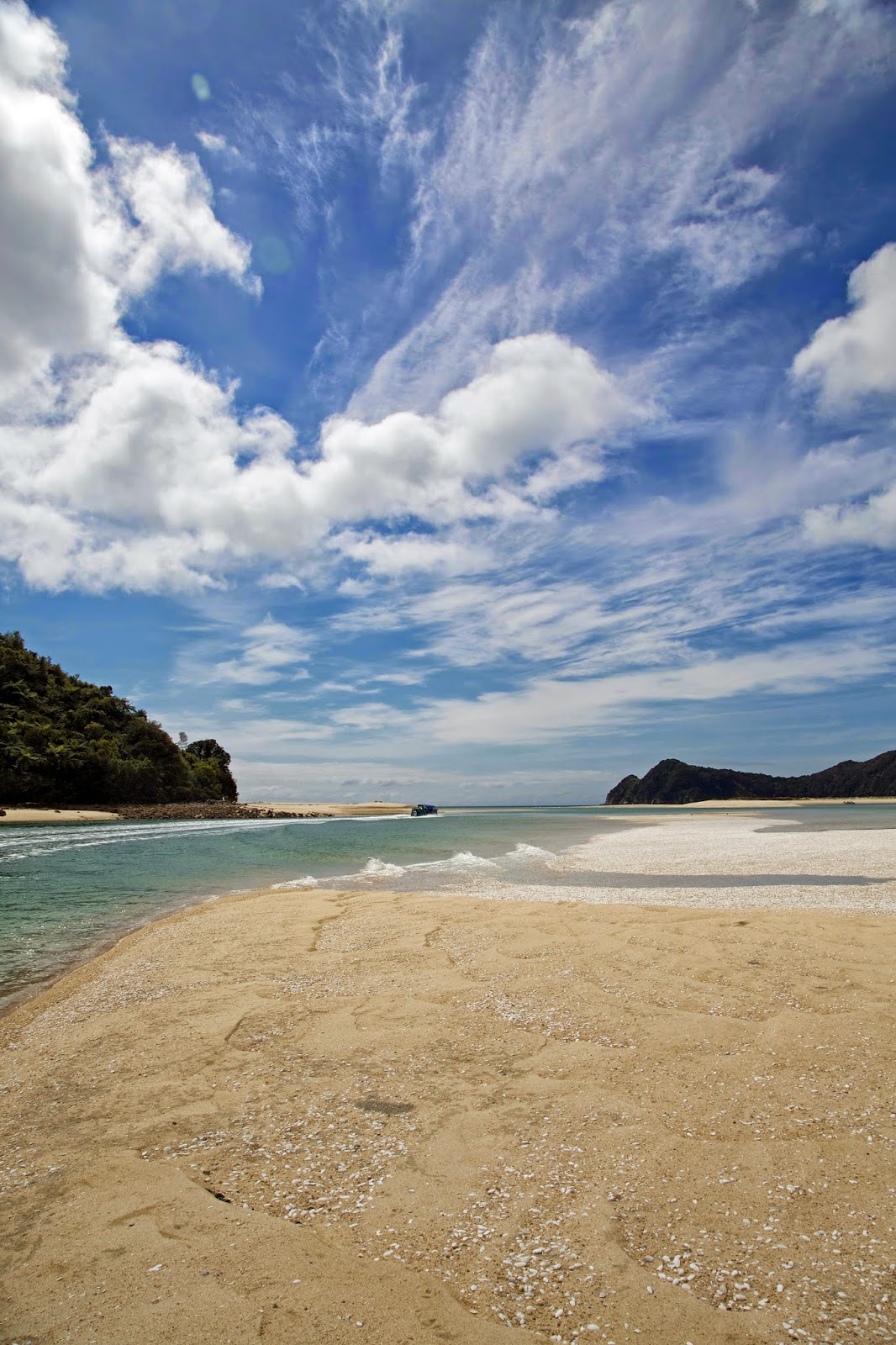
[Our water taxi leaves us in "heaven" at Awaroa Inlet] 

We were supposed to start our walk on New Zealand’s Abel Tasman Coast Track at an inlet called Totaranui. But we soon learned that in these parts you have to take seriously the saying “time and tide wait for no man”.

Just before boarding our water taxi at Marahau in the south of the Abel Tasman National Park, for our trip to Totaranui in the north, we learned a crucial piece of information about tides. To walk from Totaranui south to Awaroa, you need to cross the Awaroa Inlet. We knew that. The hut is on the southern side of the inlet, and you can only cross it two hours either side of low tide. We knew that too.

What we hadn’t pieced together was how the actual tide times for that day would affect our potential crossing times. That particular conjunction of time and tide meant a crossing at 10 o’clock in the evening. That was an option we quickly ruled out. But our water taxi skipper had a typically breezy Kiwi solution. He would show us Totaranui – allowing us a 10 minute stop and look around – before taking us back to the southern side of Awaroa Inlet.


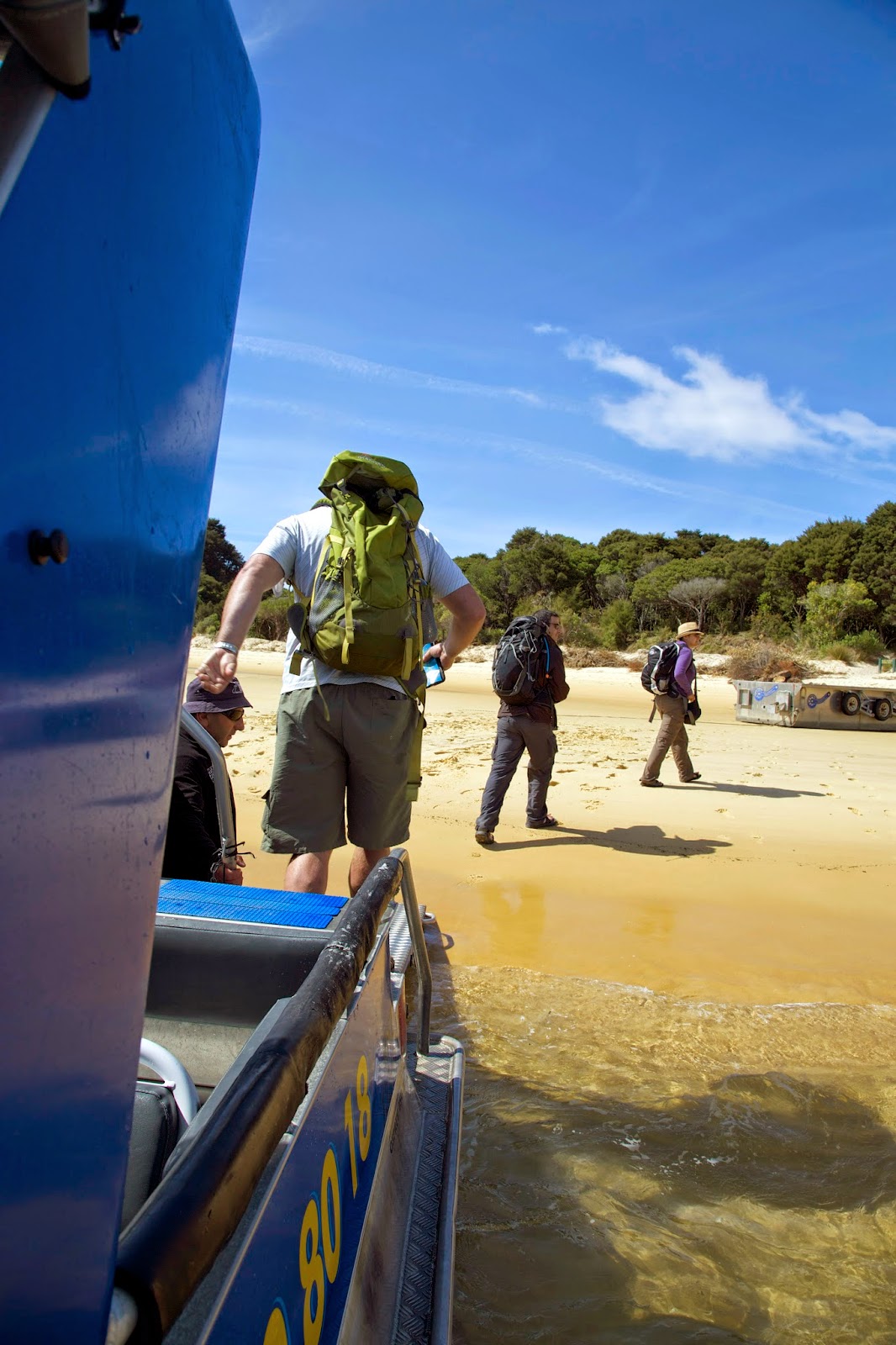
[Departing the water taxi at Totaranui] 

And that’s where, as the burr of the boat’s engine receded and we looked around, we started to think of heaven. Instead of a long afternoon’s walk and a dangerous swim/wade, we had the rest of the day to settle into both the hut and the tranquility.

We had read that Awaroa was one of the few places on this bit of coast on which Maori people had a permanent pre-European settlement. Around the well-watered flats they could plant crops of kumara to supplement the rich marine and forest resources of the area.


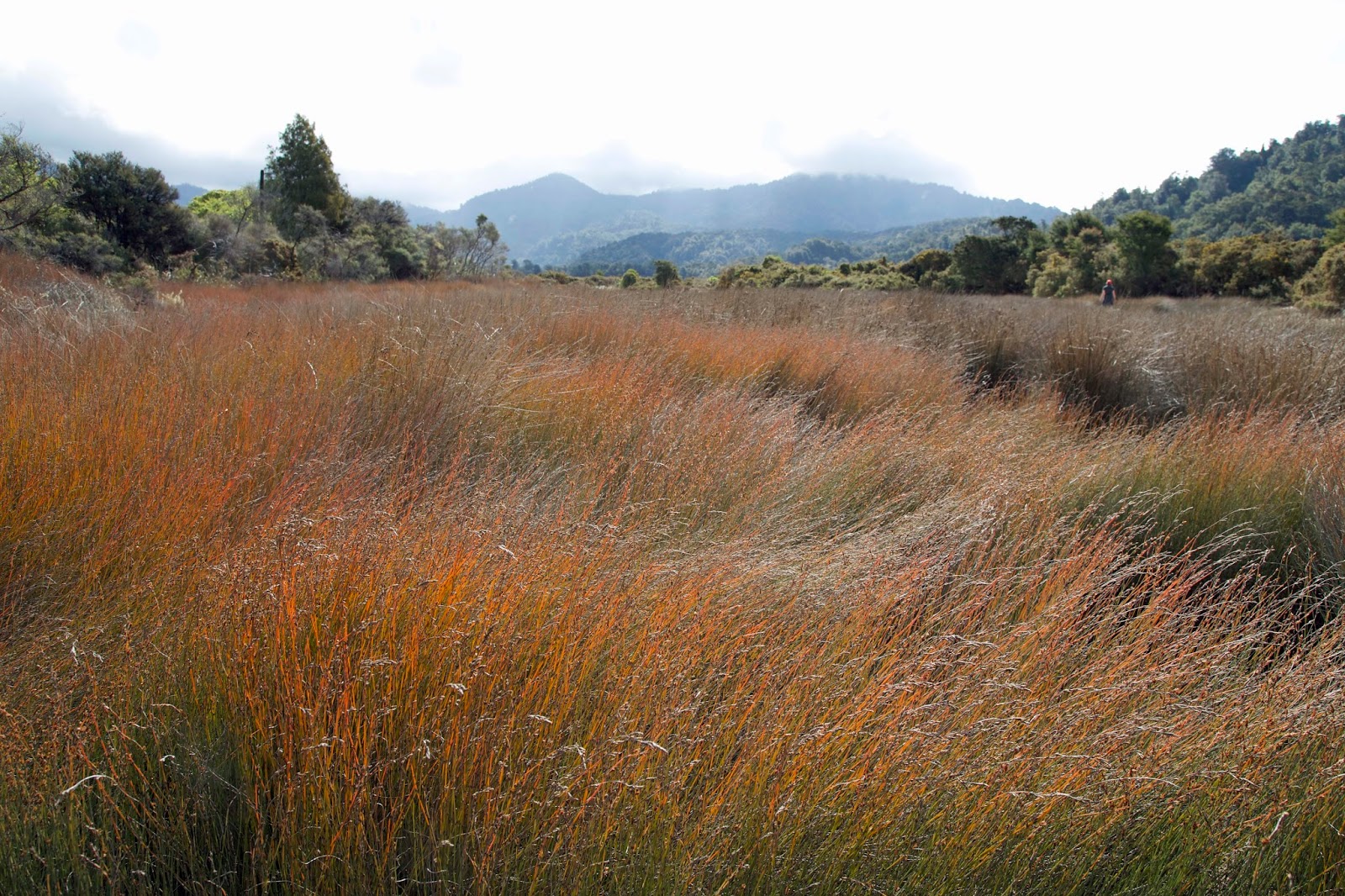
[Reeds on the flats at Awaroa Inlet] 

Dutch explorer Abel Tasman landed near here in 1642, shortly after his “discovery” of the island he named Van Diemen’s Land. Eventually both that Australian island (in 1856) and this national park (in 1942) would bear his name, as would the sea between Australia and New Zealand.

We were joined in the hut by three young trampers from Christchurch, all I.T. workers taking a few days off to recharge their batteries. The DoC hut ranger was the only other person we saw at the hut. This was a little unexpected, given that this is supposed to be New Zealand’s most popular “Great Walk”. Perhaps mid-October was early in the season; or did the locals know something in the weather forecast that we didn’t?


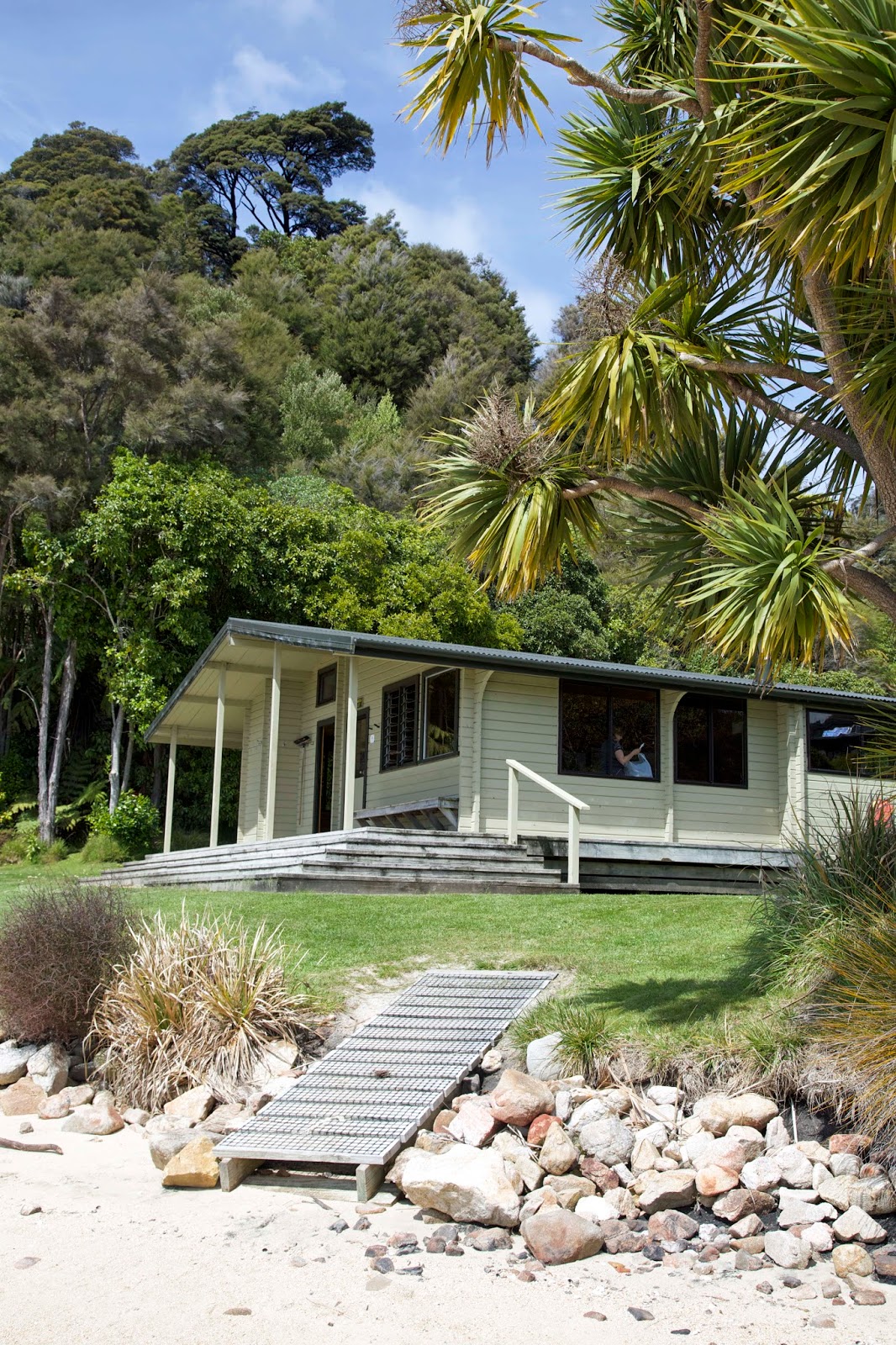
[The DoC hut at Awaroa] 

From the hut ranger we learned that there was a lodge about 40 minutes walk away, and that you could buy "proper" coffee and even a meal there. We long ago learned not to be surprised by what’s on offer on New Zealand walks. And not being at all averse to luxuries on a walk, we decided to see for ourselves.

After maybe 15 or 20 minutes we came to a building with a couple of ambiguous signs, none of which indicated it was the lodge. It certainly didn’t look open for business, but I wandered up for a look anyway. As I peered in a window, a man came out to chat. He was an electrical contractor doing a bit of work. He assured me that it was the lodge, but that no-one was around. There wouldn’t be any coffee, at least not from that source. Too early in the season again, perhaps?

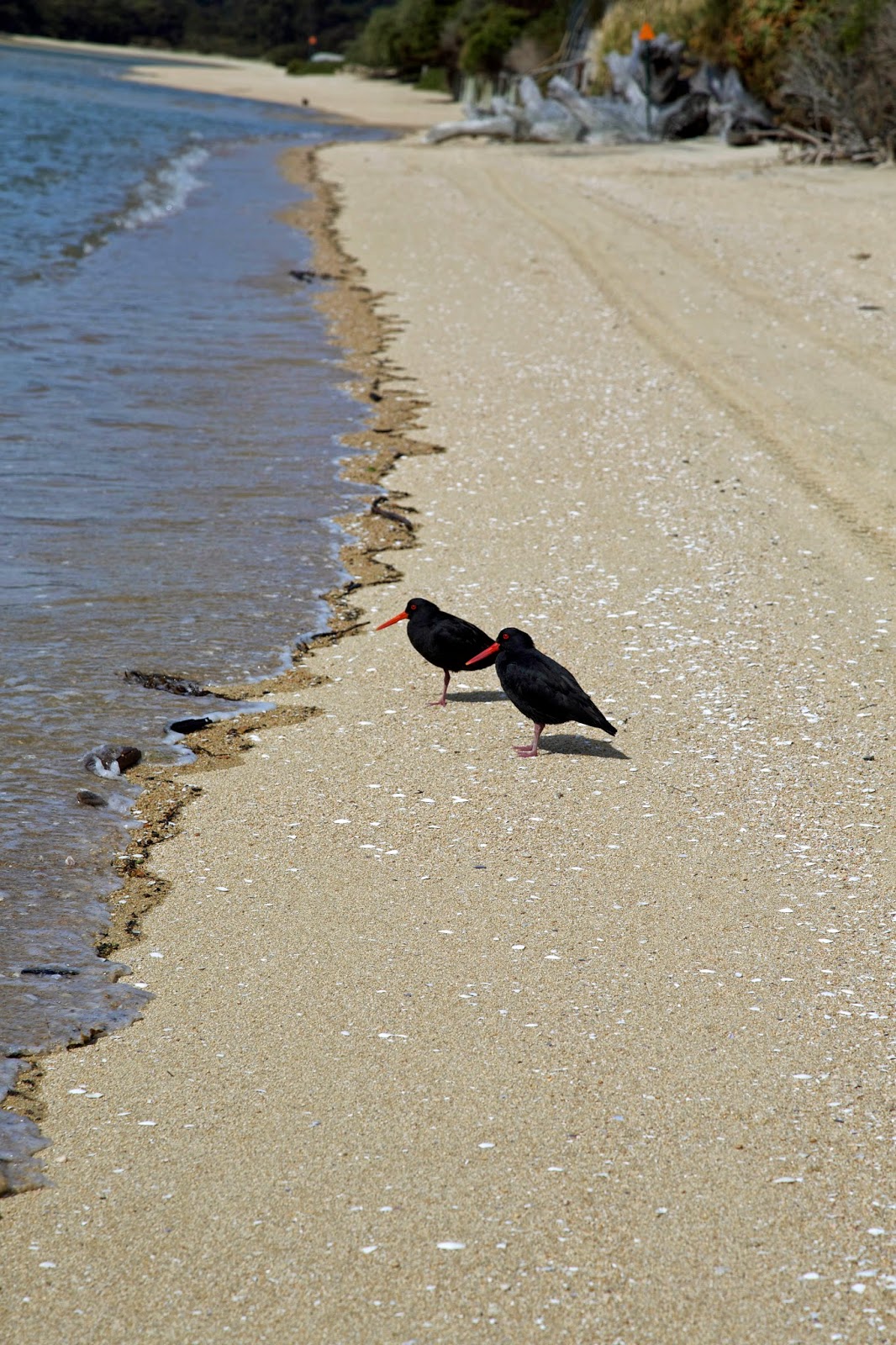
We explored the picturesque inlet for a while, taking time to watch a pair of variable oystercatchers (Haematopus unicolor) as they strutted in unison along the strand. Their Maori name is torea-pango, and they're also known in New Zealand as red bills. We found them remarkably like Australia’s sooty oystercatchers, except for the variability in their plumage (which isn't always black) and their pink rather than red legs. Also our “sooties" frequent rocky shores, whereas these appeared happy on sandy shores.


[A pair of variable Oystercatchers at Awaroa]
While it wasn’t anything like a long walk with a full pack, our small expedition in the tangy sea air was enough to work up an appetite. Back at the hut we broke out the cheese, biscuits and wine (refer to my mention of “luxuries” above), before getting on with dinner (only a freeze-dried, I'm afraid, but washed down with a little more wine). Our Christchurch hut mates had gone off to make a fire pit on the beach, but with clouds threatening and the wind getting up, we decided against joining them. Frankly, whether we'd earned it or not, we were more than happy to head for our bunks for an early night.