Some pictures to tell the story of Brickendon and Woolmers, two convict-worked, World Heritage listed farms near Longford in northern Tasmania. Please click on the link beneath this image to view the album.
http://picasaweb.google.com/auntyscuttle/BrickendonWoolmers#
Nature is home, even if we live in cities. I'm a Tasmanian-based writer who loves learning and writing about the natural world, from the smallest bugs to the broadest landscapes. That passion led me to co-found the Wildcare Tasmania Nature Writing Prize, and to write the book "Habitat Garden". I also write a quarterly column, "The Patch", for 40 South magazine. © All material in this blog copyright Peter Grant (unless otherwise stated)
Friday, 17 December 2010
Thursday, 16 December 2010
Nature Writing Prize
It's time to get that writing out of your bottom drawer, especially if it's related to nature. Here's why:
$5 000 in cash, plus airfares to Tasmania, and a two week writer's residency in one of Tassie's wilderness national parks!
That's the prize for the winner of the Wildcare Tasmania International Nature Writing Prize. Please spread the word to any writers or would-be writers you know. Details are in this flyer:
$5 000 in cash, plus airfares to Tasmania, and a two week writer's residency in one of Tassie's wilderness national parks!
That's the prize for the winner of the Wildcare Tasmania International Nature Writing Prize. Please spread the word to any writers or would-be writers you know. Details are in this flyer:
Monday, 6 December 2010
Thoughts from the Overland Track: Part 2 - Currawongs
If I were to find myself in a deep, dark dungeon, and was striving to recall one sound that would lift my mind into clear, bright skies, I would choose the call of the currawong. And not just any currawong: it would have to be Strepera fuliginosa, the black currawong, found only in Tasmania.
It’s early afternoon, mid-November, and the currawong’s kar-week, week-kar call welcomes us to the start of our Overland Track trip. It is a sound that locates me in the Tasmanian highlands as surely as a café accordion and a man saying ooh la la would land me in France. But just as the French might equally be arguing football or discussing Proust, so the currawong’s claxon call is far from its full story. Or so we will discover.
The weather is clearing after early showers, and currawongs are cavorting in the early afternoon sun. After the initial pack-settling climb, we pause at Crater Lake. A currawong hops up for a close inspection of our packs. It is all swagger and golden-eyed defiance, the large cutlass-like bill betraying its piratical attitude.
I casually warn the first-time walkers not to leave their packs unguarded. These intelligent and inquisitive birds have learned a few tricks, including pack-invasion. The two Dutch girls in our party look unconvinced: they’ve already heard enough drop bear, yowie and tiger leech stories in Australia to make them wary.
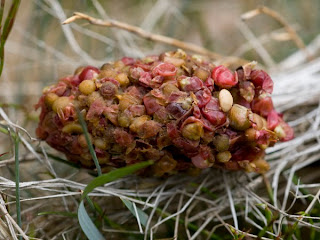
I click off a few portraits of the handsome pirate, then turn to concentrate on the grunt up Marions Lookout. The currawong’s call remains our occasional companion, along with its other “calling card”. These are its casts, odd-looking pellets that are somewhere between ugly red scats and huge, deformed raspberries. The casts are in fact undigested food, particularly pinkberries (from Leptecophylla juniperina), regurgitated by the birds.
Pelion Gap is the next place we actively notice the "pirates". Wooden platforms have been built here to manage this high traffic junction, where walkers wanting to climb Mt Ossa or Mt Pelion East can leave their heavy packs. Since they've learned their special trick, the currawongs have transformed the platform into a seasonal galley.
On a busy day there may be more than forty packs left at Pelion Gap for hours at a time. And the trick? Currawongs have learned to use their beaks to unzip packs. Once the pack is breached, the birds probe for any and everything they take a fancy to. Walkers have lost food, money, even passports to marauding birds.
The defense is to either cover your pack with a groundsheet - as the commercial groups usually do - or turn your pack onto its zips so they are minimally exposed. The three of us preparing to climb Pelion East do the latter. But when we come back, we learn that even this might not be enough. The top pocket of Tim's pack has been breached, and his mobile phone has been lifted!
After a quick search of the scoparia bushes, he locates the phone. Luckily it's still in its zip-lock bag, and undamaged by the scudding showers that have swept the Gap while we've been summitting. We can only suppose that the currawong grew tired of waiting for a signal and chucked the phone. As I said, a smart bird!
It’s early afternoon, mid-November, and the currawong’s kar-week, week-kar call welcomes us to the start of our Overland Track trip. It is a sound that locates me in the Tasmanian highlands as surely as a café accordion and a man saying ooh la la would land me in France. But just as the French might equally be arguing football or discussing Proust, so the currawong’s claxon call is far from its full story. Or so we will discover.
The weather is clearing after early showers, and currawongs are cavorting in the early afternoon sun. After the initial pack-settling climb, we pause at Crater Lake. A currawong hops up for a close inspection of our packs. It is all swagger and golden-eyed defiance, the large cutlass-like bill betraying its piratical attitude.
![]() |
| A curious black currawong sizes up my pack near Crater Lake, Tasmania |
I casually warn the first-time walkers not to leave their packs unguarded. These intelligent and inquisitive birds have learned a few tricks, including pack-invasion. The two Dutch girls in our party look unconvinced: they’ve already heard enough drop bear, yowie and tiger leech stories in Australia to make them wary.
I click off a few portraits of the handsome pirate, then turn to concentrate on the grunt up Marions Lookout. The currawong’s call remains our occasional companion, along with its other “calling card”. These are its casts, odd-looking pellets that are somewhere between ugly red scats and huge, deformed raspberries. The casts are in fact undigested food, particularly pinkberries (from Leptecophylla juniperina), regurgitated by the birds.
![]() |
| A currawong's cast, full of partially digested pinkberries. (Photo courtesy of Alex Dudley) |
Pelion Gap is the next place we actively notice the "pirates". Wooden platforms have been built here to manage this high traffic junction, where walkers wanting to climb Mt Ossa or Mt Pelion East can leave their heavy packs. Since they've learned their special trick, the currawongs have transformed the platform into a seasonal galley.
On a busy day there may be more than forty packs left at Pelion Gap for hours at a time. And the trick? Currawongs have learned to use their beaks to unzip packs. Once the pack is breached, the birds probe for any and everything they take a fancy to. Walkers have lost food, money, even passports to marauding birds.
The defense is to either cover your pack with a groundsheet - as the commercial groups usually do - or turn your pack onto its zips so they are minimally exposed. The three of us preparing to climb Pelion East do the latter. But when we come back, we learn that even this might not be enough. The top pocket of Tim's pack has been breached, and his mobile phone has been lifted!
After a quick search of the scoparia bushes, he locates the phone. Luckily it's still in its zip-lock bag, and undamaged by the scudding showers that have swept the Gap while we've been summitting. We can only suppose that the currawong grew tired of waiting for a signal and chucked the phone. As I said, a smart bird!
Subscribe to:
Posts (Atom)


