Thursday, 15 July 2010

Small Wonder


[lichen and leaf mold, Pandani Grove walk, near Lake Dobson, Tasmania]

 
My senior high biology teacher, Mr Harnack, was fond of asking questions. Nothing unusual about that, I suppose, except that it was always the same question. And he would ask it every single lesson: What is life?

I’m sure he thought he was being deep, dramatic, and more than a little cosmic. To our shame, my classmates and I focussed less on the depth of his question than on his nerdish mode of delivery and his American drawl (“Boyzz – Whaart izz larrff?”)

Spending time among lichens in recent days brought Mr Harnack’s question to mind. It’s not that I doubt lichens are a lifeform. They are actually one of the more complex and interesting forms of life on earth: a symbiosis between two other living forms, algae and fungi.

Because the algal part of the partnership processes light via photosynthesis, lichens have some plant-like characteristics. However unlike plants, if they experience extended periods of heat, drought or cold, they can go into a suspended state – known as cryptobiosis – until conditions improve. They may appear dead, hanging as crisp and lifeless as dead leaves, when they are actually full of life. Hence my asking the Harnack question.

Cryptobiosis enables them to grow in locations impossible for most plants, including bare rock, sterile soil or sand, and human-made structures like walls, roofs and tomb-stones. And they can grow on other plants, even in the darkest depths of a rainforest.

That’s where I most recently encountered them, luscious and luminescent on the trunks of rainforest trees. But I’ve also seen the more demure forms that blotch granite boulders or daub dark dolerite. And the Harnack question comes to mind wherever I observe this intimacy between lichen and its substrate. The growth habits of lichen seem to blur the distinction between the living and the dead. Where, for instance, does the rock or dead bark end and the lichen begin? Does the fungal part of the organism reach deep into the rock as fungi will in soil. And can the substrate really be excluded from the symbiosis if the lichen “protects” the rock or bark?


[lichen on granite, Maria Island National Park, Tasmania]

 
I observed its role in bridging the living and the dead when visiting some Alaskan glaciers a few years ago. There lichen plays the part of John the Baptist, preparing the way for the lifeforms that will come after it. As glaciers retreat – and they have long been seen to do so in Alaska – bare rock sees the light of day for the first time in millennia. Lichen colonises the fresh faces, slowly doing its rock-breaking, soil-producing work. The soil then enables other pioneering species, plants like willow, fireweed and alder, to gain a foothold. In Alaska it takes 70 to 80 years from glacial retreat to full-blown coniferous forest. That’s a startlingly short time in earth history, and a testament to the influence of the easily overlooked wonder that is lichen.


Tuesday, 6 July 2010

Tenacious Tenuiramis


[A silver peppermint tree clings to the edge of a stone quarry in South Hobart]

What a vantage point we have, caught as we are between earth and sky! You might technically call our dwelling place superficial, but taking into account the vastness of the universe, it is an extraordinarily uncommon superficiality.

There are some trees near home that highlight for me this amazing event horizon; this junction of heaven and earth. Both are humble trees, silver peppermints (Eucalyptus tenuiramis). One stands atop an old quarry in Strickland Avenue. Perilously close to the edge, the twin-trunked tree clasps the crag with crooked hands like Tennyson’s eagle moreso than a tree.

Often eucalypts have shallow roots, and certainly lack the tap roots that we associate with many plants. Rather they splay out strong, sometimes buttressed roots that give them a good toe-hold against storms. This particular peppermint stands on mudstone with a very shallow soil overlay. Both rock and regolith are poor sources of nutrient, and highly prone to drying out. So the tree has grown used to the botanical equivalent of thin gruel. And yet it has done far more than eke out an existence.

It has a handsome golden-flecked double bole, each trunk creased and rumpled, stretching and tapering with a slow and crooked patience towards the sky. Its irregular branches, some clean and straight, others arthritic and contorted, seem all well-covered with narrow grey-green leaves.

Here and there past difficulties have produced failed branches, some hollowed out to owl’s-nest perfection; others still pointing in mute accusation at an unblinking sky. The tenacity of tenuiramis is illustrated elsewhere in our local woodland, a place much put upon by fire, feet and mountain bikes.


[A reclining tree? This Eucalyptus tenuiramis has a very unusual growth aspect]

This tenuiramis seems just a sapling in terms of height, although a hard life may have stunted it. It faces up the slope, almost recumbent, as though it's about to succumb to fatal wounds. Yet on closer inspection I can’t help smiling as I see a nyad extracting her feet from a hole, or a dryad frozen in the act of escaping. No, this tree too is thriving, with a good covering of leaves, and a fair chance of weathering the prevailing nor-westers for decades to come.

I find G.K. Chesterton’s fanciful description of a tree very apt here. It is when we consider it as a prodigious wave of the living soil sprawling up to the skies for no reason in particular that we take off our hats. Tenacious tenuiramis, I dips me lid to you!

Sunday, 27 June 2010

The Nearby Wild: Part 2


[a pademelon's runway - a subtle but visible sign of wildlife moving through our bush]


Our old backyard had runways made by a couple of generations of dogs. Each morning I would use a ball-flinger to throw a ball 30 or 40 metres up the backyard for them to fetch. Angus, who had retriever blood, was rather worse at it than his successor, the hopelessly hybrid but eager-to-please Nuala.

This long practice produced an elongated bald patch in what passed for our back lawn: a dog line made by pounding paws. It extended up the slope towards the bush that took over beyond our back boundary. Had I known to look, I would also have found runways into the bush itself, caused not by dogs, but by marsupials.

Now that we live in that backyard, I see not only these other runways but the native animals that use them. The strange thing for me, as for so many Australians, is that I know precious little about the wildlife that shares our place. Dogs, on the other hand, are our familiars. They respond to our words; treat us as part of their pack; allow us to pat, pamper and potentially command them. We may even have seen them breed, and watched a litter of blind pups mewling and snuggling at a bitch’s teats, or later tearing up almost anything they find.

If you’d asked me about the life of a pademelon (Thylogale billardierii - aka the rufous wallaby) my answer wouldn’t have detained you long. At least until I started hearing and seeing them in our yard on a regular basis, and got curious.


[as the sign indicates, we share this place - even the roads - with wildlife]

Let’s start with hearing, because these night-active fur-balls are stealth on legs. While possums screech and scream, pademelons are largely silent. I’ve heard them occasionally “pish” at each other, presumably during a dispute. And the males are said to “cluck” when pursuing a female, though I’ve never heard this. Otherwise they are the politest of guests, and you’d hardly know they were there but for their percussive sounds. As with many grazing mammals, they thump their hind legs as a warning sound. And of course make the same sound when hopping.

I hear that sound – I call it the bush’s crepuscular heart-beat – as they make their way to bed in the wee hours. Having spent the night grazing on our’s or the neighbour’s grass, they are heading towards thicker bush: their preferred shelter during the day.

Once at rest they are very difficult to find, as their thick dark fur is flecked with a range of tones that blend perfectly with our bush: from burnt-stump black through to rusty grey. If captured at rest for a still-life study, an impressionist might see a tilted furry pear. The haunches are disproportionately large, the shoulders slim and hunched and the petite romanesque heads topped with flicking, flame-tinged ears. 

After mating, and a gestation period of about one month, the female carries young in her pouch for as long as 7 months. Another embryo (or blastocyst) is held in reserve, ready to take over when the pouch young leaves. This system allows pademelons to respond quickly to good seasons by breeding continuously.

In motion pademelons are agile and quick-footed, and bounce away rapidly when approached by humans or dogs. Although they seldom stray further than 100m from tree cover, in many areas that brings them into contact with cars.

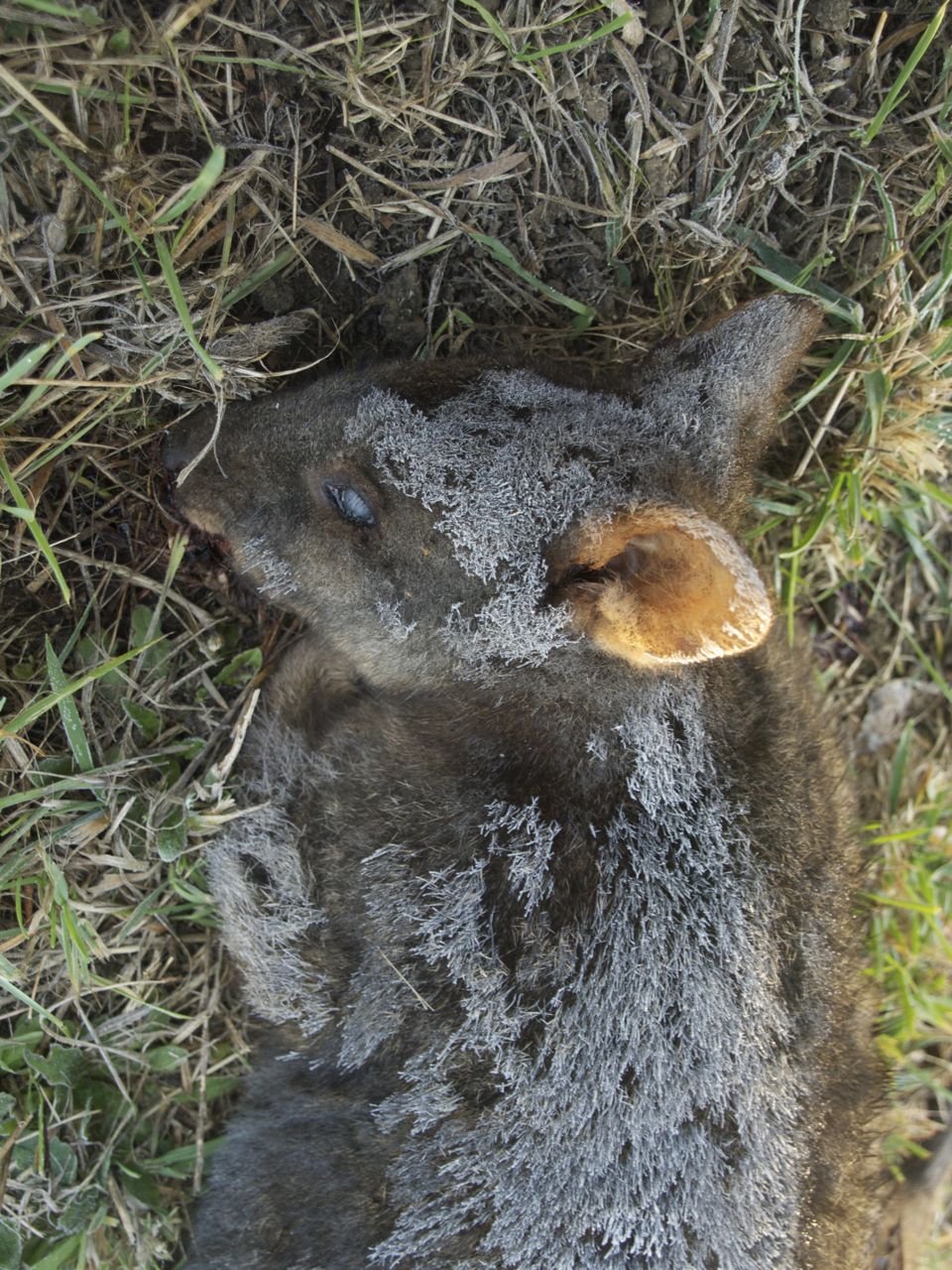
One frosty morning I find a mature pademelon dead by our road-side. It has been hit during the night. Dazzled by the car’s lights, its agility and grace has only been enough to bring it into contact with the unforgiving motion of a car. 


[the cold, dead body of a pademelon hit by a car on the road]