Showing posts with label snarers. Show all posts

Friday, 26 September 2025

Back in the Saddle: Part 2

The rain came in the evening, steady and solid. We were glad of the hut’s shelter and relative warmth. Our dinners: salad roll for Jim, rehydrated curry for me, were accompanied by red wine. We fed the fire too, although our limited stock of firewood, and the thermometer’s resistance to rising, prompted us to have an early night.


Fungi light up our dark, wet forest

It rained all night, all through breakfast, and for the rest of the morning. We only went out for firewood and toileting. Water pooling at the verandah’s edge didn’t encourage us to be out walking. Instead we chatted, read, made more coffee, and ate, congratulating ourselves on our wise choice in finding a hut to stay in. But eventually cabin fever set in, and we went for a wander around outside the hut, finding various logging artefacts, including a sled/cart and a couple of logging shoes. 


Logging shoes and trolley outside the hut

Before there were skidders and tracked vehicles, old-time loggers attached a metal “shoe” – curled like the front of a snow sled – onto the leading edge of a log. Bullocks or horses would then haul the log down the track, the shoe acting like the front of a sled and helping the log to slide more easily. This was a reminder that the original hut on this site had been built as a shelter for logging concessionaires back in the 1960s. And logging in the area started well before that.

When the drizzle turned to rain, we retreated to the fireside for yet another brew. But cabin fever – more accurately hut fever – soon set in again. So, when the rain eased a bit, we put on our wet weather gear, packed some food, and headed up the hill to see what we could see. I knew there was another smaller hut “a little further up the track”. What else do you do with hut fever than go looking for another hut?!

We hadn’t walked far before yesterday’s version of steep was greatly surpassed by today’s. At times it was like walking up a waterfall, albeit a very lush and green one. As we hauled ourselves up slippery rocks and around dripping ferns, we were more than thankful that we weren’t carrying full packs. (Yesterday we had actually considered the possibility of walking up to the second hut, if the first hut had been occupied.) 


Steeply uphill

We slipped and stumbled and sidled across the steep slope before finally reaching a plateau of sorts. And here the eucalypts, mosses and ferns gave way to smaller, thinner, lichen-dotted myrtle beech and teatree. The rain had eased, to be replaced by a cold, moist mist. We were literally walking in cloud. The track was already vague, so careful navigation now slowed further. The little blue dot on the map app became our friend. Somewhere in the fog, the map assured us, there was a small hut. 


Are we lost? Jim walks into the mist

In clear weather this would be easy walking. But in these conditions, we found ourselves back-tracking whenever we couldn’t see a tape or other track marker ahead. Eventually we reached a track junction, marked by a sign indicating the hut’s name. The blue dot confirmed that we were near our destination. As we were now soaking wet and tired, this was good news. However, the sign didn’t have an arrow, and the track went steeply up to the left. We couldn’t see a hut that way, and a slope like that seemed an unlikely place to build a hut. Instead we poked around in the misty forest for several more minutes until we finally saw the tiny hut. It was barely 50 metres away, but well camouflaged against surrounding trees by its own lichen-covered timber cladding.


The tiny hut in the mist

The neat but very humble hut was built by snarers close to a century ago. Its walls and roof were built entirely from rough-cut timber, though the substantial-looking fireplace was stone. Atop that sat a galvanised iron chimney – possibly a later addition. We stooped to enter through the tiny door, which creaked like an old-timer’s bones. Above the door was a small window, which let in minimal light. Immediately to the left of the door was the deep stone fireplace. It had a crude mantlepiece on top, dotted with a few old hut conveniences, including a mug, a candle and a small billy. Opposite the door were two small bunks and a slender bench. I dropped by pack and sat there, while Jim took a smaller seat in front of the fireplace.


Me inside the tiny hut (photo by Jim)

Despite being cold and wet, we quickly decided against lighting a fire. Our experience with the wood heater in “our” hut showed us it would be a long time before an open fire would heat us up, even in this tiny hut. 


Jim about to exit the snarer's hut

Instead, after a bit of scroggin and a cold drink, we closed the hut door and walked back into the misty forest. And back to the first hut. We’d only been out a couple of hours, and yet it felt vaguely epic. It felt even better once we had that fire cranked up again.


Getting the home fire burning again

Thursday, 30 December 2021

Walking the February Plains 3: Smurfing

If yesterday’s discoveries were unplanned, today’s will be deliberate - as long as we’re successful. From the cattle droving days of the mid 19th century, we’re skipping forward more than a century to the final days of the marsupial skin trade. And we’re looking for what’s probably the final hut Basil Steers built. He is often considered the last of the high country snarers in Tasmania. 


The hut we’re hunting was built relatively recently, during our own bushwalking days, in 1985. It’s sometimes known as ‘Basil Steers No. 3’, but is universally nick-named ‘Smurf Hut’. Its construction was partly a protest against the government’s 1984 ban on snaring as a method of taking animals. Given that provenance, Basil built the hut in a hard-to-find location, towards one edge of the Februaries. (Honouring that intention, I will not reveal its exact location here.)


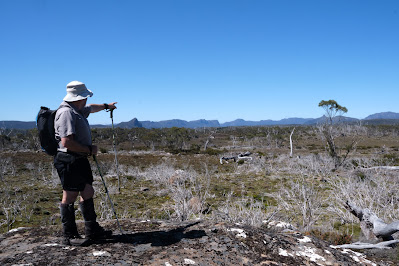
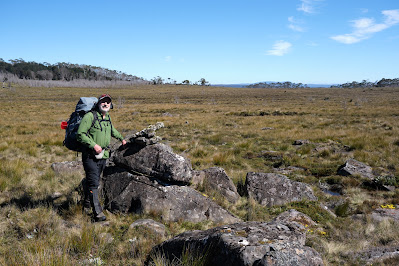
[Tim points the way, with Overland Track mountains ahead]
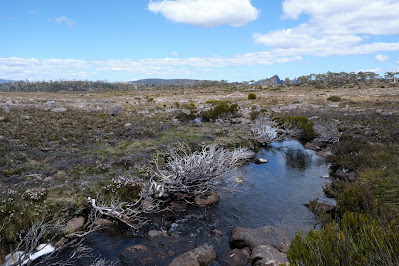
We set off quite early. The sky is predominantly blue, and the day promises to be warm. We by-pass Lake How, heading more or less south towards another lake. I naively assume it’s Lake Steers, which isn’t too far from our destination. It’s looking like a cruisy day. But not for the last time today Tim has to disabuse me of my belief. He points to some far-distant wooded hills, and tells me we’re headed towards them. We by-pass the unnamed lake, but still have to traverse some boggy ground getting across February Creek and its shallow valley.


[February Creek, with Mt Pillinger on the horizon]

Bit by bit we close in on those distant hills. Naggingly persistent feet manage this feat surprisingly well, although often at a cost. For an hour or more we’re high-stepping over knee high grasses and sedges. It’s not difficult walking, but it’s wearing. I’m encouraged when I finally see on Tim’s device that we’re closing in on the red dot marking the hut’s location. All the way I’ve been reassured by the fact that Tim has been to Smurf Hut before – hence the red dot. 


What I don’t realise until we enter some gnarly scrub is that Tim has never come to the hut from the northern Februaries. Rather he’s previously approached it from the Arm River/Wurragarra Creek direction. When you’re in bauera, tea tree and scoparia scrub, being told you’re “maybe 200m from the hut” isn’t as comforting as it may sound. After some sweat-inducing wading through said scrub, Tim concedes that we are too far west. We need to back-track. However we’re unable to stomach a complete retreat, so we choose a “tactical withdrawal", going diagonally uphill. 


We finally come out of the scrub into a pencil pine forest. This is promising, as Basil Steers and many other trappers/snarers preferred to use pines like these for building huts. Eventually we descend into the dim green of a myrtle rainforest, an even better sign, as Tim’s memory is that Smurf Hut is hidden deep in such a forest. And so it proves, as we eventually clamber down a small cliff, scramble over a series of mossy logs, and find the humble timber hut.


[Smurf Hut, with Tim outside]

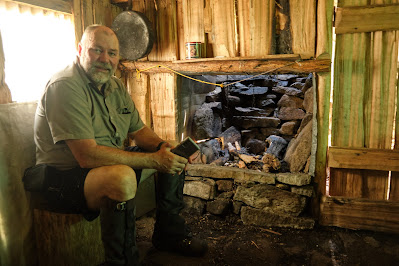
Its name has always piqued my curiosity, but as we stoop to enter the hut, it explains itself. Everything about the hut is diminutive: the doorway; the size of the logs stored in the entryway; the height of the ceiling; the three wee bunks. It would be perfect for smurfs*. Indeed Tim and I agree it would be ideal for our friend Jim. Not only does he love a hut, especially one with a fire, but he is also – how shall we put this – a vertically-challenged man. The four foot long bunks would be perfect for him.


[Tim inside the diminutive hut]

We lunch outside the hut, soothed after our exertions by the cool quiet of the forest. After lunch I wander around the hut’s exterior. According to the late historian, Simon Cubit, the hut was never used as a skin shed, and certainly the walls show none of the signs of skins having been nailed there for drying or tanning.


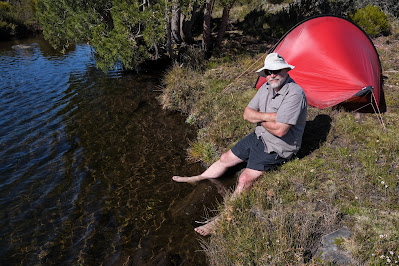
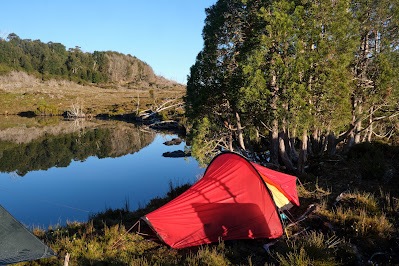
We’ve learned lessons from our outward journey, and set off for our home lake via a less scrubby route. Although it’s still a long haul, all of it off-track, I’m pleasantly surprised to get back by mid-afternoon. While Tim soaks his hot feet in the lake I just sit back and enjoy being becalmed. Had we actually been sailing, it would have been a quiet afternoon. 


[Tim cools his feet]

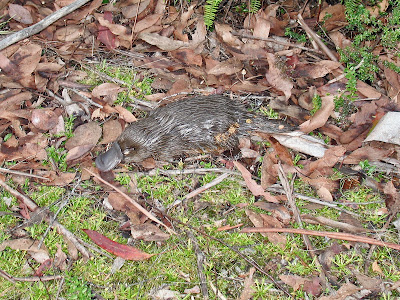
There’s just the occasional puff of wind, and the lake is still enough to reveal one further secret. On the far side we can see the tell-tale ripples of a platypus at work. Occasionally it surfaces, bill, nose and eyes briefly visible before it dives again. I am in awe of these amazing creatures, not least because they’re one of only two egg laying mammals in the world (along with echidnas). I’m also astonished how they’ve managed to occupy this small lake that’s far distant from any other reliable body of water. I once watched a platypus toddle over land, and concluded it was unlikely to set any land speed records. Yet here they are, as they are in so many isolated lakes, tarns and creeks in Tasmania.


[A platypus walking overland]

After dinner I dig out some of my writing and read it aloud to Tim. On this walk, and earlier by phone, we’d been discussing some of my lock-down work about ‘the spirit of bushwalking’. It’s good to read it, albeit to an audience of one. It’s even better to discuss some of the knotty issues with someone who shares my perspective on walking and spirituality. Tim offers some helpful suggestions, and we toss around ideas, agreeing that there will be on-going discussions. I feel encouraged to keep working on it. Being detached from the everyday seems yet again to clear the mind.


Gradually the blue day morphs into a dark jewel of an evening, and our honest day’s walk helps sleep to come swiftly. When the light of our final day leaks into our campsite, it reveals a mirror-flat lake, enticing us out for an early start. We have one more item on our agenda: to pick up the trail of cairns from day 2, and see if we can follow the old February Plains Stock Route out.


[It's perfectly calm on our departure day]

After all our years walking together, I should be aware that Tim’s journeys of discovery are rarely short-cuts. But as I’ve also been bitten by the exploration bug, the two of us happily fan out and scan for cairns. We walk far further west than we would otherwise need to, but are rewarded by the discovery of a series of cairns heading north. We follow these to Sardine Creek, near which we find some remnants of droving days. We feel sure that we have indeed been on the old February Plains Stock Route. 


[Another cairn on the February Plains Stock Route]


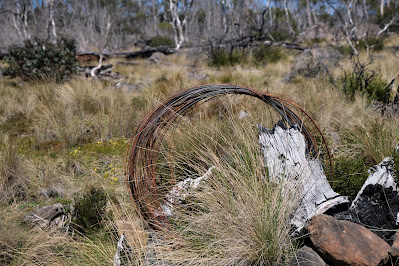
[Old fencing wire, possibly from the cattle droving days]
But now it’s time to leave off being explorers and head out for a substantial – meaning not dehydrated – lunchtime meal. We cut down valley to pick up the old (locked) road that comes down the west side of the Februaries, close to Basil Steers Huts 1 and 2. We’ve been off track for nearly four days, so it’s strange to be moving fast on a solid surface. By the time we get back to the car, our feet are hot. But soon we’re driving off, and Tim announces a supreme idea. When he gets phone reception, he pulls over to ring his wife Merran. Without him even prompting, she graciously offers to make home-made hamburgers back at their place. Any aches and pains are so quickly eclipsed, that Tim and I do a happy little smurf dance before driving home. 


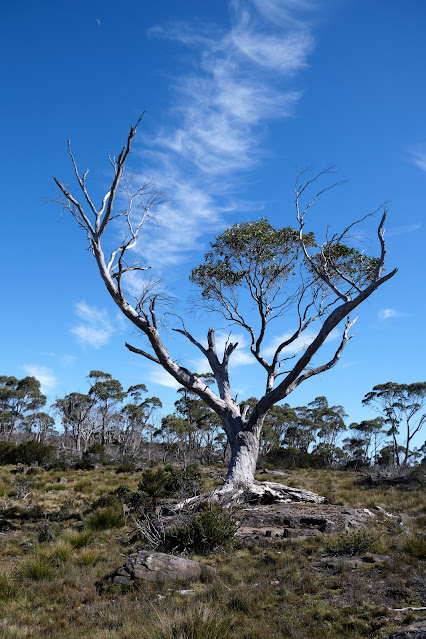
[A Smurf-blue sky bids us farewell]

* For those who don’t know, smurfs are fictional creatures from the mind of Belgian comic writer “Peyo”. Small, blue and human-like, they live in mushroom-shaped houses in the forest.