Thursday, 18 October 2012

Wildcare Tasmania Nature Writing Prize 2013


$5000 and a residency near here? Start writing! 

It's the 10th anniversary of the Wildcare Tasmania International Nature Writing Prize. The prize wobbled to its feet in late 2002, with the shy hope that it might encourage a few more writers to think and write about their connection to the natural world. Five winners and hundreds of entries later, we're amazed to see that hope being fed by a strong and growing interest in place and nature writing all around the world. And we're pleased to see Tasmania recognised as a natural hub for such writing.

We've certainly made it worthwhile. The winner receives $A5000, plus airfares, a residency in Tasmania, and publication in ISLAND. That's a wonderful prize in any writing genre!  But what is nature writing? For the purposes of this Prize, we've defined it as "literary prose whose major inspiration and subject matter is the natural world, not necessarily excluding its significance for humans and/or their interactions with it."

We hope we'll be flooded with entries between now and January 31st, the closing date. But most of all we hope people all over the world start to put their attachment to the natural world into words. Please click on the link below. All the best!

Further info here


Sunday, 14 October 2012

Astonishing the Park-Keeper


So long as we regard a tree as an obvious thing, naturally and reasonably created for a giraffe to eat, we cannot properly wonder at it. It is when we consider it as a prodigious wave of the living soil sprawling up to the skies for no reason in particular that we take off our hats, to the astonishment of the park-keeper. – G.K. Chesterton


[Some gum nuts and blossoms of Western Australia] 
There is much Chestertonian astonishment to be had in Western Australia, particularly in spring. That such poor soils can send “sprawling up to the skies” such a variety and beauty of forms and flowers is truly astounding.

There’s a metaphor in there, to be sure. But leaving that and metaphysical matters to whisper from the wings, why should Western Australia’s flora be so astonishing? Isolation is one reason. Long ages of separation from other parts of Australia have given the flora of WA time and space to deal with the difficult climate and soil conditions in their own unique ways.

The age and relative stability of the land has helped too. The glaciation, tectonic movements and other earth shattering episodes of the east have largely left the west unscathed. For perhaps 250 million years the west has known the kind of stability that has allowed its plants to develop and adapt successfully to nutrient poor soils and often dry conditions.

The very richness of species – 13 000 and counting – adds its own competitive pressure. Species push to outdo each other in the race to attract the relatively low number of pollinators, be they birds, invertebrates or mammals.


[Spring in karri and marri forests, WA] 
Adaptable as it is, the west’s amazing flora is under threat from many quarters, most of them human in origin. Land clearing, salination, climate change and inappropriate fire regimes are all obvious and potent threats. A less visible but dire threat comes from a fungus-like pathogen called Phytophthora cinnamomi. Known in the west as dieback, or cinnamon fungus, it is spread in soil and through water and mud. It attacks the root systems of some species – and not others – causing death in susceptible species. In the west that’s 40% of all native species. Boots, camping gear, vehicle tyres and earth-moving equipment are some of its major means of spreading. Once established, it cannot be erradicated.


[Spring blooms in Western Australia]
As we drove through the south-west, two things were obvious. One was the incredible number of four wheel drives, seemingly more than 50% of all vehicles. While most were probably not genuine off-roaders, the potential for spreading die-back by that means alone looks frightening.

The other obvious thing was that we could not, at a glance, see the effects of dieback. But they are there: there in the displacement of the susceptible species by other species; there in the slow disappearence of susceptible species; there in the slow spread of dieback from infected areas to uninfected areas.


[More spring blooms in Western Australia] 
Thankfully we can do something to keep the threat to a minimum, bearing in mind that dieback is a menace in many parts of Australia. We can become hygience conscious with our boots, our vehicles, and our camping equipment. And we can be aware of when we are moving into or out of a dieback infected area. That way we can maintain the park-keeper’s – and our own – astonishment at these wonderful, free floral gifts.


Sunday, 7 October 2012

Kissing Granite


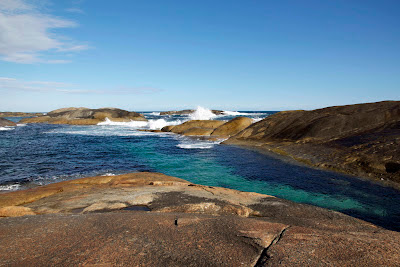
Green Pools near Denmark, Western Australia 


Wild spring winds are a regular part of living on Australia’s south island. Tasmania lies fair in the path of the roaring forties, that belt of constant winds which sailing vessels depended on for rapid movement around the globe from the 16th to early 20th centuries. In spring these winds grow in intensity, pinched between the still-cold southern waters and the warming continent.

But we are visiting Western Australia. It is much drier, older and lower in latitude than our island. Its southernmost point barely reaches 35 degrees south. We are not expecting wild winds.

Tell that to the wind! The day we walk in the Porongurup Range it is gusting to gale force. The range, a smoothed over jumble of granite, is only twelve kilometres long, two kilometres wide, and less than 700m high. As we crest the rise that leads towards Castle Rock, a prominent knuckle of bare granite, the wind tears through the trees, buffetting us constantly.

There’s one moment when it rips straight off the bald rock ahead of us, bringing an unmistakably familiar smell. I am slightly surprised to realise it’s the whiff of granite. I’d never considered that rocks might have their own scent, but this reminds me of wind off Mt Amos, or off any of the granitic rocks or mountains of Tasmania’s east coast.
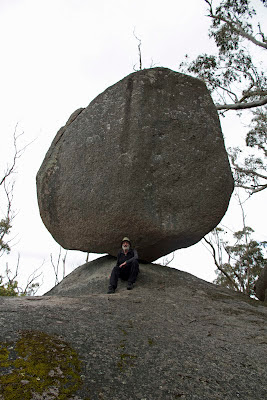


Balancing Rock (I hope!), Porongurups, W.A. (photo Lynne Grant) 
The similarity between the granites of the west and those of Tasmania is geochemical rather than chronological. In this part of Western Australia the granites are derived from the ancient Yalgarn craton, a plateau formed from a vast molten bubble nearly three billion years old. It comfortably pre-dates the Australian continent. Tasmania’s Devonian granites, in contrast, are a measly 400 million years old.

But granite is granite, with quartz, feldspar and mica its main ingredients. And I suppose it’s that blend of earth materials, being micro-shorn by the gale, that I am smelling. Given that this part of the world has probably not been glaciated for millions of years – as opposed to Tasmania’s most recent glaciation just 10-12 000 years ago – it is wind, rain and wave action that have been the main agents of rock weathering.

They have done a spectacular job. The low range has no peaks to speak of, just rounded domes with the odd egg-shaped tor. And throughout much of the south-west of Western Australia the beaches, the soil, the predominence of sand, are in large part down to the erosion of granite. Even the “sand groper” moniker given to Western Australians is an outflow.

The next day we go to where the granite meets the sea, in Torndirrup National Park near Albany. If anything, the wind has intensified. It’s a “good” day to visit the Blow Holes, if good means being blown off your feet and covered in sea spray.


Wild weather at The Gap, Torndirrup NP, W.A. 

We arrive first at the Gap and the Natural Bridge, two granite formations resulting from the wild interactions of rock and Southern Ocean. As we reach the carpark, the wind rocks the car fiercely. Sea spray rises in great spumes, lashing the carpark in a salty deluge. We park as far from the spray as we can, eschew the short but inundated track to the Gap itself, and try to climb some boulders for a side-on view out of the spray. I want to film and photograph, but am literally knocked off my feet.

I’m forced to crawl to the top of a loaf-like knoll. I lie there waiting for a let-up, periodically poking my head into the firing line. As I hug close to the rough-skinned granite, the wind and spray are deafening. I could see it as a fine chance to converse with the rock. I might, for instance, ask why its pink and clear crystals are so large. It might tell me that they result from slow sub-surface cooling while it was forming. And why, I might continue, are you so flecked with black mica, and coated with rust and dust-coloured lichen? But then our conversation would probably be cut short by a lull, and I’d have to “go over the top” to start filming.


The Blowholes in action, Torndirrup National Park, W.A. 
At the Blow Holes the fierce winds and waves produce another wildly spectacular  show. At unpredictable intervals water is punched through holes in the shoreline granite sending fat fountains of spray skyward before the wind whooshes them inland, soaking unwary wave watchers.

Earlier in the week we’d visited altogether calmer waterways, with lichen-daubed granite slabs dipping gently down into shallow, sandy pools. And we’d spent peaceful days in a house built around, against and seemingly at total peace with granite. 
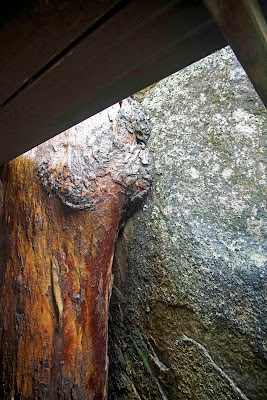


Karri kissing granite xx 

One ancient rock even allowed a karri tree to kiss it. Such are the many humours of granite.